“Bring the torch! Do your thing…” — Samuel L. Jackson. Pyrotechnics, great physical set-design, quality computer generated imagery, and swooping crane shots combine for an excellent monster set-piece in Skull Island (2017), my pick for the best feature of the MonsterVerse (2014-).
The topic of today’s blog entry concerns the ongoing batch of movies I happen to rewatch often. That’s pretty much it. To be more specific, today’s subject of Current Cinematic Comfort Food (CCCF) includes only modern or somewhat recently released movies I enjoy reviewing — as in watching again, not reviewing as in writing additional blog essays — far more than their contemporaries. I’ve limited the following list to movies that released within the past fifteen years or so, or movies I’ve particularly enjoyed throughout the 2010s-2020s.
Keep in mind that this list of CCCF only includes feature-films, not limited series (a great format for cinematic storytelling, by the way) or long-form (re: multi-season) television shows. For the latter, please see my somewhat recent appreciation essay on the high-profile works of the Home Box Office network, also known as HBO.
(1.) Skull Island (2017) = Perhaps my favorite Hollywood blockbuster of the past fifteen years, this film established the classic Hollywood monster King Kong, rather than the classic Toho Pictures monster Godzilla, as the central focus of Legendary Pictures’ ongoing MonsterVerse (2014-) franchise. Indie drama filmmaker turned big-budget Hollywood mercenary Jordan Vogt-Roberts mixes and matches audiovisual influences from Japanese animation to first-person shooters to 1970s heavy metal (e.g. Black Sabbath) to Vietnam War-movie iconography (e.g. Apocalypse Now [1979]) to Jurassic Park (1993); and to my shock, most of it works.
Skull Island is also one of the better paced blockbusters of the past decade and a half as well, clocking at just under two hours (118 minutes) with memorable yet never exhausting set-pieces. From large-scale kaiju battles to grounded shootouts, Vogt-Roberts showcases immense promise as a genre filmmaker, and his aforementioned command of some of cinematographer Larry Fong’s finest work demonstrates a consistent authorial vision. All those positive attributes make Vogt-Roberts’ limited career output in the years since a total mystery (Skull Island was his second and, as of this writing [March 2025], most recent feature).
(2.) Infinity War (2018) = Not my favorite, but almost certainly the best superhero blockbuster of the 2010s, I return to Marvel’s Infinity War because it won over the harshest Marvel skeptic in me by transforming into a sort of anti-Marvel blockbuster. Unlike the vast majority of its parent franchise (the Marvel Cinematic Universe [2008-2019]), this Russo Bros. adventure is led and defined by its villain (Josh Brolin’s Thanos) instead of its mostly vanilla heroes, the latter of whom are directed as an ensemble. The narrative focus switches between various perspectives of its massive cast to enhance pacing rather than confuse the story, making its 2.5 hour runtime feel surprisingly tight. The only thing ballsier than all the above is how the movie ends on a dour note for its good guys, with Thanos achieving unconditional victory until the somewhat less interesting, more conventional follow-up (Endgame [2019]) released a year later.
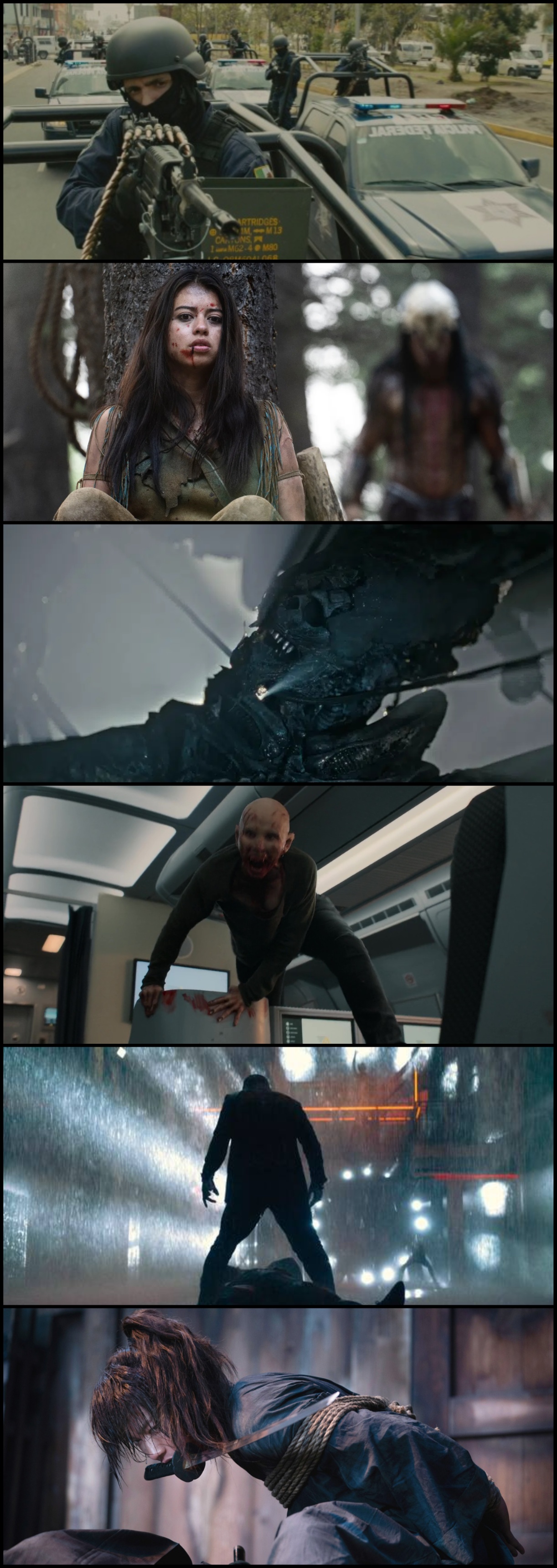
From top to bottom (1-6): (1) Mexican Federal Police escort our main characters through Ciudad Juarez (shot mostly in Mexico City, I believe) in Sicario; (2) Amber Midthunder leads a mostly indigenous American cast to battle an extraterrestrial Predator in the 18th century in Prey; (3) the titular antagonist from the original Alien makes a surprise “guest appearance” in Romulus; (4) Peri Baumeister stars in Blood Red Sky, one of my favorite Netflix Original Films and one of the better genre hybrids I’ve seen in years; (5) Keanu Reeves trades blows with fellow martial artist/actor Scott Adkins in a gloriously decorated and shot set-piece in John Wick 4; (6) Takeru Satoh portrays a much darker, relentless figure in Rurouni Kenshin: The Beginning than in the rest of the RK franchise.
(3.) Extraction (2020) = I’m more a fan of the first Extraction, which released toward the beginning of the coronavirus pandemic, than the sequel, which garnered somewhat better critical reception, but both movies are shoot-’em-up/stab-’em-down brawlers at their finest. Like Skull Island, both movies wrap at around two hours in length and pace their action sequences well, allowing enough narrative buildup before their set-pieces to avoid viewer fatigue and maximize tension.
Like most of my favorite modern action movies, Extraction excels at multiple types of on-screen violence (e.g. shootouts, hand-to-hand combat, grappling, pyrotechnics, vehicle chases, etc.) to keep the action fresh. It also takes advantage of memorable location-photography (India and Thailand in the 2020 original; Czechia and Austria in the 2023 sequel) to frame its set-pieces, scene geography, and character blocking, all while keeping pesky elements like “character development” and “dialogue” to a minimum.
(4.) John Wick 4 (2023) = The more stylish, critically accepted alternative to the likes of Extraction, Chad Stahelski’s John Wick franchise (2014-) not only rebooted Keanu Reeves’ career for the second time (The Matrix [1999] was the first) but helped re-popularize adult-oriented action filmmaking throughout Anglophone movie theatres of the 2010s (see also David Leitch’s Atomic Blonde [2017] and Bullet Train [2022], Derek Kolstad’s Nobody [2021], etc.). The Wick intellectual property (IP) grew to a $1 billion franchise and, in the process, sold its contemporary incarnation of “gun-fu” to the masses.
Matching the original Wick (2014) film’s emotional resonance while expanding to the franchise’s most epic narrative scope, John Wick 4 is the most entertaining of all these movies in my assessment. At 2 hours and 49 minutes in length, Wick 4 somehow justifies its Bollywood melodrama-size while never letting its action grow stale nor apologizing for its relentless pace.
(5.) Rurouni Kenshin: The Beginning (2021) = The Rurouni Kenshin (RK) live-action series is hit or miss from an international audience perspective. Most Japanophiles skew towards manga comics or animation rather than live-action Japanese filmmaking, as I have elaborated upon numerous times on this site. The difficulty of adapting the former media to the latter is on full display over the first three RK features, with loud, overblown monologues, swordfights that last way longer than their choreography warrant, and bizarre costumes that clearly worked better in two dimensions than three.
The fourth and final entry in the live-action series, however, The Beginning, works as a straightforward Edo Period (~1603-1868) historical drama; and by “drama,” I mean bloodsoaked chanbara action movie. While the prequel’s graceful choreography and intricate swordplay are as impressive as the rest of the RK franchise, its grounded, morbid tone and tragic ending are the dark inverse of previous series entries’ colorful graphic novel aesthetics.
(6.) Blood Red Sky (2021) Over and over again I reference Blood Red Sky as evidence of Netflix’s quality overseas (re: non-English language) Original Films, as it combines heist movie formula and vampire horror with the fluidity of famous genre hybrids like Audition (1999), Hot Fuzz (2007), Kill List (2011), Cabin in the Woods (2012), Bone Tomahawk (2015), One Cut of the Dead (2017), Parasite (2019)… the list goes on. Beyond creative, bloody action sequences, the way the film structures its flashbacks to both enhance its characters’ development and pace the narrative is masterful.
(7.) The Raid (2011) = The oldest entry on this list, Gareth Evans’ breakout feature is arguably the most important to my development as a cinephile. Besides introducing me to the world of hardcore action movies that had nothing to do with movie monsters, The Raid also introduced me to Indonesian filmmaking more broadly, the works of Timo Tjahjanto and Kimo Stamboel in particular; it furthermore helped me better appreciate earlier Hollywood action franchises like Bourne (2002, 2004, 2007) and the Daniel Craig-era Bond (2006–2021) films, which achieved mainstream success prior to the 2010s superhero fad.
Based on the classic action movie premise popularized by Assault on Precinct 13 (1976) and Die Hard (1988), The Raid features a small cast of tactical police officers breaking into a Jakarta apartment complex to arrest a high-level drug lord. Things go awry, and the remaining squad members must fight through waves of druggies, gangsters, and hitmen sent by their target, with rookie officer Rama (Iko Uwais) leading the charge.
(8.) Alien: Romulus (2024) = While Aliens (1986) remains my favorite film of all time and a perennial rewatch candidate, the franchise installment I’ve watched most often of late is, well, the franchise’s latest entry. Derided by more skeptical fans as derivative of previous well regarded Alien films (Alien [1979] & Aliens [1986], mostly), I found that Romulus operated well as a standalone adventure that could be enjoyed by both longtime series fans as well as newcomers. Its special FX, both digital and practical, are seamless and its characters are far more effective audience surrogates than the last several franchise entries (i.e. Alien Resurrection [1997], Prometheus [2012], Alien Covenant [2017]). Even totally disconnected from the Alien IP, I argue Romulus works as a superior bigger-budgeted (~$80 million) science-fiction horror picture, on par with most anything produced by both major and independent Hollywood studios in either of those genres from the past several years.
(9.) Prey (2022) = The Predator IP (1986, 1990, 2010) along with Alien(s) (1979, 1986, 1992), form the “twin pillars” of my favorite media franchises of all time. Both grimy, gritty biopunk properties skew toward the creepier side of science-fiction, but Predator has always boasted a more action-heavy, macho vibe since the Arnold Schwarzenegger-led original.
The Battle of Wakanda from Infinity War is superior to the final showdown at the end of Endgame, I argue, because the former takes place in clear daylight in an interesting savannah location, while the latter takes place at night amidst brown rubble.
Prey was a much needed creative reset for the franchise after the nonsensical, disorganized mess that was Shane Black’s The Predator (2018). Set in the early 18th century Great Plains of North America, Prey transfers the IP’s premise of The Most Dangerous Game (1924) mixed with extraterrestrials to a period setting, and that change in scenery makes all the difference. The film’s special FX are much less consistent than those in Romulus, but like Fede Alvarez’s work on the latest Alien movie, Dan Trachtenberg knew the right mix of relatable characterizations, fluid pacing, and creative creature violence to reinvigorate one of the most unique franchises in Hollywood.
(10.) Sicario (2015) = Although one might expect me to highlight Dune (2021, 2024), the two-part feature adaptation of my favorite novel, as my most rewatched Denis Villeneuve picture, Sicario has long been my favorite project of his. My last eight years in West Texas and a recent trip to Ciudad Juárez in particular — important diegetic locations in Sicario — illustrated to me how well the French-Canadian auteur conveys narrative tone through physical landscapes.
Sicario, however, is most notable for its memorable blend of western, action, and crime drama formulas. The film combines genres about as well as any Alien or Predator film, for that matter, with groundbreaking nighttime cinematography by director of photography Roger Deakins and career best performances from Josh Brolin, Benicio del Toro, and Emily Blunt as major reasons why.

 Express Elevator to Hell
Discussion
No comments yet.