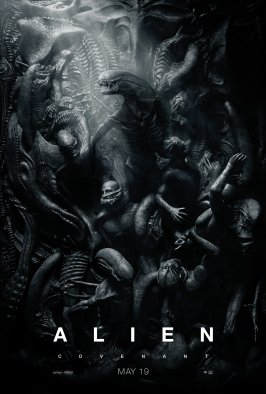
Directed by: Ridley Scott || Produced by: David Giler, Walter Hill, Ridley Scott, Mark Huffam, Michael Schaefer
Screenplay by: John Logan, Dante Harper || Starring: Michael Fassbender, Katherine Waterston, Billy Crudup, Danny McBride, Demian Bichir, Carmen Ejogo, Amy Seimetz, Jussie Smollett, Callie Hernandez
Music by: Jed Kurzel || Cinematography: Dariusz Wolski || Edited by: Pietro Scalia || Country: United States || Language: English
Running Time: 122 minutes
Few movie franchises are more of a mess or have more torrid, controversial histories than the Alien (1979, 1986, 1992, 1996, 2012) series. After the formulaic fall from grace from its influential, dare I say classic two original films by Ridley Scott and James Cameron, each franchise installment (including the prequel-spinoff Prometheus [2012]) repeats the identical narrative structure of the first Alien (1979), differing only in each auteur director’s stylistic execution of that same formula. The series’ official continuity has been bitterly contested since David Fincher’s reactionary Alien 3 (1992), which killed fan-favorite characters Dwayne Hicks (Michael Biehn) and Newt (Carrie Henn) off-screen, and whose nightmarish production troubles hobbled its theatrical release. The series has never fully recovered.
In this day and age of interconnected filmic universes, this haphazard attention to overarching characterizations or brand continuity is out of style, but I would argue makes for more interesting and unpredictable individual films. The Alien franchise suffers from name-brand nostalgia as much as any successful Hollywood property that came of age in the 1960s-1980s, and it will likely never regain its hallowed status (particularly if promising new blood like Neill Blomkamp is pushed aside for aging has-beens like Scott); but one thing the series is not is safe. It has formula, of course, but the property retains the blood, grime, and violent edge it popularized in the late 1970s-1980s.

Peter Weyland (Guy Pearce, center) introduces himself to his creation, the android David (Michael Fassbender, left) in the film’s prologue.
Perhaps the most amusing aspects of the Alien series are its fans; while fans of Marvel, DC, or various comic book adaptations verge on positivity bias, Alien(s) fans are notorious pessimists. Though it may be in keeping with their beloved saga, thematically speaking, Alien(s) fans are perhaps the most defensive cinephiles in pop culture, and it’s impossible to review any Alien sequel without discussing its hardcore fan environment. On the one hand, it is hard not to be defensive as an Alien fan given the series’ roller coaster history, but on the other, you find more balanced emotional reasoning and positive reinforcement in a psychiatric ward.
That brings us to Alien: Covenant. Constructed by Scott et al. as a sequel to Scott’s controversial prequel, Prometheus, as well as a crossover prequel to his original 1979 classic, Covenant is a hybridized installment that melds the pretentious thematic overtones of Prometheus with assorted franchise iconography from the first three films (Alien, Aliens, and Alien 3). In my mind at least, Covenant bridges the tonal and thematic gap between Prometheus and the Alien franchise proper about as well as a film could, balancing the Biblical symbolism of the former with the utilitarian, streamlined genre appeal of the latter. Unlike Prometheus, Resurrection (1996), and Alien 3, I could always follow what was going on, where all the characters were in relation to one another, and the narrative was paced accordingly. Its prologue and epilogue alone are benchmarks for how to start and end a science-fiction thriller with thematic weight, unlike, say, Predators (2010).
Much of that thematic weight is executed thanks to Ridley Scott’ stellar production-design and cinematography, as well as bravado dual performances by Michael Fassbender. The gorgeous CGI cinematography in space rivals that of Alphonso Cuaron’s Gravity (2013), which is in turn surpassed by the outdoor location photography completed in New Zealand. To that end, the near Holocaust style of the Engineer city and Fassbender’s Dr. Frankenstein-esque lair add memorable flair to the series’ overarching biopunk aesthetic.
The most memorable part of the whole film, however, is Fassbender himself. While the German-born Irishman was the biggest selling point of Prometheus as well, he ups the ante here with not one, but two excellent roles as Walter, the obedient, matter-of-fact android teamed with our principal cast of human colonists, and his reprisal as David, Prometheus‘ fastidious, possibly sinister android. Cinematographer Dariusz Wolski builds on Fassbender’s dual performances, utilizing a terrific yet subtle dolly tracking shot during an idiosyncratic scene where David teaches Walter to play the recorder, as well as effective wide-angle cinematography during an even more memorable Fassbender-on-Fassbender fight sequence.

Top: The abandoned Engineer vessel, first discovered in Prometheus, is found by the human colonists crash-landed on the Engineer homeworld. Bottom: The bitch is back…
My primary criticisms with Covenant have to do with its use of the titular xenomorph, as well as nonsensical, contrived decisions on the part of multiple important characters. One terrible scene involving an alien beating its computer generated head against a spaceship in mid-takeoff is laughable, not to mention unnecessary with regards to the story. In general, the xenomorph’s CGI FX are serviceable during low-lit indoor scenes, but unconvincing in high-key lighting setups or whenever the beast moves quickly in wide shots. Just as questionable are several key plot-points where characters act incredibly irresponsible to progress the story, a tiresome carryover from Prometheus. This criticism dovetails with my general disinterest in the cast outside of Fassbender, although at least none of them are annoying a la half of the supporting cast of Prometheus.
Alien fans are a cynical, spiteful bunch, and though I count myself among them, I neither fanboy at every property released a la Marvel nor do I view every subsequent sequel as heresy. With this latest movie, the franchise brand remains as much a burden as it is a blessing for a story indulging in its own mythology. This infatuation with all things Alien costs its attention to character logic and multilayered protagonists, but it guarantees wonderful biopunk visuals, effective cinematic violence, and an unforgettable antagonist who will never be appreciated as much as he should.
————————————————————-—————–
SUMMARY & RECOMMENDATION: Alien: Covenant sports the best script of the franchise since Cameron’s 1986 space-marine epic, whether people realize it or not, armed to the teeth with ferocious monsters, beautiful production-design, and not one, but two Michael Fassbender roles that do the series proud.
— However… if the franchise’s clusterfuck of narrative continuity irritates you, Covenant won’t help things, nor will it insist its space-faring civilians use scientific instruments or environmental suits. Scott’s depiction of his eponymous beast is surprisingly haphazard, and makes me wonder whether he half-assed these sequences as protest against the negative reactions to Prometheus.
—> ON THE FENCE; if starring castmembers Katherine Waterston, Billy Krudup, and Danny McBride (i.e. the human cast) were more the heart of the story with than side-helpings to Fassbender, my impressions might tick toward a firmer recommendation.

 Express Elevator to Hell
Discussion
Trackbacks/Pingbacks
Pingback: ‘Annihilation’ (2018): Review | Express Elevator to Hell - March 19, 2018
Pingback: ‘Soldado’ (2018): Review | Express Elevator to Hell - July 3, 2018
Pingback: ‘The Predator’ (2018): Review | Express Elevator to Hell - September 23, 2018
Pingback: Comparing and Contrasting ‘Infinity War’ (2018) and ‘Endgame’ (2019) | Express Elevator to Hell - May 15, 2019
Pingback: ‘King of the Monsters’ (2019): Review | Express Elevator to Hell - June 14, 2019
Pingback: How to Hate (or Love) Movies without Really Trying: Types of Film-Viewing Biases | Express Elevator to Hell - January 8, 2020
Pingback: Possible Franchise Expansions on Streaming Platforms | Express Elevator to Hell - February 13, 2021
Pingback: ‘Shin Godzilla’ (2016): The Timeless Horror of Natural Disaster | Express Elevator to Hell - August 22, 2021
Pingback: ‘The Matrix Resurrections’ (2021): The Power of Love | Express Elevator to Hell - December 28, 2021
Pingback: ‘The Last Duel’ (2021): Might Makes Right | Express Elevator to Hell - January 23, 2022
Pingback: ‘Prey’ (2022): The Hunt Pulls Me Back In | Express Elevator to Hell - August 15, 2022
Pingback: ‘Nope’ (2022): Dumb Titles Hide a Fearsome Spielbergian Hybrid | Express Elevator to Hell - October 29, 2022
Pingback: ‘The Killer’ (2023): Everyone’s Got a Plan Until… | Express Elevator to Hell - March 10, 2024
Pingback: ‘Alien: Romulus’ (2024): Back to Formula | Express Elevator to Hell - August 31, 2024
Pingback: ‘Prometheus’ (2012): The Weirdest Franchise Spinoff in Years | Express Elevator to Hell - August 31, 2024
Pingback: John Woo’s Return to the West: ‘Silent Night’ (2023) & ‘The Killer’ (2024) | Express Elevator to Hell - December 23, 2024
Pingback: Current Cinematic Comfort Food | Express Elevator to Hell - March 14, 2025