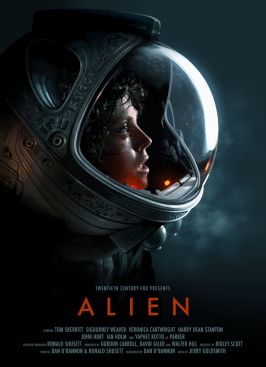
Directed by: Ridley Scott || Produced by: Gordon Carroll, David Giler, Walter Hill
Screenplay by: Dan O’Bannon, David Giler, Walter Hill || Starring: Tom Skerritt, Sigourney Weaver, Veronica Cartwright, Harry Dean Stanton, John Hurt, Ian Holm, Yaphet Kotto
Music by: Jerry Goldsmith || Cinematography: Derek Vanlint || Editing by: Terry Rawlings, Peter Weatherley || Country: United States, United Kingdom || Language: English
Running Time: 117 minutes
In many respects, Ridley Scott’s science-fiction classic was one of the first major films to be directly influenced by the original Star Wars (1977). Alien mirrored the grungy, grimy, dirty look of a “used” futuristic outer-space. It was a far cry from the sterile, bleached design of Stanley Kubrick’s 2001: A Space Odyssey (1968), as well as the original Star Trek (1966-1969). Because of this style, Alien’s world, like Star Wars before it, told a tale set in a much more believable world that the audience could relate to, as its sets and special FX looked futuristic while still feeling tangible. Alien was also made at a time when models, miniatures, matte paintings, and more practical (i.e. non-CGI) techniques were at their peak. Many of the FX look just as good as the best computer FX in modern films, and in many instances, are superior to them. It’s incredible how good this film looks even to this day. The film hasn’t aged at all, save for those 1970s-era computer screens.
Beyond the general look of the film, Alien is paced to perfection. The first act hardly presents anything foreboding at all, yet this is only setup for the dread that builds thereafter. The gradual realization that the crew members are dealing with something they couldn’t ever comprehend doesn’t come to the forefront until at least 45-minutes into the film.
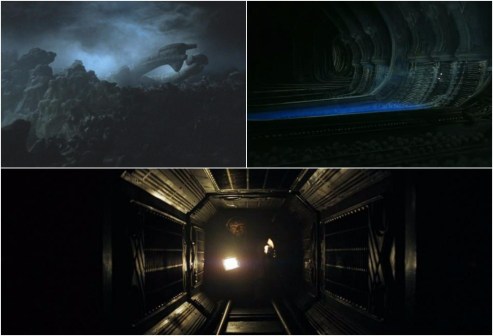
Alien is a dark, patient tale of the ultimate stalker and its near helpless, isolated victims, crying in vain for help against the vast blackness of space.
The cast is strong, particularly for a horror film, where most people nowadays expect cardboard cutouts awkwardly reciting lines until they get killed off. The dialogue feels natural and flows as if it were improv, but with none of the pretentious comedy inherent therein. The cast resembles a sort of deep space-mining crew, perhaps the future equivalent of blue collar workers or “merchant marines in space.” Though none of the cast are charismatic or particularly likable (Tom Skerrit and Sigourney Weaver are minor exceptions), their every-man and woman personas add to the film’s grounded aesthetic and narrative relatability.
As for the alien FX and ship design, much of film’s architectural style is based on the work of Swiss surrealist artist, H. R. Giger, whose trademark “biomechanical” projects were made famous in the Alien franchise. The sexual overtones of the artistic designs are obvious and add an organic look to the now famous Space Jockey-ship, while also giving the alien itself a unique “mechanical” frame, despite being an organism. This melded techno-organic, hyper-sexualized style permeates every aspect of the alien’s life-stages, and is a recurring theme throughout the film’s ominous settings. The sexual tones are so blatant that the movie, at times, feels like a sort of surreal, twisted, pornographic film. Vaginal symbolism and a wide range of phallic references abound, including in the alien’s form itself (e.g. the alien’s head resembles a penis).
These sexual overtones are a large part of the film’s xenomorph threat. While the overarching genre-tone of the Alien series is its sci-fi roots, this first installment is a horror picture before all else. The xenomorph’s terror has as much to do with sexual assault as it does with general bodily harm. The thing with the Alien series is, you don’t just have to run for your life for fear of being murdered or eaten alive, you also have to run from being penetrated and raped before you die. Many of the adult xenomorph’s later murders imply horrifying subjugation and sexual assault of its victims. You could call the alien a crude, violent, nightmarish sexual organ, somehow both vaginal and penile — and yet, the alien’s design is anything but crude. It is a darkly beautiful and terrifying artistic creation that has never been equaled, except perhaps in the more masculine Predator (1987)-design.
However, it’s not just the script’s pacing, the special FX, the set-design, and potent imagery that conjures horror in Alien, but Scott’s camera as well. Camera movements are slow and limited, with only occasional, deliberate handheld cinematography, most of which occurs in the frantic finale. Wide-shots are used prominently throughout, with close-ups rare and extreme close-up shots even rarer, often used only in a character’s final moments before their horrific death.
Scott’s use of lighting and sound design are also impressive. The film is low-lit, but never without reason; most sequences take place in extended, industrial corridors, hanger bays, a desolate planet, and the decrepit remains of an alien spacecraft. The few high-key lighting setups include the crew’s dining area and medical bay. The former is home to the film’s most iconic and violent scene, while the latter allows for patient, detailed contemplation of the alien threat in a way only a true science-fiction film could. In addition, every sound effect from clinking chains to dripping water to Weaver’s ragged breathing are mixed and edited to add further haunting mood to the unforgettable set-design and creature FX. Alien is all about the little things.
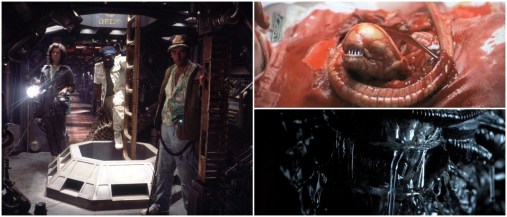
Left: A young Sigourney Weaver and company search for the recently born alien (top right), but don’t encounter it until it has matured into a lethal adult (bottom right).
For all these reasons and more, almost every horror film since has been influenced by or has ripped off Scott’s masterful Alien. It is as much a quintessential slasher picture as the original Texas Chainsaw Massacre (1974), Halloween (1978), Friday the 13th (1980), and A Nightmare on Elm Street (1984). Its influence has been felt in the science-fiction genre as well, but since the famous “space marine” archetype originated with Cameron’s Aliens in 1986, most of the original Alien’s impact has been felt in the realm of horror. It takes the vast, lonely emptiness of space and transforms it into the ultimate haunted house. At it’s core, Alien is a scary movie about a monster killing (and violating) people — but it is the gory, slimy details that make it one of cinema’s all-time greatest achievements.
———————————————————————————————————————————————————————————
SUMMARY & RECOMMENDATION: Alien derives its haunting mood and atmosphere from surrealist artist H.R. Giger’s fucked-up imagination and director Ridley Scott’s painstaking attention to detail. This movie, as well as its sequel, represent the best of B-movie genre films done with A-list writing, cinematography, and acting.
— However… none of the characters are terribly likable, save for perhaps Weaver and Skerrit.
—> HIGHLY RECOMMENDED
? I wish all films had title sequences this clever.

 Express Elevator to Hell
Innteresting thoughts
Posted by Aden C | August 2, 2022, 1:53 amWhat’s your favorite of the franchise?
Posted by The Celtic Predator | August 31, 2023, 11:44 am