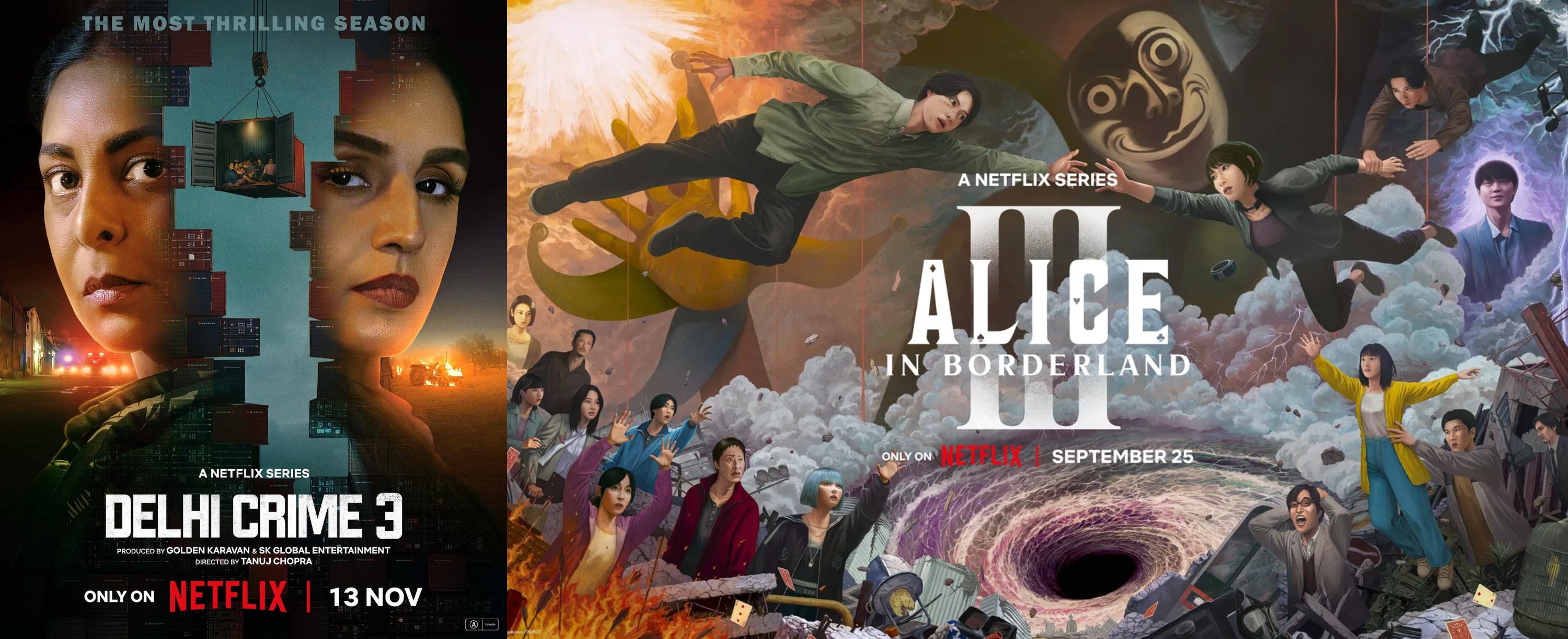
Created by: Richie Mehta [1], Shinsuke Sato, Kaata Sakamoto, Akira Morri [2] || Written by: Apoorva Bakshi, Tanuj Chopra, Anu Singh Choudhary, Michael Hogan, Shubhra Swarup, Mayank Tewari [1], Yoshiki Watabe, Yasuko Kuramitsu, Shinsuke Sato [2]
Directed by: Tanuj Chopra [1], Shinsuke Sato [2] || Starring: Shefali Shah, Rasika Dugal, Adil Hussain, Rajesh TAilang Kento Yamazaki, Tao Tsuchiya, Kento Kaku, Hayato Isomura, Ayaka Miyoshi, Katsuya Maiguma, Risa Sudou, Koji Ohkura, Kotaro Daigo, Tina Tamashiro, Ken Watanabe [2]
No. of Episodes: 6 [1], 7 [2] || 1 = Delhi Crime 3, 2 = Alice in Borderland 3
I recently canceled my family’s Netflix account after first subscribing to the premiere streaming platform in fall of 2018. This 8-year run concluded one of the most used but also one of the most expensive subscription services of my adult life, where I enjoyed access to not only “the big titles” (e.g. Stranger Things [2016-2026], Mike Flanagan’s The Haunting of Hill House [2018] & Midnight Mass [2021], etc.) but also high-quality foreign shows (e.g. Sacred Games [2018-2019], The Green Frontier [2019], Kingdom [2019-2021]), foreign feature-films (e.g. Blood Red Sky [2021], The Platform [2019], Black Crab [2022], Lost Bullet [2020, 2022, 2025]), and English-language genre movies that were run out of theatres by the mid-2010s (e.g. Calibre [2018], In the Tall Grass [2019], The Killer [2023]). To be sure, I also spent — maybe not “wasted,” per se, but spent — a decent amount time with bloated, overindulgent auteur pieces (e.g. Mank [2020], Bardo [2022], El Conde, Khufiya [both 2023]) that I would have treated with indifference regardless of whether I watched them in theatres or not. That is to say nothing about the many hours my family and I spent sifting through the Netflix library to find the aforementioned gems in the first place, a downside of a streaming library so massive it has essentially become the home for the modern equivalent of “straight-to-DVD” or “straight-to-home-video” titles.

Top: Series lead Shefali Shah returns home after being reassigned to a remote outpost in Assam at the end of Season 2. Bottom: Huma Qureshi stars as Season 3’s main antagonist, a tactical and chameleonic “madam” and sex trafficker.
Two of the more notable Netflix Original foreign-language shows I enjoyed were Delhi Crime (2019) and Alice in Borderland (2020, 2022): The former launched out of the gate with one of the better standalone seasons of any television production, limited or long-form series, I have seen in the modern streaming era; it dramatized the 2012 gang rape and murder that took place on a New Delhi city bus, handling the hyper-controversial incident and massive sociopolitical upheaval that followed with incredible cinematic precision and sensitivity. After a change in creative leadership (Tanuj Chopra took over showrunner duties from creator Richie Mehta), Delhi Crime (DC) followed that immaculate debut with a sophomore season, based on a semi-fictionalized premise this time, that felt truncated, tiresome, and underwhelming. By contrast, Alice in Borderland’s (AiB) 2020-2022 release straddled the divide between limited or miniseries formats and long-form, multi-season television story arcs, building a cohesive FX-driven science-fiction epic with meaningful, relatable characters over sixteen episodes.
Two of the final Netflix Original properties I watched prior to canceling my subscription were the third seasons of both shows, each debuting in 2025 about three years after their sophomore outings. With respect to DC Season 3 (DC3), Chopra and team use another semi-fictional yet realistic criminal enterprise as the foundation for this third story arc: South Asian sex trafficking rings. Right away, this feels more urgent, interesting, and multilayered than the clunky, unintimidating burglars of Season 2. The writers incorporate lead Shefali Shah’s arc and that of her costars (e.g. Rasika Dugal) organically from previous seasons, making you care about the personal lives of the main castmembers even when the primary law-and-order conflict doesn’t take centerstage. Their chemistry with supporting cast newcomers (e.g. Aditi Subedi) as well as main antagonist Huma Qureshi, meanwhile, pays off with a meaningful conclusion.
Direction-wise, DC3 is edited more like Season 1 than 2, unfolding across six episodes at a relentless pace (Season 1 boasted seven episodes, while Season 2 had only five). The series has never presented itself as an action-heavy genre piece but rather a tense police procedural, with footchases and brief shootouts from small arms being its largest scale “set-pieces.” Mixing and matching the aforementioned three-dimensional characterizations with great pacing, minimal yet relatable violence, and diverse location-photography brings the series back to form.
There is not much to say about the third season of AiB, by contrast, which functions more as a stylized yet nonessential epilogue to the base narrative of AiB. Power couple Kento Yamazaki and Tao Tsuchiya are the lone main castmembers from the first two seasons to return (Ayaka Miyoshi reprises her supporting character in a minor recurring role), focusing Season 3 on a leaner, more personal level. However, the Cube (1997)-esque purgatory games of this abbreviated 7-episode arc, a defining feature of AiB, do not feel nearly as creative or memorable. The first game Season 3 depicts is its best —- a deadly trivia contest where wrong answers are punished in proportion to their inaccuracy with flaming arrows — but thereafter, the contests feel more and more perfunctory as the storyline trolls along. More than anything else, the lack of narrative mystery that dominated Seasons 1 and 2’s story arc robs this latest and presumably final season of any suspense it might otherwise have. I appreciate cowriter-director Shinsuke Sato’s dedication to his central characters’ emotional relationships, as they form the heart of AiB, but the narrative tension of this de facto epilogue is a fraction of the series’ height.

Left: The best game of AiB 3 features deadly trivia questions featuring, among other things, 100 million flaming arrows. Bottom: Series leads Kento Yamazaki and Tao Tsuchiya return as a couple whose growth feels natural between seasons.
At the end of the day, these unexpected follow-ups to two of my favorite Netflix Original series felt like closure for my eight-year subscription to the dominant streaming platform of the modern era. I feel that I more than got my money’s worth despite the unavoidable “filler” titles that populate every corner of Netflix’s library, as the heights of exclusive properties like Delhi Crime and Alice in Borderland feel truly unique to me. Delhi Crime’s latest season redeemed its original glory in my eyes, while Borderland’s unpredictable epilogue could never hope to recapture the original multi-genre magic (Action! Sci-fi! Drama! Thriller!) of its original unforgettable 16-episode arc. As a dedicated fan of both properties, I enjoyed my time with both third seasons, but can only recommend one of them outright (see below), making my conclusion to my time as a Netflix customer somewhat bittersweet.
——————————————————————————————————————————————————————————-
SUMMARY & RECOMMENDATION: No other streaming platform or production studio could have or would have financed international projects as complex or as ambitious as Alice in Borderland or Delhi Crime in the late 2010s to early 2020s. These non-English language limited to extended television series are as fundamental to Netflix’s success as titles like KPop Demon Hunters (2025) or Bird Box (2018), yet I feel they remain overlooked by many international audiences. Unfortunately, neither third iteration of either series blows my socks off, but at least Delhi Crime 3 rediscovers the grace its original season had for some of the most sensitive true-to-life source material imaginable.
— However… the production values of AiB 3 are comparable to any Hollywood production, while its characterizations remain strong. DC3, meanwhile, never comes close to touching its unparalleled debut, however much of a “return to form” it feels in comparison to Season 2.
—> DC3 comes RECOMMENDED, while I remain ON THE FENCE in regards to AiB 3.
? Aditi Subedi: I don’t know what you see in me. || Shefali Shah: I see hope.


Discussion
No comments yet.