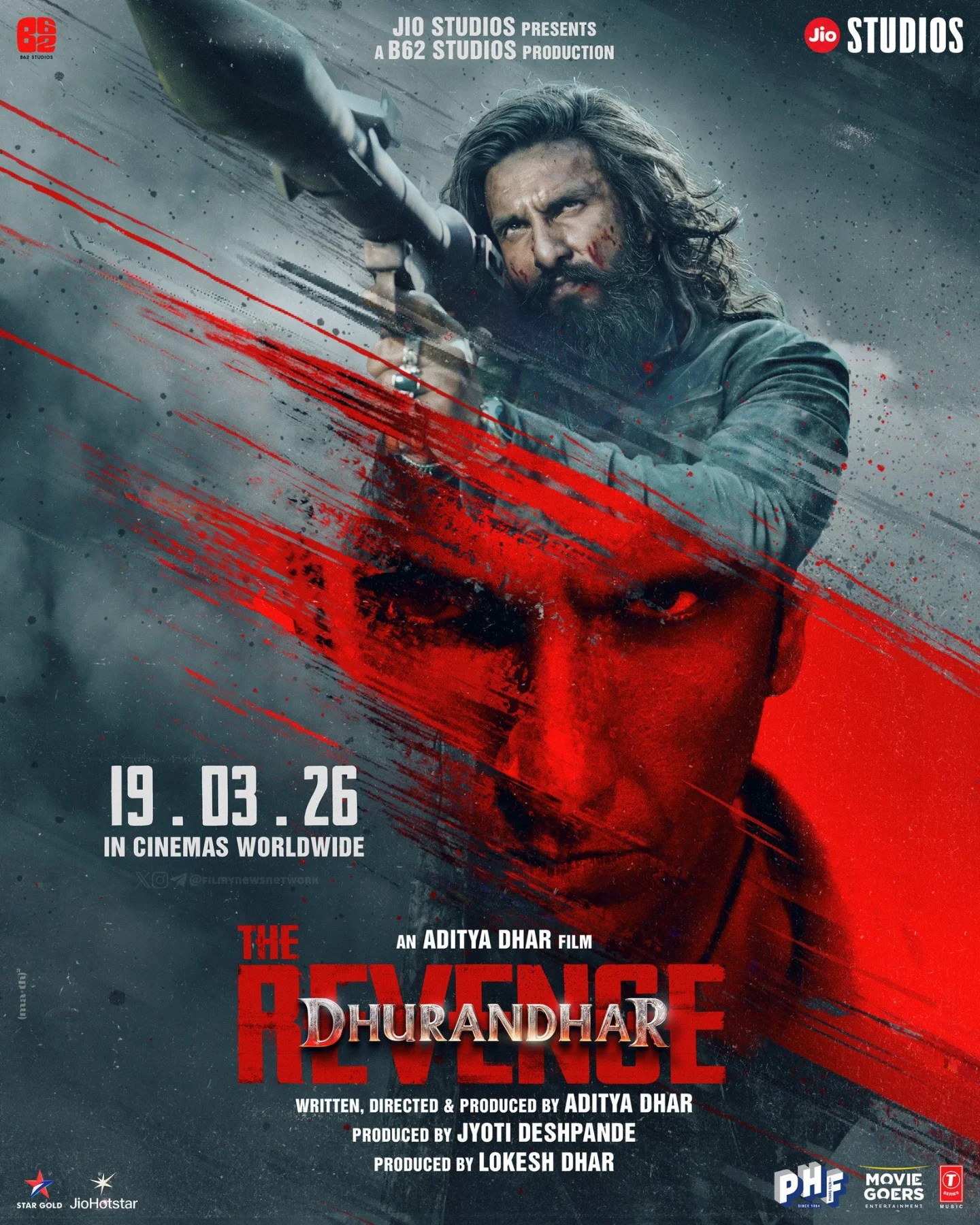
Directed by: Aditya Dhar || Produced by: Aditya Dhar, Lokesh Dhar, Jyoti Deshpande
Screenplay by: Aditya Dhar, Shivkumar V. Panicker, Ojas Gautam || Starring: Ranveer Singh, Akshaye Khanna, Arjun Rampal, R. Madhavan, Sanjay Dutt, Sara Arjun, Rakesh Bedi, Gaurav Gera, Danish Pandor
Music by: Shashwat Sachdev || Cinematography: Vikash Nowlakha || Edited by: Shivkumar V. Panicker || Country: India || Language: Hindi
Running Time: 446 minutes
Mainstream Bollywood filmmaking (Hindi cinema based in Mumbai) flaunts five major attributes that stand out to me as a Westerner and non-Indian viewer:
1.- An impressive focus on both diegetic and non-diegetic music, exemplified most notably in their industry’s emphasis on musical or musical-adjacent films — This cultural feature extends across instrumental soundtracks as well as elaborate dance numbers, an industry staple that Hindi cinema shares with most other Indian film cultures, including and especially mainstream Telugu, Tamil, and Kannada-language filmmaking of South Indian Cinema (SIC).
2. Long-winded storytelling — Another feature Bollywood shares with other popular regional film industries (e.g. SIC) of South Asia, this stereotypical attribute is more often a weaknesses than a strength in both mainstream blockbuster and smaller scale features. Whether through bloated casts, overextended, unnecessary action sequences, lackadaisical editing, or just plain verbose screenwriting, Hindi movies, particularly the big-budget ones headlined by major stars, most always overstay their welcome. Well known, let alone commercially successful Indian movies at or under two hours like Tummbad (2018) or Laapaata Ladies (2023) are extraordinarily rare.
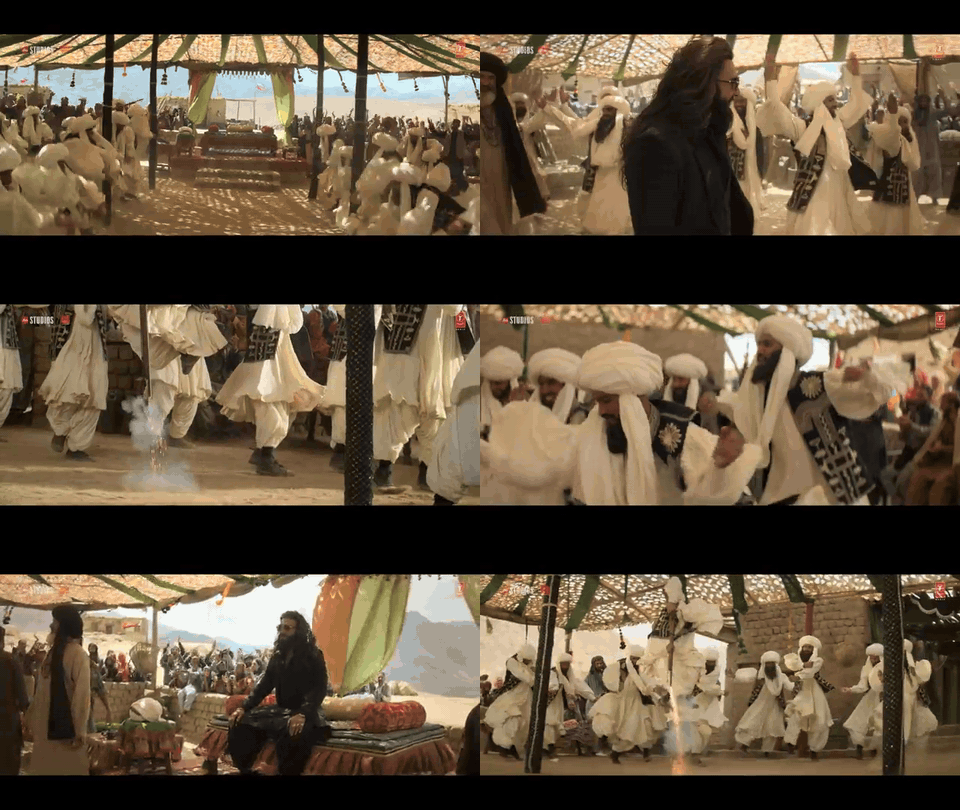
Diegetic song-and-dance percolate throughout Dhurandhar, such as this unique rifle dance from the film’s second half, which is primarily composed of the Balochi chaap but remixed with the visual language of the Saudi taasheer.
3. Identifiable mise-en-scène defined by colorful costume-design, striking hair and makeup, and memorable locations — These elements gel with Bollywood and much of Indian cinema’s fluency with the film musical, emphasizing their cultural backdrop’s appreciation for bright, primary colors and elaborate traditional ethnic fashion, not to mention the bustling village and urban megacity backdrops that define the most populous nation on earth.
4. Preachy, heavy-handed sociopolitical messaging — It is not uncommon for the main characters of Bollywood movies (… or SIC, for that matter), blockbuster or independent, to abruptly turn to extras or their costars (re: the audience) multiple times throughout their storyline, stand on a soapbox, and then explain their movie’s obvious social commentary. Oftentimes, this dynamic is complimented by lame, one-note, cartoon villains who spout such hamfisted dialogue that would make even a Hollywood comic book-movie supervillain blush.
5. Mediocre-to-bad action filmmaking — While musical numbers and fight sequences on film overlap considerably in terms of choreography, actor athleticism, and narrative pacing, for whatever reason, most Indian action scenes outside of exceptional pictures like Kaithi (2019) or Kill (2023) seesaw between clunky, overchoreographed nonsense and slow-motion spoofs of Matrix (1999) stunts.
The overwhelming commercial and cultural success of Aditya Dhar’s two-part film, Dhurandar, now the highest grossing Indian film in history sans Dangal (2016), is at least in part a function of its ability to maximize the aforementioned positive attributes common to Hindi filmmaking, namely Points 1 and 3, while minimizing or subverting its parent industry’s common weaknesses (Points 2 and 5). The few weaknesses of Dhurandar concern its so-so big bads (e.g. Arjun Rampal) and obvious, at times on-the-nose political messaging (Point 4), but even those drawbacks are smoothed over by effective sub-villains (e.g. a great Akshaye Khanna) and fluid transitions between live-action fiction and documentary footage of real-life terrorist attacks.
Because Dhurandar is best left experienced with minimal baggage, I’ll skate over the movie’s premise and focus more on its overall style: The film draws inspiration from numerous terrorist attacks across India throughout the 1990s-2000s, all of which were coordinated by various Pakistani extremist cells connected to other organized crime syndicates concentrated in Karachi. As a result, a more proactive, nationalist Indian government in the 2010s responds with a multilayered, yearslong undercover operation to investigate and eliminate these bad actors. Dhurandar follows the infiltration of an ethnic Baloch gang in Pakistan’s capital city by one Hamza Ali Mazari (Ranveer Singh), whose backstory is later explored in captivating detail in the film’s second half.
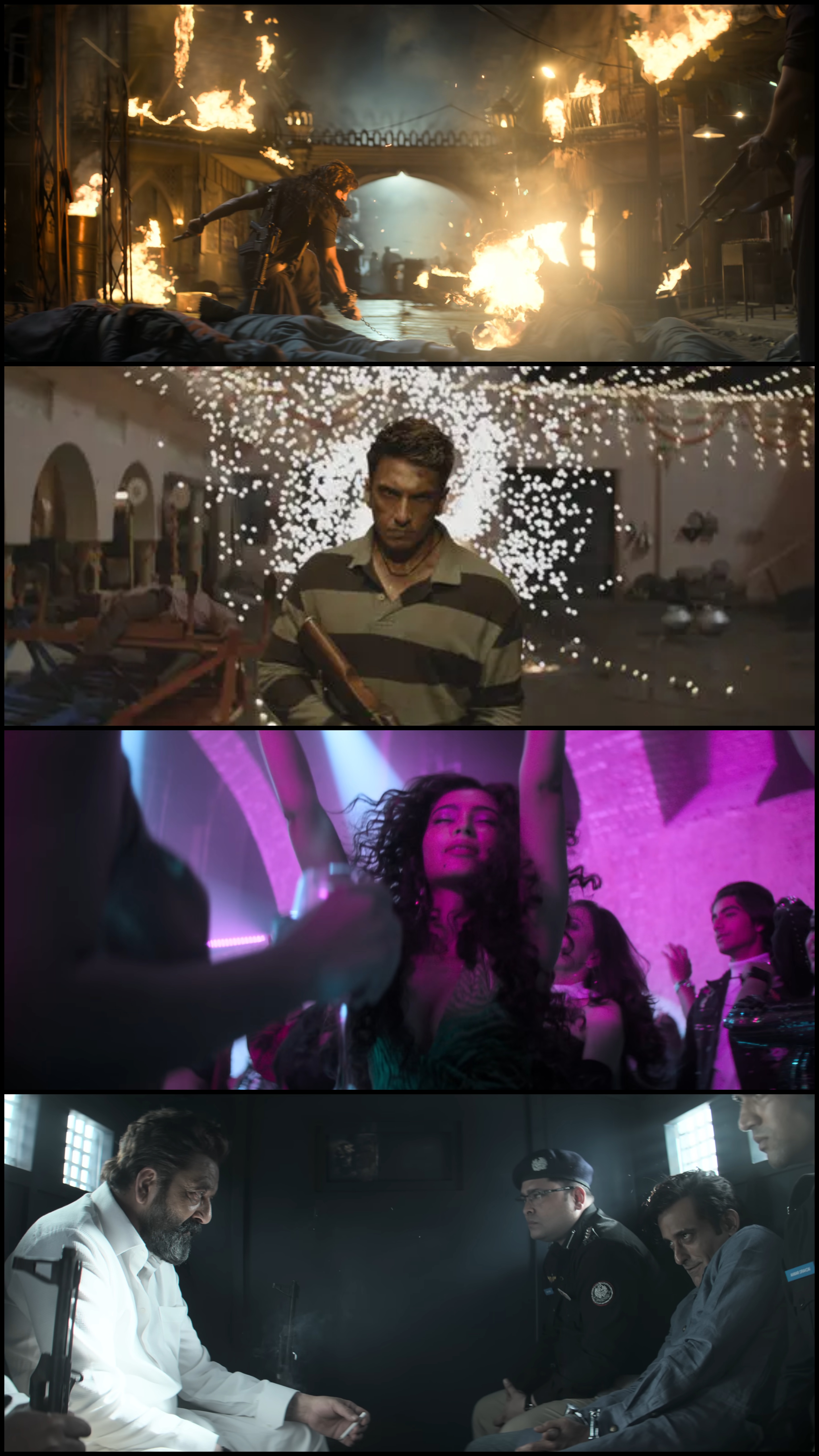
From top to bottom: Lead Ranveer Singh wreaks havoc between rival Karachi gangs during his undercover tenure; Singh tears through a rival family clan during his horrific backstory flashback; female lead Sarah Arjun leaves an impact despite her minimal screentime and underutilized character; supporting actors Sanjay Dutt and Akshaye Khanna give perhaps the most interesting performances in the entire movie thanks to their mercurial, morally grey personas.
The overarching Pakistan v. India rivalry of this mammoth (446-minute long) adventure I did find not nearly as interesting as the narrative’s undercover spy tropes, dominant crime drama flavor, stylized brutality, and diverse soundtrack. With regards to the latter, Dhurandar features as much musical variety and diegetic musical numbers as Gangs of Wasseypur (2012), which is high praise from yours truly. Its spy-political thriller tone combines with its gangster aesthetics to feel equal parts Infernal Affairs (2002)/The Departed (2006), Zero Dark Thirty (2012), and even Scarface (1983). Dhar mixes and matches characteristic Indian slow-motion cinematography with brilliant musical flourishes, powerful costume-design, and diverse location-photography to produce a genre-hybrid that feels worth the time investment.
Speaking of that time investment, the way Dhar, cowriter-editor Shivkumar V. Panicker, and cowriter Ojas Gautam pace Dhurandar goes a long way toward making Singh’s character arc feel earned, developing key supporting characters like Sanjay Dutt and Khanna, and fleshing out the Karachi setting. The film takes its time without wasting it, prefacing its second half with one of the best flashback sequences in recent memory, for example.
Put another way, Dhurandar represents a potential paradigm-shift in blockbuster Bollywood cinema thanks to its impressive execution of established Bollywood filmmaking tropes free of cultural censorship. At least a portion of Dhurandar’s formula is based on filmmaking traditions I still find somewhat bland at best and downright annoying at worst (e.g. the nationalist preaching, heavy-handed dialogue from mustache-twirling villains), sure, and not every character gets time to shine (e.g. female lead Sara Arjun); that being said, the criticisms of Aditya Dhar’s likely career magnum opus beyond politics remain so few and far between that the film feels nearly impossible not to recommend to general audiences.
——————————————————————————–
SUMMARY & RECOMMENDATION: While the six-year journey Aditya Dhar took to develop his sophomore feature after his gritty directorial debut, Uri: Surgical Strike (2019), may be as interesting as the cultural reception to the former, Dhurandar stands head and shoulders above the vast majority of both Hindi-language and South Indian blockbusters from the past decade. The reasons for that cinematic prowess are many, yet chief among them are great pacing, stylized yet grisly violence, an unforgettable soundtrack, and the fluid hybridization of crime drama and political thriller formulas.
— However… the Jai Hind!-political preaching inherent to much of mainstream Indian cinema cannot be avoided, it seems, even in a movie as otherwise as intelligent like Dhurandar. For a storyline that approaches 7.5 hours in length, Dhurandar is more theatrical miniseries than traditional feature, and as such, the lack of screentime for key characters like Sara Arjun is inexcusable.
—> Dhurandar comes RECOMMENDED.
? Aditya Dhar being born into a Kashmiri Pandit family makes sense, in hindsight.


Discussion
No comments yet.