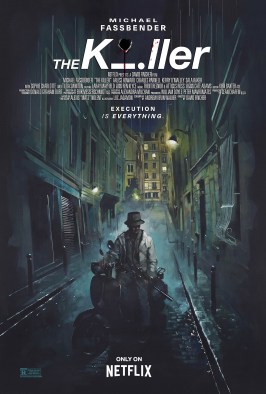
Directed by: David Fincher || Produced by: William Doyle, Peter Mavromates, Ceán Chaffin
Screenplay by: Andrew Kevin Walker || Starring: Michael Fassbender, Arliss Howard, Charles Parnell, Kerry O’Malley, Sala Baker, Sophie Charlotte, Tilda Swinton
Music by: Trent Reznor, Atticus Ross || Cinematography: Erik Messerschmidt || Edited by: Kirk Baxter || Country: United States || Language: English
Running Time: 118 minutes
In case you didn’t know which corporate behemoth won the “streaming wars” — the somewhat new direct competition between different tech companies (e.g. Netflix, Apple) and major film studios (e.g. Walt Disney, Warner Bros., Paramount Pictures, etc.) through online subscription video on demand (SVOD) platforms, which started toward the end of the 2010s and escalated during the coronavirus pandemic — let me catch you up to speed: Netflix reigns supreme. The original streaming platform weathered the pre- and post-pandemic business climate better than its rivals, one of the various reasons likely being its diverse, multilingual, and multinational original properties, including its often underrated catalog of original feature-films. Many of those features have been directed by established veteran filmmakers such as Jane Campion, Alejandro Gonzalez Iñárritu, Alfonso Cuarón, Martin Scorsese, David Michôd, Anurag Kashyap, Paco Plaza, J. A. Bayona, Shinsuke Sato, John Woo, Gareth Evans, and one of my favorite working directors, David Fincher.
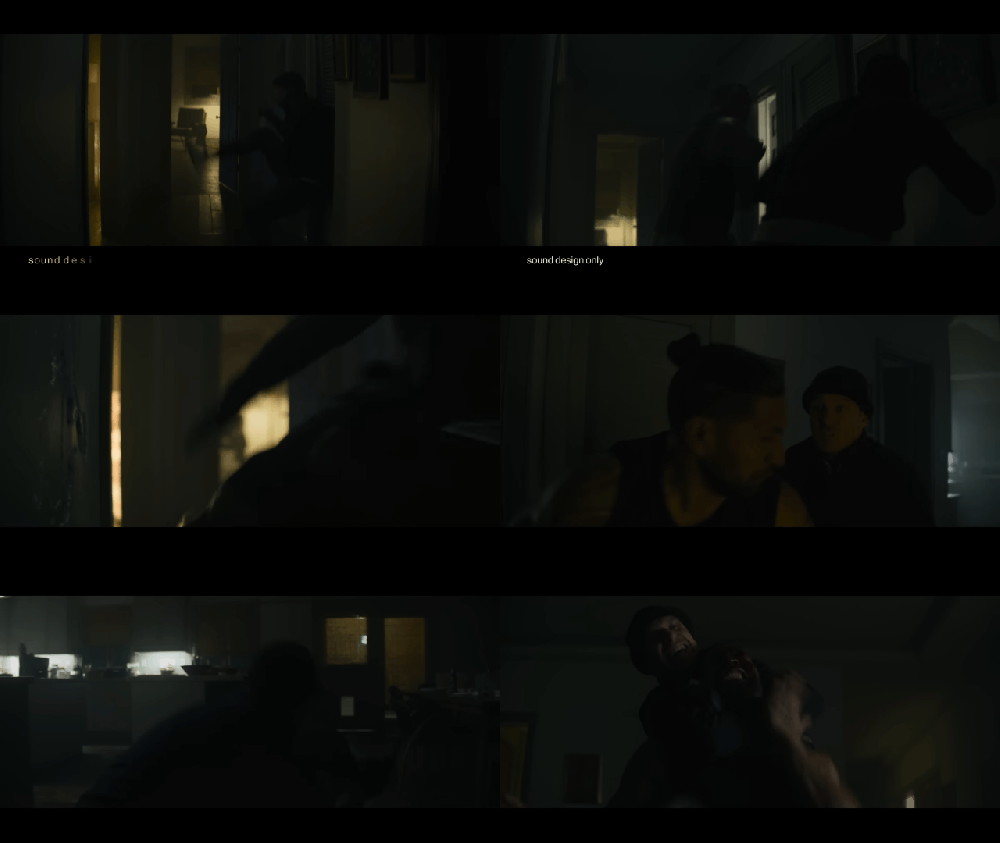
In The Killer’s action centerpiece, Michael Fassbender (intercut with a stuntman) trades blows with costar Sala Baker to produce one of the scrappiest, least flowery close-quarters-combat sequences on film in years.
A notable vocal supporter of the Netflix business model, Fincher recently extended his employment contract with the platform after various contributions to the House of Cards (2013-2018), Mindhunter (2017-2019), and Love, Death, + Robots (2019, 2021, 2022) series, as well as directing two features. The first of the latter two was 2020’s Mank, one of the Oscar-favorites of the pandemic era and perhaps the most forgettable Fincher movie since The Game (1997). Last year’s The Killer, on the other hand, retains the seedy, grimy, creepy tone, neo-noir lighting, and blunt violence of most of his Netflix Original productions and his earlier theatrical works.
Adapted from the French graphic novel series of the same name by Alexis “Matz” Nolent and Luc Jacamon, The Killer is to Fincher like Cape Fear (1991) and Casino (1995) are to Martin Scorsese — mid-tier relative to its auteur’s famous, influential filmography, yet still a well made and highly entertaining genre film that sports most all the classic hallmarks of its filmmaker’s identifiable directorial style. The Killer is not the pinnacle of David Fincher’s “B-movie executed with A-movie precision” modus operandi, where grungy crime drama premises are endowed with the dedicated auteur’s eye for surgical detail a la Seven (1995), Zodiac (2007), or even Gone Girl (2014), but it is a welcome return to genre form after the bland period drama biopic that was Mank, which felt like Fincher only directed because of that film’s screenplay’s connection to his late father.
In The Killer, lead Michael Fassbender plays a pretentious, bored, and self-absorbed hitman who’s either lost his passion for his job or is not nearly as disciplined as he thinks he is who screws up a major assassination in the film’s meticulous, suspenseful opening scene in Paris. The movie then jumps from France to the Dominican Republic to various mid-sized cities across the United States as Fassbender deals with the violent fallout of his botched hitjob thanks to vengeful clients and an unsupportive handler, a common trope in these types of crime dramas centered around hitmen or hitmen adjacent professions.
What sets Fincher’s Killer apart from the numerous cliches and semi-predictable rhythm of the “assassin’s revenge” narrative formula are (1) Fincher’s characteristic unparalleled direction and (2) Fassbender’s now expected subtle, charismatic performance of a nontraditional genre lead. With respect to the audiovisual style of The Killer, the minimal yet precise use of handheld camerawork when Fassbender makes mistakes contrasts with the dominant, more typical Fincherian style of motion-operated rigs and eerie static shots. The sound-design of both quieter, patient scenes of Fincher methodically stalking his targets mesh well with the pinpoint, well choreographed audio of louder, explicit scenes of violence, and help imply to the audience exact scene geography and blocking of all important castmembers in darker nighttime sequences. This complex mix of cinematographic and editing styles crescendos in a spectacular 2nd Act brawl between Fassbender and costar Sala Baker, where the audience is intentionally misled as to who’s hunting whom in the tense buildup to their violent encounter. It’s one of the more unglorified, unembellished yet memorable fight sequences of the past several years.
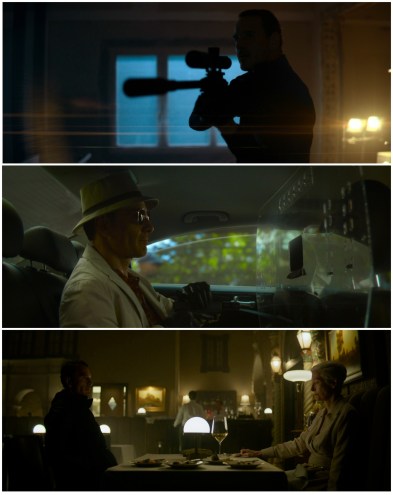
Fassbender’s protagonist’s rigorous dedication to dispassionate, meticulous strategy, which mirrors David Fincher’s approach to most screenplays, funnily enough, is challenged by the unpredictability of his targets as well as the titular killer’s own emotions.
Fassbender’s lead performance, likewise, is a mix of athletic precision and sardonic, almost self-indulgent arrogance. His physical performance is threatening in accordance with the movie’s title, yet his running voiceover commentary throughout the picture clashes with his constant screwups to produce dark, unpredictable comedy. The cynical self-delusion of Fassbender sets The Killer apart from countless assassin revenge plots we’ve seen before (e.g. Kill Bill [2003-2004], No Country for Old Men [2007] In Bruges [2008], Killing Them Softly [2012], John Wick [2014]), and in my interpretation, his narration adds more to the personality of the film than any other voiceover since Wagner Moura’s in Elite Squad (2007).
To be clear, the subtle black comedy of The Killer may fly over audiences’ heads or even strike certain viewers as pretentious regardless of David Fincher and screenwriter Andrew Kevin Walker’s (yeah, the guy who wrote Seven!) ultimate intensions. It felt like the overall point of the movie to me, just captured in the now stereotypical Fincherian neo-noir aesthetics of low-key light, urban to suburban decay, and unsettling sound-design. The fact that all the above are wrapped within seamless, almost unappreciated digital compositing and FX and provided worldwide to audiences on an affordable, convenient SVOD platform like Netflix almost feel like a bonus to me… but a welcome bonus nonetheless.
———————————————————————————
SUMMARY & RECOMMENDATION: Saddled in between the likes of foreign-language awards-favorites such as All Quiet on the Western Front (2022) and independent American shlock like Bright (2017) within the Netflix library stands the latest installment in the venerable filmography of David Fincher, one of the most consistent and entertaining Hollywood auteur filmmakers of the last thirty years. Without much pomp and circumstance or false pretentions of any kind, The Killer, ahem, subverts hitman revenge-movie expectations through realistic protagonist incompetence, an amusing, frankly unforgettable voiceover, and some of the most effective, surgical cinematic violence of the post-pandemic era.
— However… some viewers may find The Killer’s metacommentary cute in a bad way. Other than the filmmakers behind the camera, this is Michael Fassbender’s movie, so don’t expect much personality from the supporting cast.
—> RECOMMENDED, because even “middling” David Fincher is great filmmaking.
? … and look at that, another great modern (2010s-2020s) movie that just so happens to be under two hours!

 Express Elevator to Hell
Discussion
Trackbacks/Pingbacks
Pingback: Bhardwaj & Son’s ‘Khufiya’ & ‘Kuttey’ (2023) | Express Elevator to Hell - March 19, 2024
Pingback: ‘The Three Musketeers’ (2023): Burning Castles & Drunken Sword Fighting | Express Elevator to Hell - May 21, 2024
Pingback: ’60 Minutes’ (2024): The Punching Show, Not the Talking Show | Express Elevator to Hell - May 31, 2024
Pingback: ‘Kingdom of the Planet of the Apes’ (2024): The More Things Change | Express Elevator to Hell - August 24, 2024