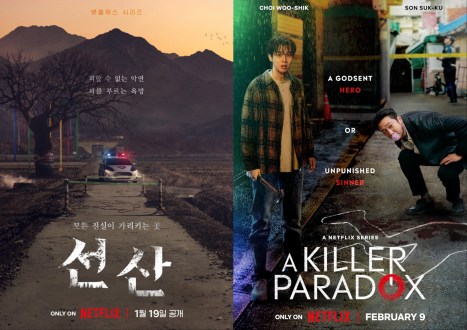
Created by: Yeon Sang-ho [1], Son Seung-ae [2] || Written by: Yeon Sang-ho, Min Hong-nam, Hwang Eun-young [1], Kim Da-min [2]
Directed by: Min Hong-nam [1], Lee Chang-hee [2] || Starring: Kim Hyun-joo, Park Hee-soon, Park Byung-eun, Ryu Kyung-soo [1], Choi Woo-shik, Son Suk-ku, Lee Hee-joon, Kim Yo-han [2]
No. of Episodes: 6 (~270 minutes total) [1], 8 (~416 minutes total) [2] || 1 = The Bequeathed, 2 = A Killer Paradox
A trend I’ve long noticed in mainstream filmmaking the world over, but in the United States (Hollywood, chiefly) and India (Hindi-language Bollywood plus Dravidian-language South Indian Cinema) in particular, is the high rate of weak to superfluous supporting roles even in movies dominated by lucrative stars or star-producers like Tom Cruise or Dwayne Johnson in US cinema and Shah Rukh/Salman/Aamir Khan, Ranbir Kapoor, Prabhas Raju, or Mahesh Babu in Indian cinema. Even in many of the better tentpole blockbusters headlined by those leading men, the ranks of their supporting casts are often bloated with annoying comic relief characters, stunt casting of athletes, singers, and other popular entertainers, or other types of unnecessary roles whose subplots and screentime weigh their movies down.
Recent notable examples of problematic starring roles can be found in Korean cinema of all places, perhaps the best, most consistent, and dynamic filmmaking culture on the planet over this past generation (circa 2000-2020s). Stranger still is how the two chosen case studies for today’s review, Yeon Sang-ho’s The Bequeathed and Son Seung-ae’s A Killer Paradox, are both Netflix Limited Series. Though the Netflix platform is no stranger to underwhelming original properties, particularly with respect to its Original Films (I am a general defender of those titles relative to most people, for the record), most titles I’ve criticized for their lackluster supporting roles are feature films, theatrical or otherwise, that often struggle allocating appropriate screentime to a large cast of characters (e.g. ensemble casts) within 100-150 minute runtimes. Television series don’t have that strict time limitation even if they only run for a lone, abbreviated season, and yet somehow both The Bequeathed and A Killer Paradox, weird crime thrillers about secret, estranged family members who happen to be serial-killers and M. Night Shyamalan-esque vigilantes, respectively, overreach through the scope of their ensemble casts.
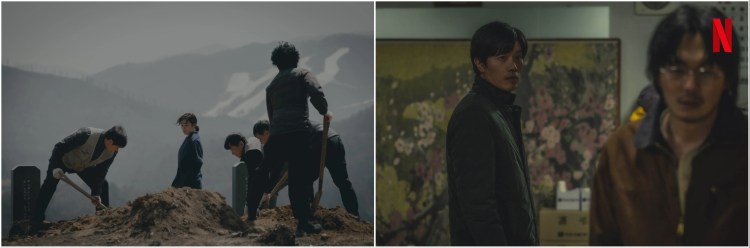
Left: Kim Hyun-joo (second from left), protagonist of The Bequeathed, puts to rest the last of her long forgotten relatives in her inherited burial ground. Right: Also in The Bequeathed, Park Hee-soon (left) delivers an understated, nuanced performance as a fastidious detective while his disheveled costar, Ryu Kyung-soo (right), gives one of the worst performances I’ve seen in a Korean drama.
Starting in alphabetical order, I suppose, The Bequeathed follows the convoluted journey of protagonist Kim Hyun-joo through her enigmatic familial history after a previously unknown paternal uncle (Kim Jae-geon) dies amidst suspicious circumstances, leaving the former as the sole heir to the latter’s property, a mysterious family burial ground in a nearby town. The uncle’s death, likely at the hands of a local cabal of religious fundamentalists, may be the inciting incident of this narrative, but the rapid discovery of the cause of his demise by detectives Park Hee-soon and Park Byung-eun (the exception to this essay’s theme of questionable, distracting side characters) shift the focus of The Bequeathed to the sordid, cryptic family tree behind Hyun-joo’s uncle. Long story short, a previously unknown half-brother (Ryu Kyung-soo) to Kim Hyun-joo as well as other mystery family members I won’t spoil here crawl out of the woodwork to complicate Kim’s life after her uncle’s funeral and her unfaithful husband, Park Sung-hoon, is later violently murdered.
Ryu and his cryptic relatives, most of whom reveal themselves to be antagonists before the series ends in six brief episodes, give tiresome, one-note performances to match their simplistic, one-note characters. Ryu in particular overacts the personality of a homeless drug addict and crazy person in every scene he’s in despite his character being neither homeless nor addicted to any substances. His hair and makeup, much like another “memorable” supporting character in A Killer Paradox, add to his cartoonish persona and give the viewer whiplash whenever the show transitions from its grounded, gritty murder-mystery tone to a cable television soap opera.
In similar fashion, Paradox builds its main character, Korean-Canadian lead Choi Woo-shik, into a sort of moral guineapig who mulls the personal and legal consequences of vigilantism, personal vengeance, and anger management, but undoes much of that introspective journey thanks to simplistic, cornball side characters who devolve their show’s overarching neo-noir thriller into a cheesy melodrama. The show essentially morphs into a longer Korean version of Shyamalan’s Unbreakable (2000, 2016, 2019) by the time Kim Yo-han debuts in the fourth episode as a sort of nerdy, out of shape “live-action cartoon” version of an Alfred Pennyworth or Robin archetype. The show grows more predictable still once antagonist Lee Hee-joon arrives to play a dark inversion of Choi’s character (both have a Sixth Sense [1999] for detecting criminality amongst strangers), but even prior to their confrontation, the series already segued into multiple subplots with castmembers Lim Se-joo, Roh Jae-won, et al. that don’t go anywhere.
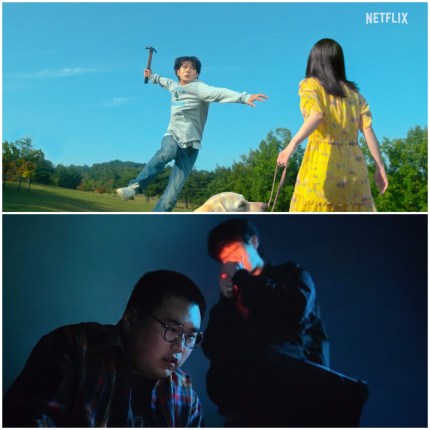
Lead Choi Woo-shik of A Killer Paradox demonstrates his vengeful side in a darkly comedic metaphorical sequence (top), but that emotional rage is tempered once he encounters Kim Yo-han’s corny stereotype (bottom) in the latter half of the series.
What makes these often cheesy, sometimes pointless side roles so frustrating is how capable the tone, camerawork, setting, and overall direction of both series are. When they’re given time to breathe outside the distracting, overacted performances of multiple side characters, The Bequeathed and Paradox showcase relatable, engrossing choreography of realistic cinematic violence and pace their investigative procedural elements well. The former utilizes great handheld cinematography while the latter makes ample use of super slow-motion to heighten tension during and before fight sequences, respectively; Paradox’s extensive parallel editing also incorporates flashbacks and dream sequences in creative, unpredictable patterns to illustrate its lead’s deteriorating mental state.
Mix all the aforementioned into a charismatic, consistent neo-noir lighting scheme complemented by harsh shadows, moody sound-design, and dynamic contrast of urban and rural infrastructure, and both The Bequeathed and A Killer Paradox should be easily recommendable Netflix gems on par with My Name (2021), The Green Frontier, Delhi Crime (both 2019), and Dear Child (2023). In other words, both limited series may resemble a common filmmaking phenomenon where mediocre to bad scripts are elevated through the herculean efforts of cinematographers, editors, and directors most of all. Both series have interesting enough if derivative premises — cryptic seedy family legacies that invite criminal conspiracy (e.g. Crimson Peak [2015]) and characters spiraling into a depressed state of self-destructive outbursts (e.g. Taxi Driver [1976]) —- that dovetail with their detective procedural thriller B-plots; but their bloated casts and inconsistent supporting performances have too much influence on their teleplays for me to recommend them.
———————————————————————————————————————————————————————————
SUMMARY & RECOMMENDATION: As enticing as their paragraph-sized summaries on the Netflix main menu read, the half character study, half crime drama miniseries of The Bequeathed and A Killer Paradox showcase the drawbacks of excessive characterizations and haphazard casting choices even within the subscription video on demand media ecosystem. Questionable hair, costume, and makeup combine with unnecessary or plain bad performances in several key roles in both series to kneecap their narrative flow, tone, and ultimate conclusions.
— However… the lead roles of both series coalesce with creative neo-noir audiovisual direction to produce the sort of warped crime thriller or crime thriller-adjacent diegeses for which Korean cinema has become famous (e.g. The Chaser [2008], Mother [2009], Time to Hunt, Night in Paradise [both 2020], The Witch [2018, 2022]).
—> ON THE FENCE
? Did the writer of A Killer Paradox not realize that the stereotypical, mainstream superheroes Kim Yo-han displays in his apartment — Batman, Superman, etc. — typically don’t kill their enemies?

 Express Elevator to Hell
Discussion
Trackbacks/Pingbacks
Pingback: ‘Ratsasan’ (2018) & ‘V’ (2020): What Genre(s) Are Serial-Killer Movies? | Express Elevator to Hell - May 30, 2024
Pingback: Another Korean Genre Sampling: ‘Believer’ (2018) & ‘Ballerina’ (2023) | Express Elevator to Hell - September 1, 2024
Pingback: ‘Bangkok Breaking’ (2024): Over-the-Top in Every Way | Express Elevator to Hell - November 24, 2024