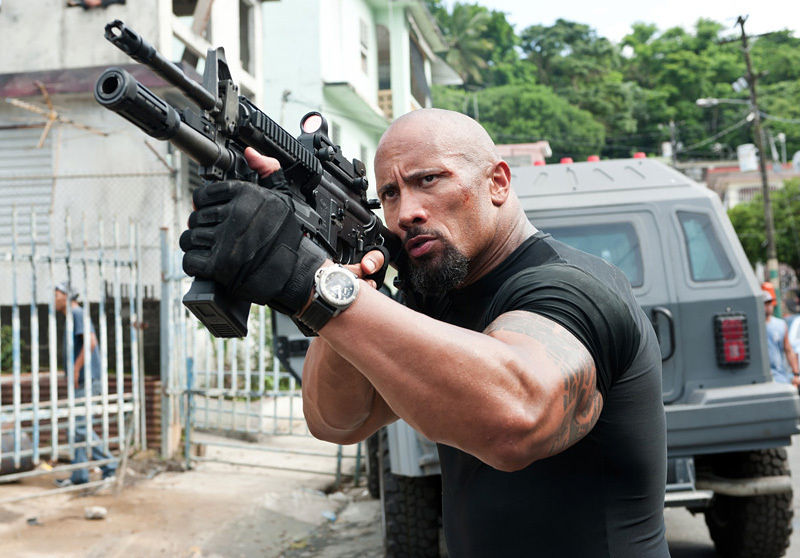
Introducing The Rock Franchise-Saver 9000!
Some time in the early 2000s, my fellow small-town, Midwestern citizens got excited over another non-distinct, brainless summer action movie called The Fast and the Furious (2001). It starred then unknown actor Paul Walker and recent breakout “star” Vin Diesel, the latter of whom had previously broken onto the map from the low-budget sci-fi film, Pitch Black (2000). It also starred one of my least favorite actresses to date, Michelle Rodriguez, plus a few other no-names. The movie didn’t look up my alley at all, because while I was (and still am) into action movies like any hot-blooded male adolescent, the story seemed enamored with cars, street-racing, and brain-dead, shallow characters played by non-charismatic actors driving around in toothless PG-13 action sequences and cartoony, CGI stunts.
Turns out I was completely right. I didn’t enjoy the movie at all, but it killed two hours of my time for free (I saw it on DVD, not in theatres, thank God) and I checked off another dull, monotonous pop-culture reference that dumb rednecks and the dimwitted masses would constantly ask if I had seen to back up my totally justified cinematic snobbery.
Years passed from 2001 to 2006 and beyond, and I noted with passing interest as the series devolved with fewer returning stars and increasingly laughable titles with each new entry; 2 Fast 2 Furious debuted in 2003 as the first sequel without Vin Diesel and starring new cast members Tyrese Gibson and Ludacris alongside Walker; then, The Fast and the Furious: Tokyo Drift emerged in 2006 without either Walker or Diesel or any of the main cast, simply starring a new soon-to-recurring minor character called Han Seoul-Oh (aka “Han Solo“).
Assuming the franchise was dead at this point, its box office returns having dipped with its less marketable casts and ludicrous titles, imagine my surprise when the franchise rose from its grave with the 2009 film Fast and Furious (they took at the “the’s“) with Walker, Diesel, Rodriguez, and others from the original 2001 cast returning and nailing the series’ highest gross yet, over $360 million. Congratulations?
Amused as I was by this, little did I know that the dumbest moments of the furiously fast franchise were yet to come. At least at this point, critics were able to divorce themselves from the massive hype of the dimwitted, popcorn-eating masses and call out these movies for what they were, but as soon as the franchise added Dwayne ‘The Rock’ Johnson and diluted itself from niche dumb action schlock to generic mainstream action-schlock, nearly all critics inexplicably started to go along with it. Here is a summary of the entire 7 10-film canon thus far with each film’s budget, box office, and Rottentomatoes ratings:
| Film | Rotten Tomatoes | Budget | Box Office |
|---|---|---|---|
| The Fast and the Furious | 54% (154 reviews) | $38 million | $207 million |
| 2 Fast 2 Furious | 36% (161 reviews) | $76 million |
$236 million |
| The Fast and the Furious: Tokyo Drift | 38% (138 reviews) | $85 million | $158 million |
| Fast & Furious | 28% (177 reviews) | $85 million |
$363 million |
| Fast Five | 77% (204 reviews) | $125 million |
$626 million |
| Fast & Furious 6 | 71% (211 reviews) | $160 million |
$788 million |
| Furious 7 | 82% (277 reviews) | $190 million |
$1.52 billion |
| Fate of the Furious | 67% (314 reviews) | $250 million |
$1.26 billion |
| F9 | 59% (315 reviews) | $200 million |
$716 million |
| Fast X | 56% (310 reviews) | $340 million |
$714 million |
| Untitled 10th Film, Part II | – | – |
– |
As you can see, up through Tokyo Drift, (The) Fast and (the) Furious (henceforth, FF) movies’ budget/profit ratio steadily declines, but once main stars Walker and Diesel return for the article-free fourth entry, the box office spikes again. Once the franchise fully abandons its redneck street-racing roots and embraces generic blockbuster action like heists-on-wheels (Fast Five) and car-terrorists (Furious 6 and 7), not to mention adding Dwayne Johnson’s big name and charismatic screen presence, the series kicks it into high-gear —- from a profit-making and cultural acceptance standpoint, not in terms of actual quality, mind you.
The only thing that separates these later films post-Fast and Furious (2009) from the series’ genesis is that the films’ action formula has changed ever so slightly from a dumb, macho street racing-focus to a more generic, all-inclusive action menu highlighted by occasional nods to the franchise’s drag-racing origins. FF still has fast cars and goes vroomvroom(!), but it’s intermixed with a healthy, more mass-audience-appealing vanilla mix of action features (shootouts, hand-to-hand fisticuffs, shootouts and hand-to-hand fisticuffs in the middle of car chases, etc.). From a marketing perspective, the choice to change up the series framework starting with Fast Five was a stroke of genius. This shift in series’ formula has coincided with massive surges in box office success and mainstream acceptance of the franchise, so much to the point that even critics are now jumping on the bandwagon, forking over “Fresh” Tomatometer ratings by implementing the same low standards and limited context most mainstream film critics employ when giving Thor (2011) or other Marvel movies a pass as well.
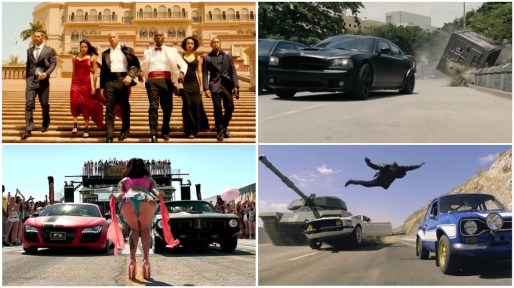
Fast and Furious: Because… faaaaaaamily!
In actuality, though, despite years of box office slump-to-homerun recovery and a full rebooting of the original cast, not much in the series has changed. The things that kept me from falling in love with the franchise with the first film are the same things that keep me from joining the hype-train with the fifth, sixth, and seventh. I just can’t get into the characters or the cast playing them for the life of me, in particular Paul Walker’s wooden performances as the same, skinny white cop-gone-bad and Michelle Rodriguez as the same wannabe “badass” Latina she plays in every film. None of these characters are interesting to me, and given all those slow talking parts in the stories, they count against these movies in a big way. I’m a fan of Diesel’s work in Pitch Black (2000, Riddick is probably one of favorite film characters), but he’s not given much to work with here other than stand around with that incoherent baritone growl of his and look tough. As an action-star, he has zero screen presence and I can barely understand what he’s mumbling during half his lines. Dwayne Johnson’s casting was a (marketing) stroke of genius and he’s a much more charismatic presence than either Walker or Diesel, but he’s barely in any of these movies other than Five, where he plays a supporting role. Throw in fairly bland, vanilla narratives with the thinly drawn characters and you have the big “dumb” part of these supposedly “dumb but fun” movies.
It’s hard for me to overlook the lack of substance in these films however stylish the chase sequences may be. A few cool scenes here and there like the tank-chase in 6 and the favela-shootout in Five are neat, but numerous set-pieces like the endless runway at the end of 6, the train heist at the beginning of Five, and most every action-sequence from films 1-4 oscillate between silly and ridiculous; and by ridiculous, I don’t mean ridiculously awesome or over-the-top, I mean fake and cartoonish and dumb. Not exactly cream-of-the-crop, action-wise, if you ask me.
If we overlook the bad acting, cornball lines, and laughably thin plots from film to film and just focus on the action, which is the main defense of this series, I struggle to find things to laud or praise as “awesome.” Even ignoring foreign action-flicks like The Raid films (2011, 2014) or Snowpiercer (2014) or various other Asian thrillers, which feature everything from superior fistfights to shootouts to brilliant car-chases themselves, even if we just focus on Western English-language options, I can’t help but point out the plethora of better options. The Hollywood studio releases have been weak these past fifteen years, sure, but there are numerous exceptions and great lower-budget stuff, such as:
- Casino Royale (2006)
- The Bourne Trilogy (2001, 2004, 2007)
- John Wick (2014, 2017, 2019)
- Dredd (2012)
- The Winter Soldier (2014)
- The Expendables (2010)
- District 9 (2009)
- Rambo (2008)
- Collateral (2004)
- Fury Road (2015, aka Fast and the Furious for grownups)
- Kill Bill (2003-2004)
- Mission Impossible: Ghost Protocol (2011), Rogue Nation (2015), Fallout (2018)
- Django Unchained (2012)
Even if we ignore the issues of plot and characterizations, which I argue are laughable in every FF and superior in every film listed above, FF pails in comparison from an action-standpoint to all these aforementioned features. To some extent, FF suffers from the suffocating restrictions of the mass audience-friendly PG-13 rating, but films like The Winter Soldier, Casino Royale, and The Bourne series produce great action — including car chases — within the same rating. FF’s action just isn’t up to par as an action series, so I have no idea why this series remains so financially successful, let alone critically acceptable, other than people’s familiarity with the brand name and general critical apathy.
Maybe some of those films listed are high bars to compare a FF film to, but if so, that assertion makes my point that this series is painfully mediocre and overrated. I just don’t get the appeal.
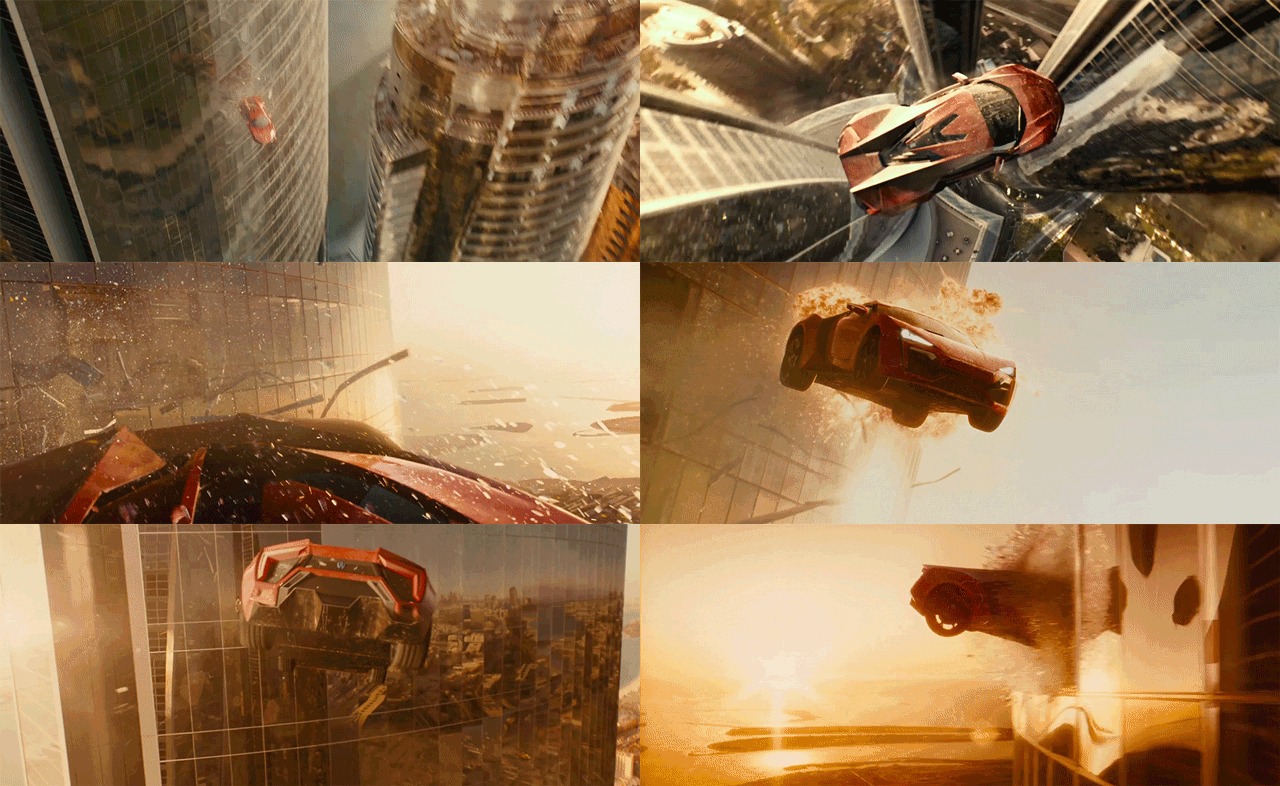
Furious 7…
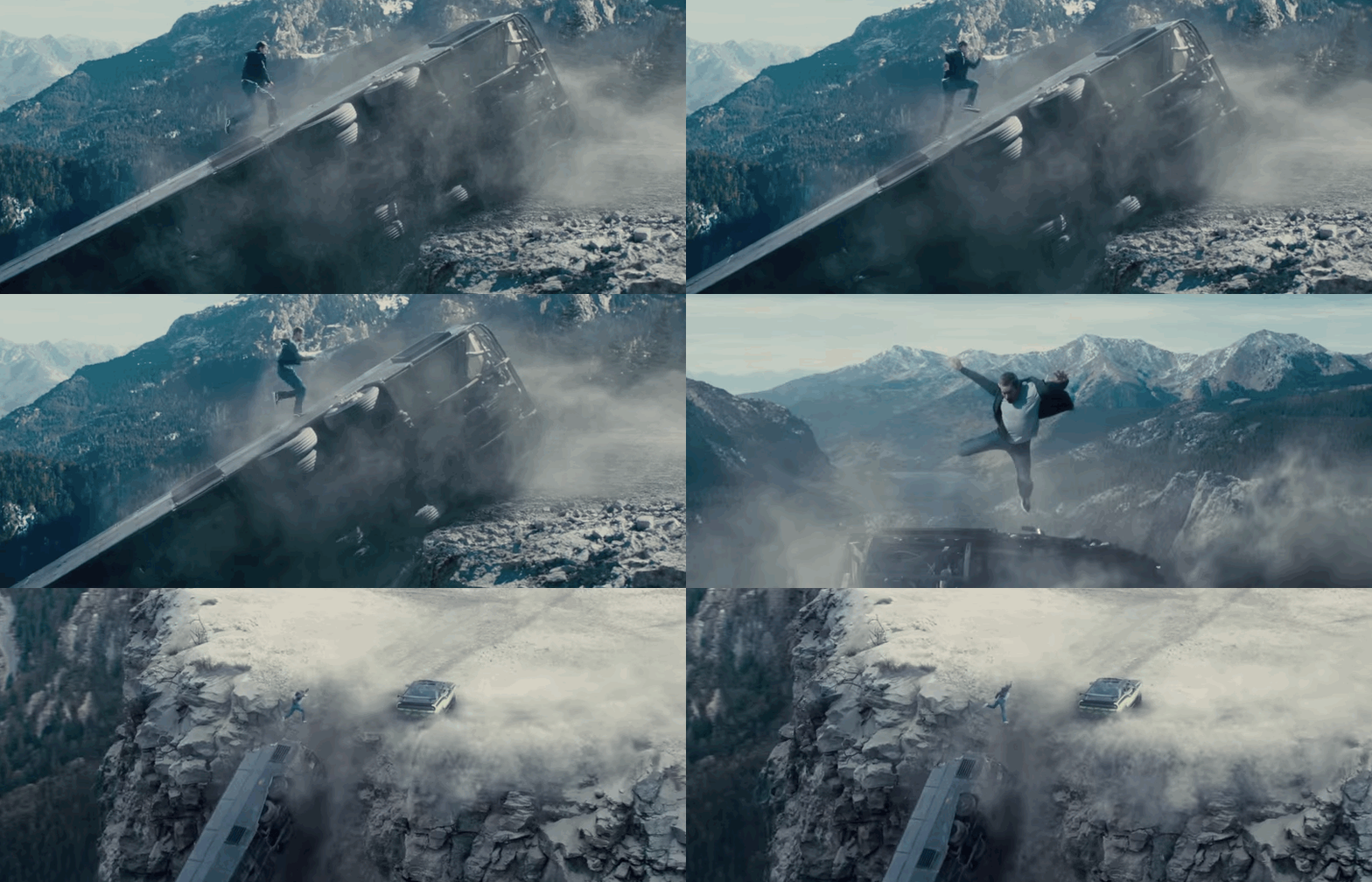
…because the first six weren’t ridiculous enough.
I understand some critics want to give a nod to the series’ ethnically diverse cast and “strong female characters,” yet I can’t help but compare those arguments to how Paul Feiges leans on the faux feminine empowerment angle for his painfully unfunny Melissa McCarthy comedies that everyone loves, or the way Tyler Perry uses minority casts and Christian themes to mask the fact that his movies are exploitative trash. Moreover, movies don’t (or at least they shouldn’t) get artistic points simply for being culturally sensitive.
My point is that this franchise is not lasting as long as it has because it is a worthy franchise, but like most any superhero blockbuster or Avatar (2009), it has managed to appeal to as many filmgoers as possible. Its bland homogeneity appeals to the lowest common denominator. It provides mass audience-friendly action (big crashes with flashy cars, loud explosions, little in the way of blood, gore, adult language, or brutal combat) and features a plethora of good looking stars. It checks every box in the generic PG-13 action blockbuster list with ease. To that end, the stylized action elements of these films hardly break mediocrity even without looking beyond the mainstream hits of Hollywood.
What does impress me is the series’ miraculous resurgence from mild cult hit status to cultural irrelevance and obscurity to box office dominance and mainstream acceptance. Who could have predicted the vehicle for mainstream success for a muscled, charisma-free Vin Diesel and a wooden Paul Walker would come from this series following the straight-to-DVD quality release of Tokyo Drift? I certainly did not. Too bad it couldn’t have happened with a better franchise that had some legitimacy to begin with.

 Express Elevator to Hell
Discussion
Trackbacks/Pingbacks
Pingback: ‘Dungeons & Dragons’ (2023): If at First You Don’t Succeed… | Express Elevator to Hell - April 14, 2023
Pingback: ‘The Queen of Black Magic’ (2019): Villains Always Want Revenge | Express Elevator to Hell - May 21, 2023
Pingback: ‘Extraction 2’ (2023): Fun Yet Frontloaded Violence | Express Elevator to Hell - July 1, 2023
Pingback: ‘Chungking Express’ (1994): Dreams Don’t Make Sense, & Neither Do Wong Kar-wai’s Love Stories | Express Elevator to Hell - August 22, 2023
Pingback: ‘Killer Book Club’ (2022): Copycat Slashers in Spain | Express Elevator to Hell - September 1, 2023
Pingback: Telugu Reviews, Volume 8: ‘Parugu’ (2008), ‘Major’ (2022), & ‘Adipurush’ (2023) | Express Elevator to Hell - September 23, 2023
Pingback: ‘Dune’ (2021, 2024): The Box Office Dollars Must Flow | Express Elevator to Hell - March 7, 2024
Pingback: ‘Born to Fly’ (2023) & ‘Fighter’ (2024): ‘Top Gun’ Copycats | Express Elevator to Hell - May 7, 2024
Pingback: ‘Kingdom of the Planet of the Apes’ (2024): The More Things Change | Express Elevator to Hell - August 24, 2024
Pingback: ‘Black Storm’ & ‘Blade of Fury’ (2024): Qin Pengfei’s Modernized Kung Fu Cinema | Express Elevator to Hell - March 21, 2026
Pingback: ‘Mayhem!’ (2023) & ‘Lost Bullet 3’ (2025): More French Ultraviolence | Express Elevator to Hell - March 21, 2026