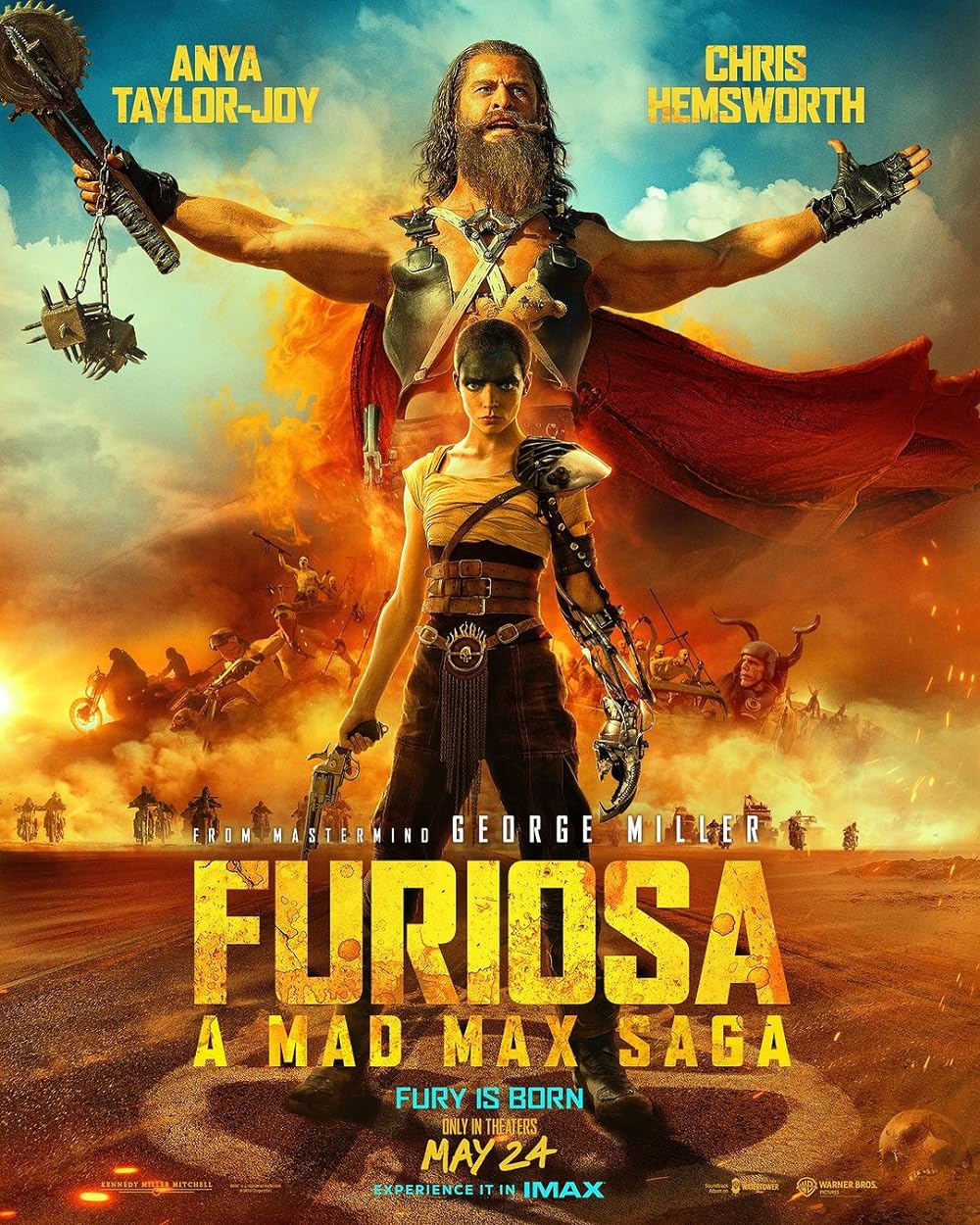
Directed by: George Miller || Produced by: Doug Mitchell, George Miller
Screenplay by: George Miller, Nico Lathouris || Starring: Anya Taylor-Joy, Chris Hemsworth, Tom Burke, Alyla Browne, Lachy Hulme, George Shevtsov, John Howrd, Angus Simpson
Music by: Tom Holkenborg || Cinematography: Simon Duggan || Edited by: Eliot Knapman, Margaret Sixel || Country: Australia, United States || Language: English
Running Time: 148 minutes
When I first caught wind of the marketing for Mad Max: Fury Road (2015) around 2014, I was not overly excited given how I had only watched the first Mad Max (1979) a year or so earlier. Max Rockatansky, portrayed throughout the eponymous franchise’s first three entries by Mel Gibson in his breakout role and in Fury Road by Tom Hardy, didn’t hold my attention until the first sequel, Mad Max 2 (also known as The Road Warrior [1981] in the United States). Most critics and fans have long considered the latter not only the best of the Mad Max franchise, but one of the best action films ever made until Fury Road released to even greater acclaim in 2015.
While the third Mad Max film, Beyond Thunderdome (1985), remains the forgettable middle-child of the series and was a wet fart of a viewing experience for me after seeing Fury Road three(!) times in theatres, most of the cinephile community appeared happy to ignore that and the first film when gearing up for Furiosa. George Miller, the auteur filmmaker behind Mad Max, waited nine years and a non-franchise flop (Three Thousand Years of Longing [2022]) to release his prequel to Fury Road, Furiosa, which told the backstory of the eponymous breakout character introduced in Fury Road and portrayed therein by Charlize Theron. Hailed by many commentators as the true lead figure of Fury Road and an understated genre heroine in the vein of Sigourney Weaver’s Ellen Ripley (see Alien [1979, 1986, 1992]), demand for a Furiosa prequel-spinoff amongst cinephiles peaked before the COVID-19 pandemic but fell well short of commercial success once the actual film dropped earlier this year. This latest Mad Max franchise expansion — the first to not include the series’ title character — is now often held as a regrettable example of one of the better, if not the best of the 2024 box office flops.
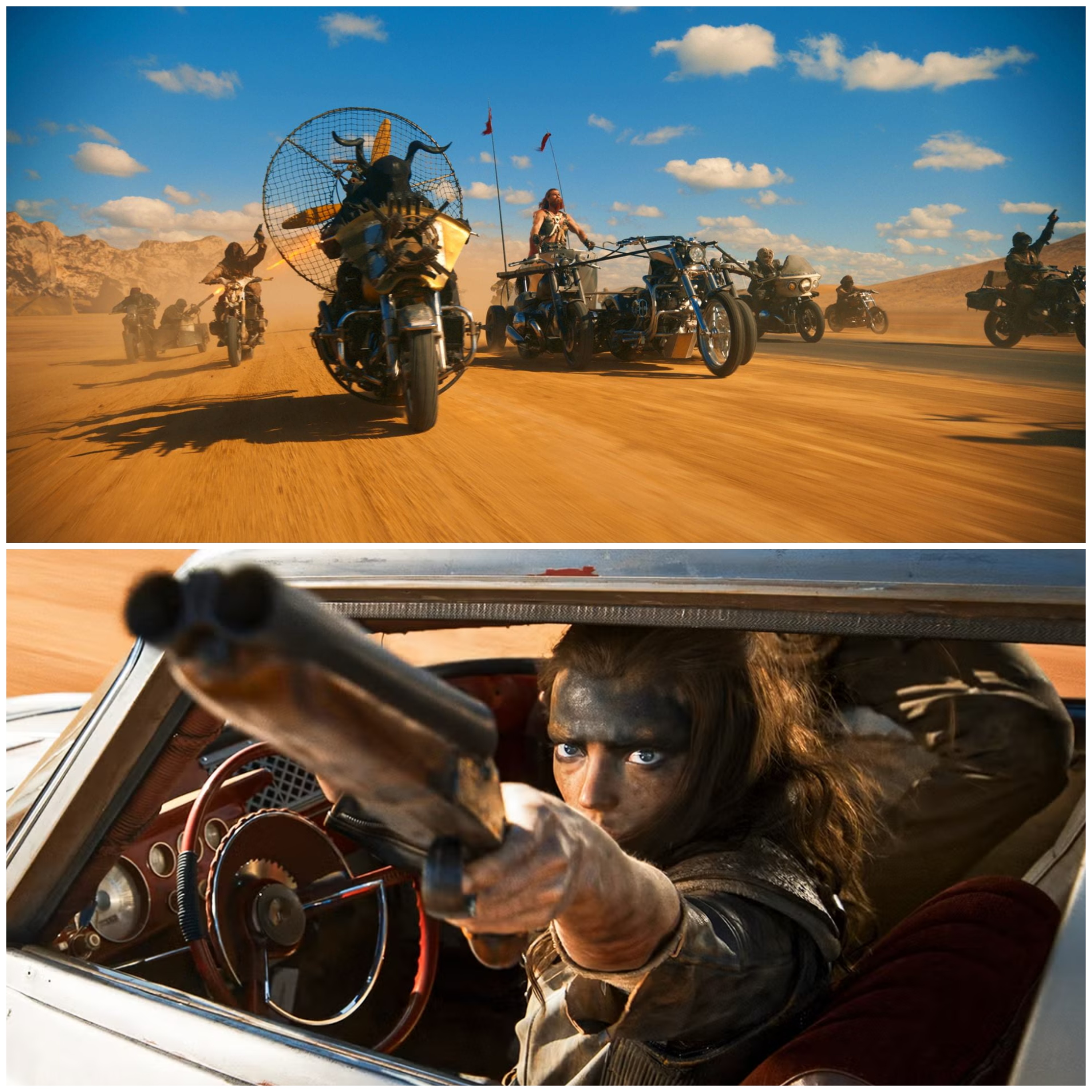
When Furiosa’s visual FX are limited to extensive color-grading with a modest number of elements on screen (top), or when the action is framed in medium to close-up shots (bottom), the post-apocalyptic setting works. Otherwise, the movie looks like a cartoon.
Is Furiosa worth the critical hype and that cinephile goodwill, however? While I enjoyed my time with the film, I did not rush to see it in theatres and now feel as if my initial hesitation toward the film’s lackluster trailers was justified. I feel that, in short, the overall positive reaction toward the prequel-spinoff by critics in particular and the few audiences who patronized it are a function of (a) general professional goodwill toward Miller for his innovative work on Fury Road, and (b) fan biases in favor of the niche franchise, respectively. Why? Besides the movie’s inexplicable 2.5 hour runtime (the bane of my existence, nowadays), Furiosa both lacks consistent forward narrative momentum, meandering from set-piece to set-piece without much tension or urgency, and resorts to obvious computer generated imagery (CGI) for everything from stunt doubles to composite backgrounds to pyrotechnics.
That is not to say Furiosa is a bad movie — far from it. Miller defines Furiosa through his clear artistic vision of post-apocalyptic mayhem and desert iconography that made his previous Max films — even the bad ones (e.g. Beyond Thunderdome) — so identifiable. From start to finish, Furiosa’s impeccable art-design eases the viewer into the story across a variety of semi-arid to arid landscapes and dozens of (too many) characters. The costume, hair, and makeup departments work overtime a la Fury Road to illustrate character personalities without superfluous dialogue, while vehicle-designs are dieselpunk aesthetics at their finest.
Most of the performances and main characterizations are effective too, holding non-franchise fans’ attention when the special FX frequently go overboard. Lead Anya Taylor-Joy works as a younger version of Theron’s character, as does Alyla Browne for the character’s preteen to adolescent stages. The CGI touches on Browne to enhance her resemblance to Taylor-Joy as the former “ages” are also the most impressive digital FX in the film. As for the supporting cast, minor yet notable performances from Tom Burke, Lachy Hulme, George Shevtsov, and John Howard as both new and returning characters from Fury Road are colorful enough. The only true disappointment amongst the cast is Chris Hemsworth as the chief antagonist, Lord Dementus, whose personality is one-note despite his abundant screentime and whose accent shifts unrealistically depending on the scene.
Furiosa’s biggest problem, however, is its overall narrative structure. Beyond its intimidating length, the movie feels like a 5-7 episode limited series condensed to a 2.5 hour feature; Miller jumps his story from action sequence to character building moments to chase scenes with inconsistent narrative pace, often abbreviating set-pieces seemingly at random and refusing to let certain dramatic confrontations breathe. If it wasn’t for both of the film’s major problems of jumbled storytelling and frequent distracting CGI, issues that seem to feed into each other the longer the film lasts, I might’ve found the patience to recommend Furiosa to general audiences.
As the film stands, Furiosa’s length, pacing, and inconsistent visual FX aren’t going anywhere. To say that I remain perplexed by the overwhelming cinephile reaction in favor of George Miller’s latest would be an understatement, yet the filmmaking legacy of Miller and the passionate fanbase of this franchise provide adequate explanations. I can only review a given film based on its execution, though, and Furiosa is miles from not only Fury Road’s smooth thrill-ride, but many, many other quality action films and series I’ve viewed in the nine years since its predecessor’s release.
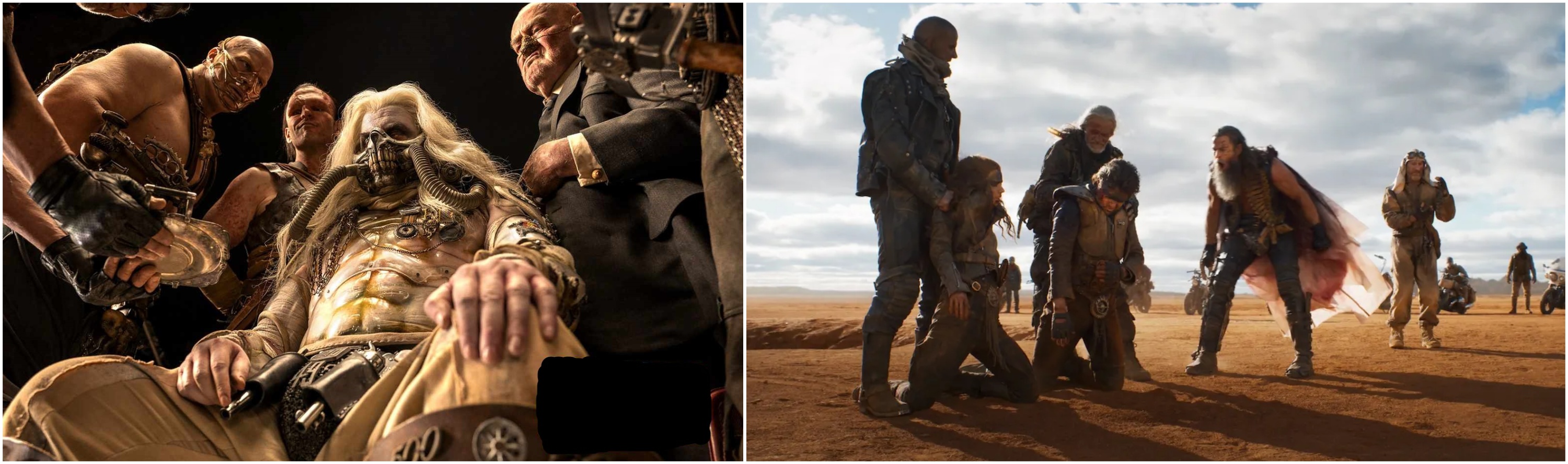
Left: All of the main villains from Fury Road return in some capacity in Furiosa, though some, like Immortan Joe (e.g. Lachy Hulme, center) are portrayed by different actors. Right: Chris Hemsworth (center right) plays an overblown, uncomplicated villain who ranks as one of the less interesting antagonists of the Mad Max franchise.
———————————————————————————————————————————————————————————-
SUMMARY & RECOMMENDATION: As good as George Miller is, his dedication to franchise continuity between his latest two Mad Max films appears to have forced excessive CGI on Furiosa to make his native Australia look like Namibia (Fury Road was shot in the latter, while Furiosa was shot in the former). That, combined with the haphazard pacing of an overly long story better fit for streaming television than a theatrical feature, kneecaps the narrative power of this war rig for yours truly.
— However… most, though not all (e.g. Chris Hemsworth) of the cast give admirable performances as colorful characters, while the artistic design of the post-apocalyptic diegesis remains enticing.
—> ON THE FENCE
? Was the soundtrack for Furiosa almost the same as Fury Road? I couldn’t tell because I barely noticed it this time around…

 Express Elevator to Hell
Discussion
No comments yet.