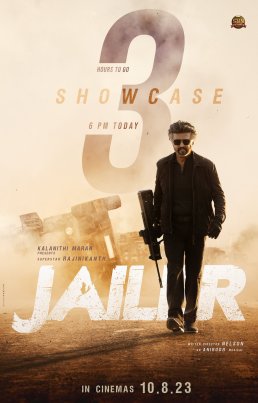
Directed by: Nelson Dilipkumar || Produced by: Kalanithi Maran
Screenplay by: Nelson Dilipkumar || Starring: Rajinikanth, Vinayakan T. K., Ramya Krishnan, Vasanth Ravi, Vasanth Ravi, Tamanna Bhatia, Indukuri Sunil Varma, Yogi Babu
Music by: Anirudh Ravichander || Cinematography: Vijay Kartik Kannan || Edited by: R. Nirmal || Country: India || Language: Tamil
Running Time: 168 minutes
Wiser cinephiles than I have remarked before on the repetitive, tiresome invulnerability of many protagonists in Hollywood blockbusters, superhero films most of all. The likes of Robert Downey Jr. (e.g. Iron Man 2 & 3 [2010, 2013]), Chadwick Boseman (e.g. Black Panther [2018]), Scarlet Johansson (e.g. Black Widow [2021]) et al. from the Marvel Cinematic Universe (2008-2019) and Henry Cavil (e.g. Man of Steel [2013]), Jason Momoa (e.g. Justice League [2017], Aquaman [2018]), and Gal Gadot [e.g. Wonder Woman [2017]) from the now defunct DC Extended Universe in particular are famous for their ironclad, near impenetrable superhero alter egos, even when their characters ostensibly don’t have any innate superpowers at all. Their on-screen abilities rob their films of much of their narrative tension; we already know these characters are goody two-shoes who’ll always do the right thing, but we must also take into account that they’ll defeat the vast majority of their foes without breaking a sweat 99% of the time. These films also rarely suspend disbelief by making the viewer doubt, even just a little bit at the heroes’ lowest point, that maybe, just maybe, these characters won’t win based on formula alone.
If the near universal invincibility of modern (i.e. late 2000s-2020s) Hollywood superheroes irritates me, given how they make the run-of-the-mill macho stereotypes by Sylvester Stallone (e.g. Cobra [1986]), Arnold Schwarzenegger (e.g. Commando [1985]), and Jean-Claude Van Damme (e.g. Bloodsport [1988]) from the 1980s feel relatable, then I don’t know what to tell you about your stereotypical mainstream Indian action stars, Bollywood (Hindi-language), South Indian (Dravidian-language), or otherwise. Popular action movies starring the likes of Salman/Aamir/Shah Rukh Khan in Hindi cinema or Puneeth Rajkumar (e.g. Yuvarathnaa [2021]), Mahesh Babu (e.g. Srimanthudu [2015]), and Saravanan Sivakumar (e.g. Anjaan [2014]), in Kannada, Telugu, and Tamil movies, respectively, generally bore me to tears with their predictable, nonstop slow-motion fight choreography and the way their leading men effortlessly dispatch waves of henchmen before knocking the main villain on their ass.
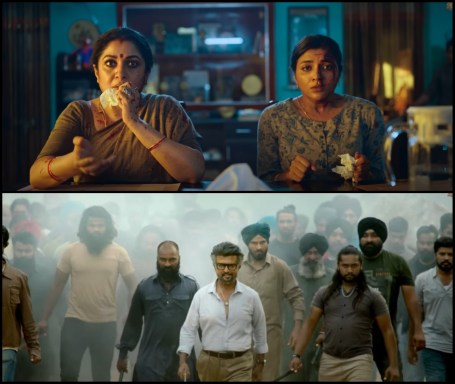
Top: Ramya Krishnan (left) and Mirnaa Menon (right) star as Rajinikanth’s diegetic wife and daughter-in-law, respectively, who both contribute a grand total of nothing to the film. Bottom: At the film’s proper endpoint — but, in reality, the film’s midpoint — Rajinikanth turns the tables on his Malayalam antagonist (Vinayakan, not pictured) with a small Punjab army.
I am a defender of genre formula more than I’m a critic, sure — I understand the good guys are supposed to win in these kinds of movies (for recent partial exceptions, see War for the Planet of the Apes [2017] and No Time to Die [2021]) — but even formula must have reason to it other than pure tradition. Filmmakers must try just a tad harder than that.
In more recent years, Indian action movies have aped the audiovisual style of the Wachowskis’ Matrix (1999, 2003) and Zack Snyder’s 300 (2007) so extensively that they don’t even bother with musical numbers half the time anymore, or if they do, it’s as a single throwaway dance sequence (perhaps an item song?) at intermission or during the credits (e.g. 2.0 [2018]). Shankar Shanmugam’s 2.0, the most expensive Indian production at the time of its release and one of the most digital FX-heavy South Asian blockbusters this side of Baahubali (2015, 2017), is a great case study of the contemporary populist Tamil blockbuster and the generalized Indian superstar: Shivaji Rao Gaikwad, better known by his stage name, Rajinikanth.
Rajinikanth’s latest feature is Nelson Dilipkumar’s fourth film, Jailer, and is only a few spots down from 2.0 on the list of the highest-grossing Indian films of all time as of this writing. Given how my limited exposure to both men’s careers has been overwhelmingly negative (Dilipkumar directed Doctor [2022], which I forgot existed), I steeled myself for a rough time with this movie after noting its runtime of 168 minutes (still typical of mainstream Indian filmmaking, but something I have never gotten used to). I was pleasantly surprised through the first 90-95 minutes, however, as the action sequences are modest in scale and utilize limited computer generated imagery, Rajinikanth (age 72) plays an age-appropriate senior citizen role instead of attempting a 30-40-something character romancing a female love-interest in her late 20s, and Rajinikanth’s lead is given reasonable motivation (the death of his son, supporting actor Vasanth Rav) to drive the story.
After Jailer barreled past the natural endpoint of its story for another 70-ish minutes, though, I realized I had initially given Dilipkumar too much credit; that, or the producers, studio executives, etc. stepped in and pressured him to almost double the film’s length to shove in multiple unnecessary plot-twists, multiple action sequences that add nothing to the plot, multiple pointless guest appearances by Mohanlal Viswanathan, Shiva Rajkumar, et al., a forgettable item song featuring Tamanna Bhatia, and a bizarre, dark ending that clashes tonally with the rest of the movie’s goofy comedy.
By the time Rajinikanth transforms from a capable yet somewhat grounded, relatable hero into a walking, talking cartoon with a small army of cartoon henchmen, you’ll wonder if the main problem of your typical Indian action blockbuster is either (a) their untouchable heroes or (b) their incredible average length. I might argue, particularly in the case of Jailer, that those issues are intertwined to a large extent, where set-piece after set-piece demonstrates how unstoppable our main character is and, thus, how little we should care about whether or not they prevail… because we already knew they would over an hour ago.
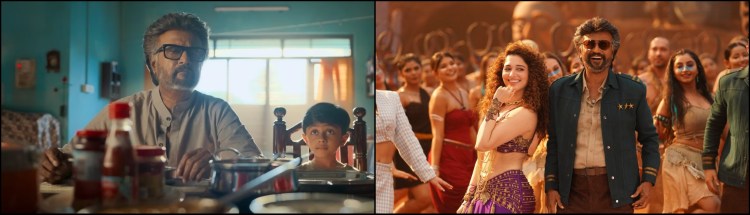
Left: Rajinikanth bonds with his diegetic grandson, credited only as Rithvik. Right: Enjoy a pointless musical number with a cameo appearance by Tamanna Bhatia.
————————————————————————————————————————————————————————————
SUMMARY & RECOMMENDATION: Nelson Dilipkumar’s Jailer is Exhibit No. 231 in the seemingly ubiquitous “ordinary yet somehow extraordinary” Indian badass-action genre, where common professionals ranging from beat cops to college professors to political candidates to prison wardens somehow have the strength and stamina of Black Panther, Iron Man, or Captain America (2011, 2014, 2016), even without all the Vibranium, nanotech, or steroids. Maybe I should stop punishing myself with these types of movies, already.
— However… the first 90 minutes or so of Jailer ain’t half bad when the story isn’t inundated with all the extraneous populist filmmaking bullshit that doesn’t need to be there.
—> Still curious? Jailer is NOT RECOMMENDED, son.
? You ain’t fooling anyone with those ridiculous toupees, Mr. Gaikwad.

 Express Elevator to Hell
Nelson did not direct Etharkkum Thunindhavan. That’s some guy named Pandiraj. Watch Doctor if you havent
Posted by Vaga | October 21, 2023, 11:11 pmCorrected. Thanks for catching that. I reviewed those two movies together (wasn’t impressed by either of them, unfortunately), so that may be why I switched them in my mind while writing this essay.
Posted by The Celtic Predator | October 24, 2023, 1:43 pm