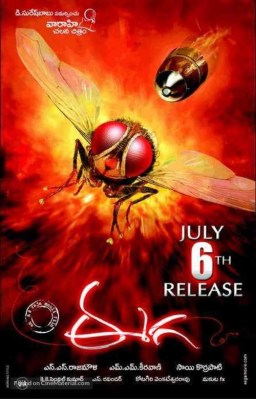
Directed by: S. S. Rajamouli || Produced by: Sai Korrapati
Screenplay by: S. S. Rajamouli, Janardhana Maharshi || Starring: Sudeep Sanjeev, Nani Babu, Samantha Ruth Prabhu, Adithya Menon, Adithya Menon
Music by: M. M. Keeravani || Cinematography: K. K. Senthil Kumar || Edited by: Kotagiri Venkateswara Rao || Country: India || Language: Telugu, Tamil
Running Time: 134 minutes
I’ve long thought that mainstream cinema benefits as much from oddball, bizarre storytelling concepts as it does from talented filmmakers who are permitted reasonable creative control over their projects (e.g. auteurs like Martin Scorsese, Brian DePalma, Francis Ford Coppola, and William Friedkin in the American New Wave movement of the 1970s, James Cameron, John Carpenter, and Paul Verhoeven in later decades in Hollywood). While I’m not a fan of metatextual absurdism as realized in most English-language cinema (e.g. Synecdoche, NY [2008], The Lobster [2015], Everything, Everywhere, All at Once [2022]), I appreciate when filmmakers and the studios that fund them take chances with material beyond blockbuster franchise intellectual properties, and have enjoyed some of Hollywood’s more recent attempts at self-reflexive filmmaking like Cabin in the Woods (2012), Deadpool (2016), and even Jurassic World (2015).
One of S. S. Rajamouli’s films from about a decade ago, Eega (English = “The Fly”), challenged general audiences with its bizarro premise without resorting to either absurdist humor, metatextual commentary, or genre satire. The film tells the story of a man (Ghanta Navee Babu, or “Nani”) who is murdered by a wealthy Hyderabadi industrialist (Sudeep Sandeev, or “Sudeepa”) out of the latter’s jealousy over the former’s budding romance with female lead Samantha Ruth Prabhu, but is then reincarnated as a fly; yes, you read that correctly.
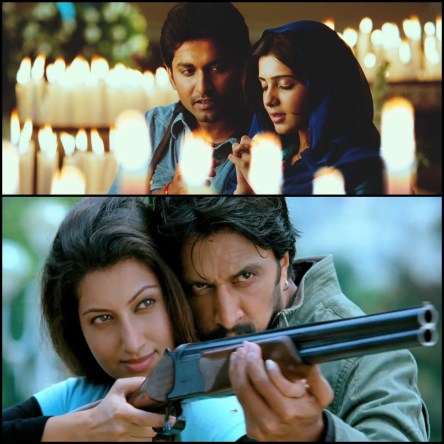
While lead Nani romances his love interest, Samantha (top), the wealthy, powerful villain Sudeepa courts every attractive woman he sees (bottom) and, in a refreshingly realistic bent, grows enraged when Samantha rejects his advances.
Though its first act begins traditionally enough, with Nani courting Samantha while Sudeepa stalks them menacingly from the background, Eega takes a sharp left turn around the half hour mark when Nani’s soul is inexplicably transferred to a larval housefly. The movie henceforth abandons the common romantic musical formula that serves as the bedrock for most popular Indian filmmaking and grows into a fantastical special FX showcase, with almost 90 minutes of its 134-minute runtime dedicated to its insect protagonist, rendered entirely through computer generated imagery (CGI), waging an almost dialogue-free vendetta against his human antagonist.
This is the sort of batshit premise that almost never gets greenlit in major studio filmmaking (e.g. James Wan’s Malignant [2021]), at least not for big-budget features. As crazy as most comic book source material may read in a vacuum, (1) most audiences have become desensitized to the heightened science-fiction attributes of most popular superheroes, from mainstream favorites like Spider-Man to niche properties like Hellboy, and (2) most of those over-the-top characterizations are still humanoid with speech capabilities. It is difficult to overstate how unconventional Eega’s latter two acts feel given its rejection of almost all traditional protagonist traits, as Nani’s live-action performance never returns after his on-screen human persona dies at the hands of Sudeepa’s villain, nor does Nani provide any sort of voiceover or internal monologue to articulate his character’s thoughts. How well the narrative works despite — or perhaps because of — these storytelling limitations is the primary appeal of the picture.
On that note, Eega is one of the few South Asian films to use extensive CGI effectively; Rajamouli’s later filmography (RRR [2022] to an extent and Baahubali [2015, 2017] in particular) suffers from creativity overload to a degree, where his imagination often outstrips his film’s visual FX (VFX) budget; his work often supersedes these limitations, anyway, where others (e.g. Krrish [2003, 2006, 2013], 2.0 [2018], Pathaan [2023]) might falter due to his powerhouse soundtracks courtesy of his cousin, M. M. Keeravani, memorable cinematography from longtime collaborator K. K. Senthil Kumar, and overall strong characterizations brought to life by his venerable acting-direction. Eega’s odd narrative structure restricts its musical components to a lone song-and-dance number (“Nene Nani Ne“), but its emphasis on CGI and extreme close-ups on near microscopic objects allows Kumar to experiment with nontraditional camerawork. Highspeed digital photography, high intensity, high-key lighting setups, substantial racking focus, and extremely long lenses bring the oddball digital FX to life in ways that accentuate the reincarnation fantasy instead of highlighting its absurdity. Perhaps the greatest strength of Eega, in other words, is how its cinematography takes the ridiculous concept of a man avenging his death through an insect avatar seriously, so the audience has permission to do so in kind.
That is not to discount the effective screenplay and supporting performances in selling this wacky premise, either. No doubt because of budget restraints and the difficulty of interweaving CGI with live-action photography across a range of physical scales, Eega wraps at a reasonable two hours and fourteen minutes, which is nearly unheard of in mainstream Indian filmmaking (most Hindi and Dravidian-language crowdpleasers run for 2.5 hours at a minimum). Samantha’s female lead and Sudeepa’s villain are themselves further highlighted once Nani leaves the picture; the former’s collaboration with the titular CGI insect feels oddly endearing, while the latter’s relatable paranoia, physical comedy, and delicious one-liners bring the film’s modest set-pieces to life in conjunction with the memorable VFX.
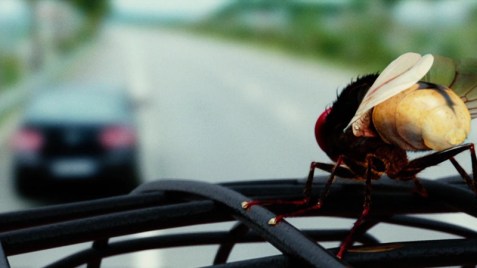
One way director of photography Senthil Kumar sells Eega’s prolific CGI is by shooting much of it on long lenses with extensive racking focus.
With all that said, I don’t mean to say that Eega is a genre masterpiece nor that’s its CGI is seamless. The film is a unique, eclectic entry within Rajamouli’s filmography that emphasizes fantasy and comedy through its VFX instead of trying to make everything look “epic,” which feels like a breath of fresh air to me. In comparison to the recent deluge of Hollywood films referencing the concepts of multiverses to attempt self-reflexive commentary, absurdism, or satire, Eega at once feels more streamlined in its atypical structure but also far more ambitious in terms of its unconventional execution. You don’t need alternative diegetic realities to make your film crazy; just tweak your protagonist a little bit.
————————————————————-
SUMMARY & RECOMMENDATION: Casino Royale (2006) may be the last time a big-budget Western production successfully pulled off a screenplay so far off the beaten path (e.g. its story consists of two halves instead of three acts, the female lead [Eva Green] isn’t introduced until the midway point, the primary antagonist [Mads Mikkelsen] is eliminated before both the final narrative twist and last major set-piece), but Eega may be even more off the reservation structurally as well as directorially. Its FX are not “realistic” in the traditional sense, but given the film’s odd yet meaningful combination of different tones, they sell the arcs of all major characters.
—> RECOMMENDED for those who want something a little different in their blockbuster entertainment.
? Sudeepa should’ve used a flamethrower instead of all those firearms.

 Express Elevator to Hell
Discussion
No comments yet.