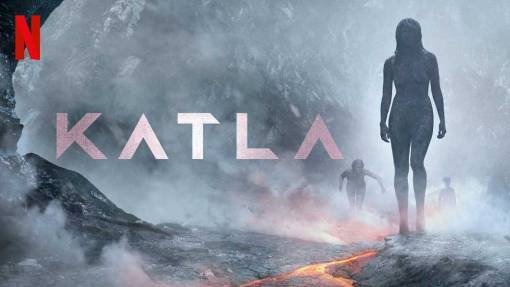
Created by: Sigurjón Kjartansson, Baltasar Kormákur || Written by: Sigurjón Kjartansson, Davíð Már Stefánsson, Lilja Sigurðardóttir
Directed by: Baltasar Kormákur, Börkur Sigþórsson, Þóra Hilmarsdóttir || Starring: Guðrún Eyfjörð, Íris Tanja Flygenring, Ingvar Sigurðsson, Aliette Opheim, Valter Skarsgård, Aldís Amah Hamilton, Þorsteinn Bachmann, Sólveig Arnarsdóttir, Haraldur Ari Stefánsson, Björn Thors, Birgitta Birgisdóttir, Hlynur Atli Harðarson, Helga Braga Jónsdóttir, Björn Ingi Hilmarsson
No. of Episodes: 8 (~360 minutes total)
A general rule I follow with most Netflix Original Series on my personal queue is to wait 1-3 years after their official release before watching them. I find this oddball strategy useful because (1) I often later decide against viewing many series due to a combination of lost interest and limited free time, (2) Netflix often cancels burgeoning series if they underperform, though to many fans’ chagrin, and (3) many shows fall into the gray areas between long-running and limited series. With regards to the latter point, a variety of shows launch on Netflix every year (Squid Game [2021-] is perhaps the most famous example) whose “debut” season could either serve as a self-contained story or as the launching pad for a multi-season arc. I postpone watching most of these shows given my blogwriting habits, seeing as how I find it repetitive at best to write individual reviews for each season of a show that may last anywhere from 2-7+ seasons.
A show that’s lain dormant on my Netflix queue for some time now that I at last finished is the Icelandic mystery-drama — not quite science-fiction, not quite fantasy — Katla, created by writer-producer Sigurjón Kjartansson and longtime writer-director Baltasar Kormákur. Though not classified de jure as a Netflix Limited Series, Katla’s first and presumably lone season is, like Richie Mehta’s award winning debut season of Delhi Crime (2019), a standalone project worthy of dedicated analysis. Katla is far from the dramatic tour de force that Delhi Crime is, to be sure, yet its unique premise and notable cinematic use of its native Icelandic landscapes argue for its consideration by many cinephiles.
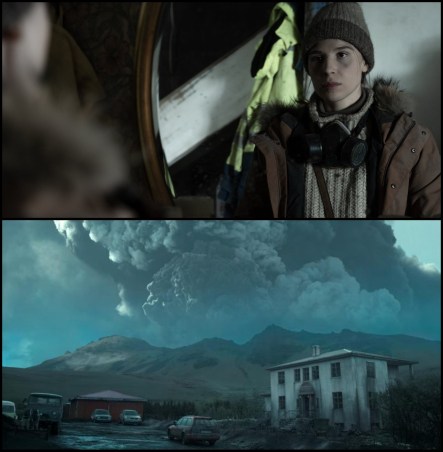
Top: Singer, former footballer, and lead actress Guðrún Eyfjörð examines her reflection in an early episode of Katla, one of many “mirror images” throughout the series. Bottom: Volcanic ash erupts from the titular volcano in the background of most outdoor shots as a constant reminder of its presence.
Katla’s premise concerns semi-surrealist phenomena produced by the frequent eruption of its titular volcano in southern rural Iceland. The nearby village of Vík í Mýrdal (Vík for short), including protagonist and dairy farmer Guðrún Eyfjörð, Eyfjörð’s diegetic father, Ingvar Sigurðsson, local police chief Þorsteinn Bachmann, and Reykjavík vulcanologist Björn Thors, discover a series of doppelgängers of known or presumed dead citizens, of visitors from decades past who haven’t aged a day, and eventually of living townspeople, stumbling from the caverns of Katla covered in volcanic ash. As more doppelgängers crawl from their geothermal crevasses, the locals eventually put the pieces together — at a much slower pace than most viewers will, I’d wager — about who’s who and what the purposes of these changelings are.
Let us first examine the better parts of Katla: Its visual direction and performances. The entire cast feel like real people with relatable problems, and their chemistry is often more effective at conveying the thematic symbolism of the aforementioned supernatural phenomena than the show’s teleplays (more on that in a minute… ). Their relationships are complicated by everything from personal loss (grief over dead family members is a running theme) to the dreary, overcast volcanic landscape of their North Atlantic island. Some of this emotional impact could also be credited to the script, I suppose, but here I default to the subtle yet memorable human faces the cast bring to their roles, as their emotional reaction to volcanic changelings is what sells the impacts of the latter.
As for Katla’s direction, the location-photography featured contrasts starkly with the scenic snowcapped vistas of Iceland captured in mainstream US productions like Batman Begins (2005), Interstellar (2014), Game of Thrones (2011-2019), The Force Awakens (2015), etc., though Katla’s ominous visual tone feels somewhat akin to the parts of Iceland captured in, say, The Northman (2022) or Blade Runner 2049 (2017). The landscapes, weather FX, and soft indoor lighting arrangements create a layer of nonstop melancholy that penetrates most every scene, and often for the better. The series also has the shallowest average depth of field of any work I’ve seen since Army of the Dead (2021), particularly in its tense, stylized close-ups, though that cinematographic choice works miles better in this drama than in Zack Snyder’s action piece because of, well, the requirements of those respective genres.
What holds back the show for me are two things: (1) The 8-episode length and (2) the classical “mystery box” reveal of the show’s bizarre doppelgänger phenomenon. To be as concise as possible, the film’s narrative could’ve wrapped in 5-6 episodes at around 45 minutes each given how glacial (pun not intended) the reveal of each changeling is and how repetitive the emotional beats of those sequences are. Additional seasons of Katla are nonsensical for not only how definitive the conclusion to this single-season narrative is, but also for how stretched episodes 3-6 feel.
Last but not least, the proposed explanation for Katla’s volcanic production of quasi-human clones is clunky at best, delivered entirely through dialogue from Thors in a couple exposition dumps that feel like they were pulled out of the filmmakers’ asses. I give Kjartansson and Kormákur credit for not making an Icelandic riff on Invasion of the Body Snatchers (1956, 1978, 1993, 2007; Lord knows we’ve had enough renditions of that premise), but the revelation they’ve substituted in place of pod people isn’t much more creative, like a less coherent take on Solaris (1972).
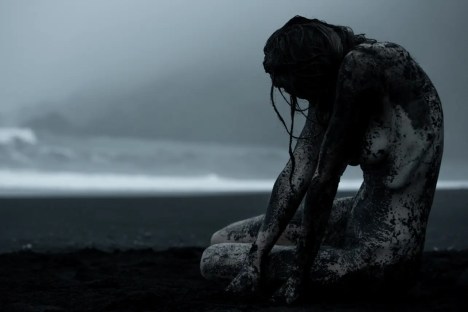
Katla’s changelings always first appear naked but covered in ash.
Katla could never be accused of being derivative of other works despite the plethora of doppelgänger-related cinema out there (e.g. Possession [1981], The Prestige [2006], Enemy [2013], Us [2019]), and I have nothing but compliments for its overall audiovisual style, which is partially a function of its unique choice of location. I remain somewhat underwhelmed by the whole experience after letting the Netflix Original Series marinate on my queue for some time, however; there’s good stuff here, but the cast’s impeccable performances and the creepy thematic imagery are interspersed with too much repetitive telewriting (I won’t say filler) for most audiences to consider it bingeworthy.
————————————————————–
SUMMARY & RECOMMENDATION: Connoisseurs of A24’s style of minimalist filmmaking will enjoy this approximately 6-hour Icelandic meditation on grief and loss given the strong performances, characterizations, and effective geographic backdrops. At the same time, the series has enough cinematographic identity that one doesn’t have to squint to appreciate its visual storytelling.
— However… even general audiences who may have grown more tolerant of introspective, artsier foreign cinema thanks to Netflix’s ubiquity will likely scratch their heads over most aspects of Katla. There’s too much of J. J. Abrams’ mystery box–nonsense here to recommend it outright.
—> ON THE FENCE
? Which version of our main character survived at the end? Which would you prefer?


Discussion
No comments yet.