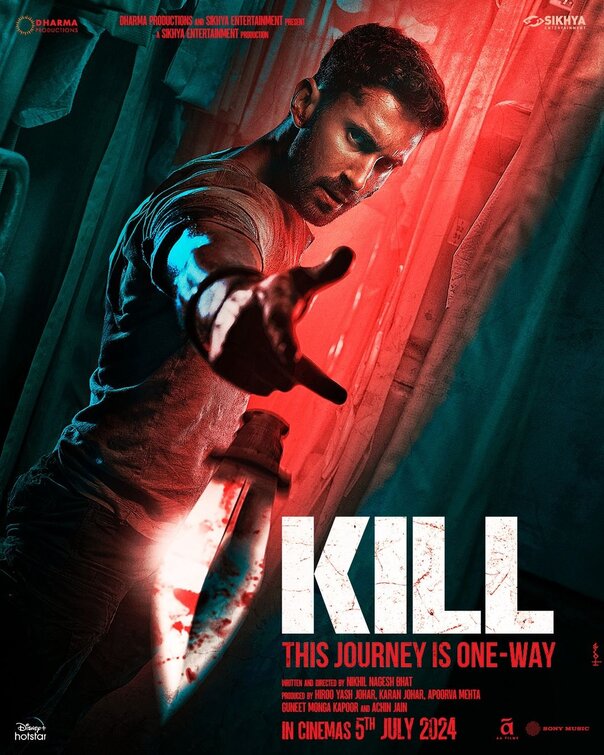
Directed by: Nikhil Nagesh Bhat || Produced by: Karan Johar, Guneet Monga, Apoorva Mehta, Achin Jain
Screenplay by: Ayesha Syed, Nikhil Nagesh Bhat || Starring: Laksh Lalwani, Raghav Juyal, Ashish Vidyarthi, Abhishek Chauhan, Harsh Chhaya, Tanya Maniktala
Music by: Ketan Sodha, Vikram Montrose, Shashwat Sachdev, Haroon-Gavin || Cinematography: Rafey Mehmood || Edited by: Shivkumar V. Panicker || Country: India || Language: Hindi
Running Time: 105 minutes
I have long lamented how uninterested most of the general public is in straightforward, uncensored action films. While it might stretch credulity to expect the average North American, Anglophone, or Western viewer to seek out hardcore, hyperviolent extravaganzas like the works of Timo Tjahjanto or Park Hoon-jung, I still do not understand why adult-oriented action flicks perform so inconsistently in Hollywood when not directed by Zack Snyder (e.g. 300 [2007]), Quentin Tarantino (e.g. Kill Bill [2003-2004], Django Unchained [2012]) or starring Keanu Reeves (e.g. The Matrix [1999, 2003], John Wick [2014–2023]). Action diversity and creativity has improved in the past decade, to be sure, what with the rise of subscription video-on-demand platforms (e.g. Extraction [2020, 2023]) and the success of now mainstream properties like Deadpool (2016, 2018, 2024; see David Leitch’s Atomic Blonde [2017] and Nobody [2021]); but I have accepted that most general audiences will only tolerate, let alone celebrate, unadulterated cinematic violence in theatres under specific circumstances.
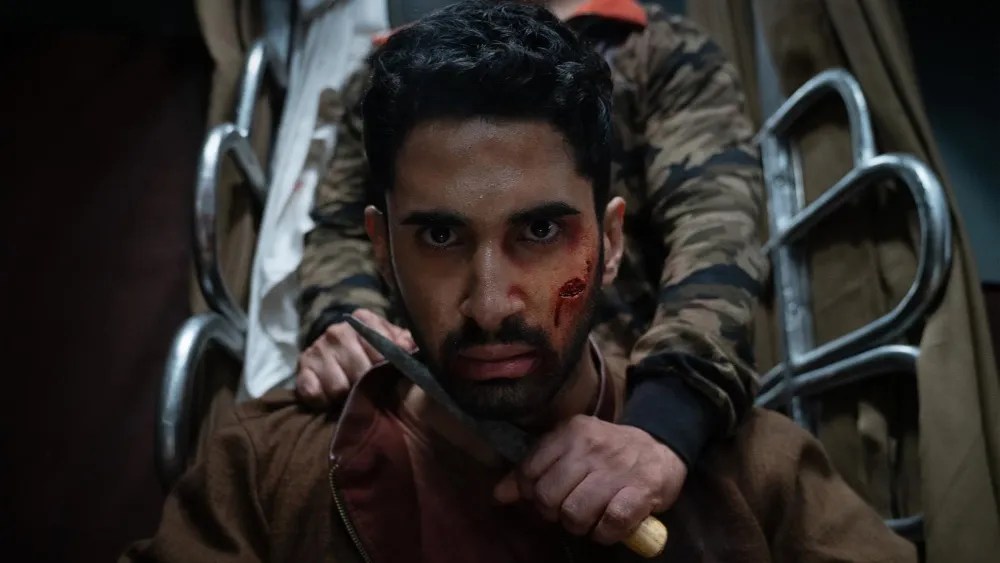
Around the 30-minute mark, a notable plot-development pivots Kill’s story and galvanizes Lakshya’s protagonist, leading to one of the best timed title cards I’ve seen in years.
All the above applies equally, if not more so, to South Asia, where most commercial cinema is expected to house a minimum number of song numbers regardless if they progress the story, intrusive comic relief side-characters no matter whether they fit in their overarching film’s narrative tone, and bland “action” sequences that feel inserted into their parent script at random. The latter have avoided the notorious Hollywood trends of overedited shaky-cam that plagued mainstream American action movies from the late 2000s-2010s (see Bourne [2002, 2004, 2007]), instead aping the speed-ramping techniques of Snyder’s earlier movies to the point of absurdity. Otherwise ordinary (i.e. non-superhuman, non-genetically engineered, non-superhero) main characters dispatching legions of bad guys with the agility and strength of Neo, where henchmen bounce off the ground like a Dragon Ball Z (1989-1996) cartoon, is an ubiquitous trope in masala blockbusters.
Enter Kill by Nikhil Nagesh Bhat, a purebred, hardcore, and yes, violent Hindi action movie whose limited filming locations, brutal hand-to-hand combat sequences, small budget, and short running time beg comparisons to Gareth Evans’ The Raid (2011), which kickstarted the 2010s-2020s Indonesian action wave (see Tjahjanto, mentioned above). Bhat, a burgeoning auteur filmmaker who specializes in shorter, straightforward genre films in contrast with the bloated, 2.5-3 hour masala blockbusters of both northern and southern Indian major studios, is an unsurprising creative force behind Kill. What is far more notable is the Dharma Productions banner that coproduced Kill, a company founded by Yash Johar and run by his son, Karan Johar, since 2004. Dharma has produced and/or distributed, among other things, numerous Shah Rukh Khan vehicles from Kal Ho Naa Ho (2003) to Dear Zindagi (2016), including multiple high-profile films the younger Johar himself has directed (e.g. Kuch Kuch Hota Hai [1998], Kabhi Khushi Kabhie Gham… [2001], My Name is Khan [2010]). To say I have hated almost every directorial credit of Karan would be an understatement, but the man’s producer credits are enviable beyond just their box office statistics and the man has become instrumental in legitimizing business ties between Hollywood and Indian film industries.
As for the movie itself, Kill is the now almost stereotypical — again, amongst niche genre audiences, not mainstream blockbuster cinema — gonzo action movie constrained to a more or less singular location. I would describe it in shorthand as an Indian Raid or Dredd (2012): A small cast of heroes trapped with/outnumbered by a vicious gang of antagonists, where the main characters must fight their way to freedom. Instead of a tactical police squad storming a drug lord’s hideout, however, Kill is incited by a protagonist (Laksh “Lakshya” Lalwani in his feature debut) attempting to “rescue” his diegetic girlfriend (Tanya Maniktala), from — what else? — a marriage arranged by her wealthy father (Harsh Chhaya). Both Lakshya and costar Abhishek Chauhan, the former’s diegetic colleague and close friend, happen to be National Security Guard commandos, a profession that comes in handy when a large group of bandits overtake the main characters’ express train when traveling from Ranchi, Jharkhand to New Delhi.
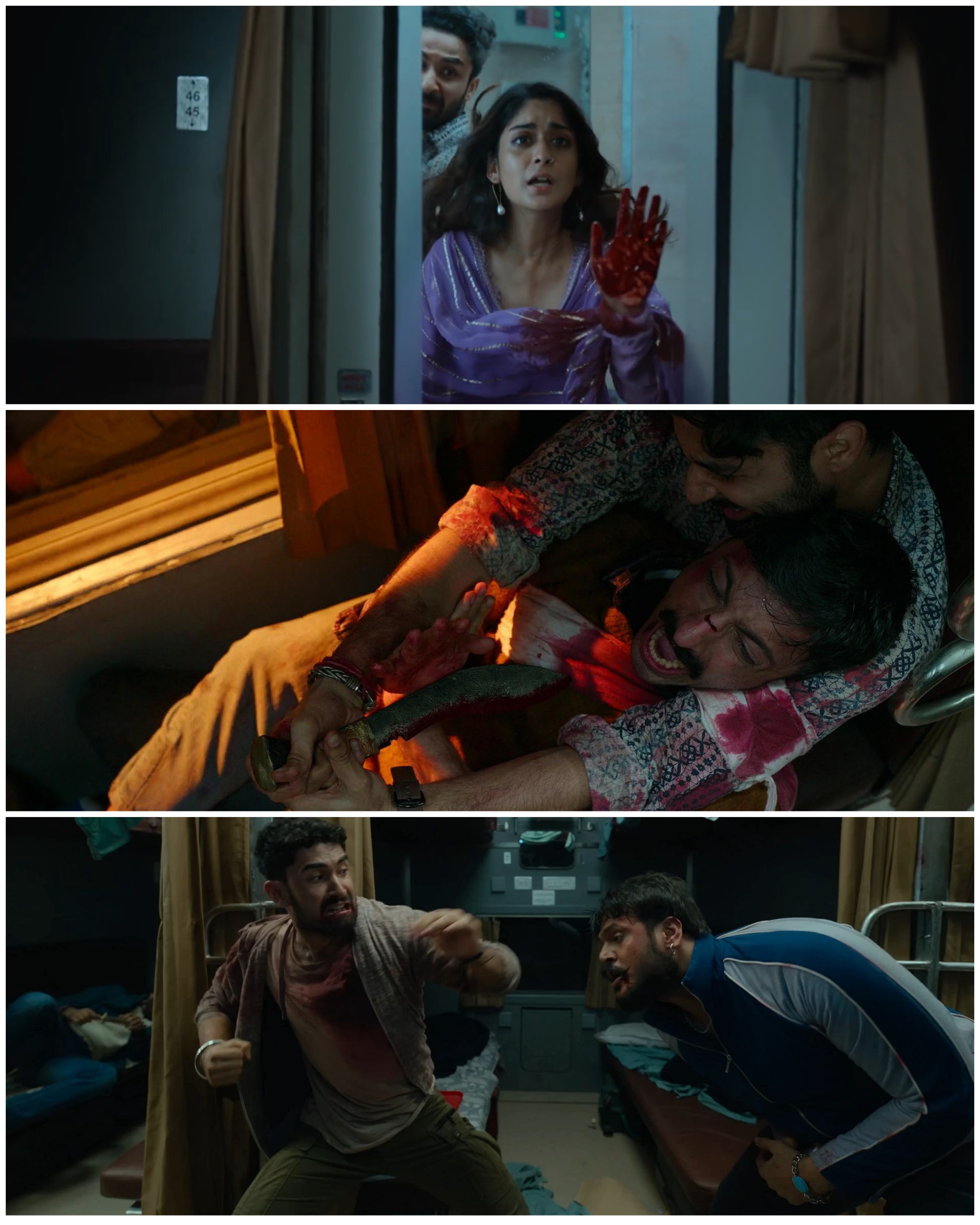
Top: Female lead Tanya Maniktala gets more involved in the action than most audiences might expect. Middle: Raghav Juyal (right) is endowed with a far more developed lead villain than most Indian movies allow. Bottom: Lakshya takes on Parth Tiwari’s 6′ 2.5″ (~190 cm) “heavy” in Kill’s final act. As in most well paced, semi-realistic action movies, the fight choreography grows scrappier the longer the movie lasts and the more desperate the characters become.
This “Die Hard (1988) on a train”-premise sets up the screenplay for success, but Bhat’s acting direction, command of Rafey Mehmood’s action cinematography, and effective set-design make Kill a winner of an action film. Bhat writes all the aforementioned performers as three-dimensional characters and develops them across all three acts despite the movie’s modest runtime (105 minutes); even the main villain, Raghav Juyal (a dancer by trade), is treated with respect and gives arguably the best performance of the entire cast. In terms of action choreography and stunts, Mehood and Bhat take advantage of the tight, confined geography of their train car sets, embracing the realistic fisticuffs and close-quarters combat natural to any indoor melee brawl. Even the train sets, created almost entirely in studio, are wholly immersive and differentiate Kill’s tone, pace, and ambiance from many similar hardcore action films from other industries.
Top to bottom, Kill is a cultural sucker punch from within Hindi cinema. I hope its stylistic, if not financial success (Kill grossed little more than its ₹40 crore/$4.7 million budget) outlives its debut, given how an English-language American remake is on the way from Lionsgate and 87Eleven Entertainment, also known as the studios behind the John Wick franchise. Whether it can generate enough domestic momentum throughout India for unapologetic, auteur-driven genre cinema remains to be seen; but if Dharma Productions and Karan Johar can sponsor a movie like this, I am hopeful more ultraviolent Indian action movies may compensate for the repetitive, generic Pathaans, Jawans, Salars (all 2023), Kalkis, and Pushpas (both 2024) of the world.
———————————————————————————
SUMMARY & RECOMMENDATION: Kill is the sort of straightforward, self-contained thrill-ride I’ve waited to release from an Indian studio for over a decade now. While auteur-driven horror (e.g. U-Turn [2016], Tumbbad [2018]) and a handful of action movies (e.g. Kaithi [2019]) have found middling critical to commercial success across the subcontinent, none have struck so far outside the mainstream as Kill. A solid f%$&ing script, an entire cast of memorable performances, great physical production-values, and tenacious fight sequences make this an easy win for genre fans.
— However… low-budget movies, please stop using computer generated fire FX. Bhat uses them for maybe 30 seconds in this film and they still look horrible.
—> Kill comes RECOMMENDED.
? Can we also please stop with these generic one-word titles? Filmmakers must borrow a leaf from S. Craig Zahler’s movies.

 Express Elevator to Hell
Discussion
Trackbacks/Pingbacks
Pingback: ‘Furiosa’ (2024): A Longer-Winded ‘Mad Max’ Saga | Express Elevator to Hell - January 12, 2025
Pingback: ‘Brij Mohan Amar Rahe’ (2018): Long Live Nikhil Nagesh Bhat! | Express Elevator to Hell - March 12, 2025
Pingback: ‘Pushpa’ (2021, 2024): The Rise & Rule of Telugu Blockbusters | Express Elevator to Hell - March 20, 2025
Pingback: Time in the Joint: ‘Cell 211’ & ‘Black Warrant’ (2025) | Express Elevator to Hell - May 21, 2025
Pingback: ‘Kingdom’ & ‘Ashin of the North’ (2019-2021): Unique Genre-Blending Joseon Drama | Express Elevator to Hell - May 25, 2025