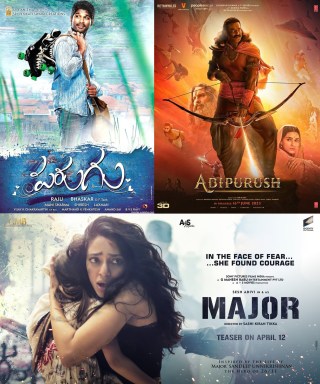
Directed by: Bhaskar Natarajan [1], Sashi Kiran Tikka [2], Om Raut [3] || Produced by: Dil Raju [1], Mahesh Babu, Namrata Shirodkar, Anurag Reddy, Sharath Chandra [2], Bhushan Kumar, Krishan Kumar, Om Raut, Prasad Sutar, Rajesh Nair [3]
Screenplay by: Bhaskar Natarajan [1], Adivi Sesh, Abburi Ravi [2], Om Raut, Manoj Muntashir [3] || Starring: Allu Arjun, Sheela Kaur, Prakash Raj [1], Adivi Sesh, Prakash Raj, Sobhita Dhulipala, Saiee Manjrekar, Revathi, Murali Sharma, Anish Kuruvilla [2], Prabhas Raju, Kriti Sanon, Saif Ali Khan, Sunny Singh, Devdatta Nage [3]
Music by: Mani Sharma [1], Sricharan Pakala [2], Sanchit Balhara, Ankit Balhara, Ajay-Atul, Sachet-Parampara [3] || Cinematography: Vijay K. Chakravarthy [1], Vamsi Patchipulusu [2], Karthik Palani [3] || Edited by: Marthand K. Venkatesh [1], Vinay Kumar Sirigineedi, Kodati Pavan Kalyan [2], Apurva Motiwale, Ashish Mhatre [3] || Country: India || Language: Telugu
Running Time: 169 minutes [1], 146 minutes [2], || 1 = Parugu, 2 = Major, 3 = Adipurush
For newcomers to this site, my interests in Indian filmmaking are primarily a function of their populist narrative formula along with their national film culture’s sheer size; not only does Indian cinema consist of multiple independent, massive industries — often demarcated by region and language, such as the Hindi-language studios based in Mumbai (Bollywood), which play to most of northern India, as well as South Indian Cinema (SIC), a loose conglomeration of Telugu, Tamil, Kannada, and Malayalam-language production houses — but the bread and butter of most of those industries are traditional genre crowdpleasers with decent production values, much like Hollywood. At the same time, Indian cinema’s populist bent trends toward areas where Hollywood is weaker and that best gel with South Asian culture, including an emphasis on song and dance (India remains the last major stronghold of the film musical), explosive, colorful costume-design, and melodramatic, larger-than-life romantic characters. Indian cinema, in other words, recalls the type of genre filmmaking I like in broad strokes while scratching a cinematic itch that the world’s other main blockbuster film industry, that of the United States, doesn’t itch; and much like in US cinema, whenever I get tired of that particular culture’s cinematic mainstays, the filmmaking of Mumbai, Hyderabad, or Chennai are large enough that there always enough smaller, weirder, eclectic — often independent — film alternatives available.

Adipurush doesn’t lack for imaginative, striking visuals thanks to its mythological source material, but its digital execution of most all of them is lacking.
Several interesting trends throughout mainstream Indian cinema in the past decade or so include (1) the spread of Indian film distribution across online streaming platforms like Netflix, which I like, as well as (2) an increase in the typical budget of major studio productions, which can be good or bad depending on the context, and (3) films, from North to South Indian, aping the digital FX, epic scale, and overall visual style of Hollywood franchise movies (e.g. the Marvel Cinematic Universe [2008-2019], The Fast & the Furious [2001-], The Lord of the Rings [LOTR, 2001-2003], The Matrix [1999], Zack Snyder’s entire filmography post–300 [2007], etc.). Some attempts at the latter are stronger (e.g. Baahubali [2015, 2017], War [2019]) than others (e.g. Krrish 3 [2013], 2.0 [2018], Pathaan [2023]), but altogether this trend of cross-cultural artistic pollination concerns me to the extent it makes previously distinct film industries feel like bland copycats of one another (see recent popular cinema from Hong Kong and mainland China).
The films we’ll discuss today, Parugu (“The Run”), a more traditional romantic musical by writer-director Bhaskar Natarajan, Major, a military biopic of the life and death of the late Major Sandeep Unnikrishnan by director Sashi Kiran Tikka, and Adipurush (“First” or “Best Man”), the latest star-vehicle flop for Prabhas Raju by writer-director Om Raut, provide a decent summary of these trends. While modern Bollywood seems to have long ago abandoned much of the musical melodrama that defined its most popular hits (e.g. Dilwale Dulhania Le Jayenge [DDLJ, 1995]), SIC in general and Telugu cinema in particular have a much longer, more consistent track record with diverse genre films (re: not strictly romance or musical melodramas) in the new millennium era.
The most consistent of this bunch is the first, Parugu, which demonstrates the incredible charm and likability of its lead man, Allu Arjun, as both the world’s best wingman to an eloped buddy (Sanjay Vellanki) and as a stylish romantic in his own right. Lead by Arjun’s smooth dance skills and sizeable range, Parugu is your classic DDLJ-esque coming-of-age melodrama where a big city boy wins the hearts and minds around his village girl lover-to-be. Parugu boasts some of the smoothest transitions between dialogue-based dramatic scenes, tense chase sequences, and musical numbers I’ve ever seen, a testament to its impeccable editing as well as its well paced screenplay. Its soundtrack, use of rural village scenery, character blocking, and overall narrative flow congeal so well, again, thanks in part to Arjun’s sheer charisma, that its 169-minute length almost flies by.
Major, by contrast, feels like a much more contemporary 2020s “pan-Indian” production given its slick visuals, inconsistent pacing, and clunky action set-pieces. Co-written by star Adivi Sesh and shot in the glossy, inoffensive style of most Indian or American biographical films, Major makes the mistake of trying to incorporate too much of its central figure’s life into a single feature and feels way too long at 146 minutes. I give the filmmakers credit for not going the jingoistic route in light of how its eponymous character died fighting Lashkar-e-Taiba terrorists in the 2008 Mumbai attacks, but the end result is that Major looks and sounds almost identical to your run-of-the-mill melodramatic South Indian action movie. Instead of trying to make audiences care about his marriage, for example, I believe a gritty, minimalist, cinema-verité style in the vein of Paul Greengrass (e.g. United 93 [2006]) or Kathryn Bigelow (e.g. The Hurt Locker [2009], Zero Dark Thirty [2012]) would’ve been more appropriate and better honored the sensitive, tragic subject-matter.
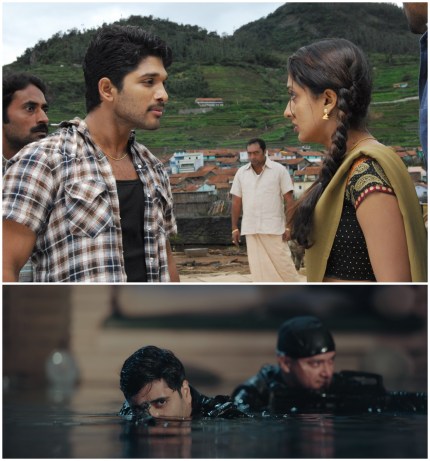
Top: Allu Arjun (left) courts female lead Sheela Kaur (right) while the latter’s father, Prakash Raj (center), glowers from the background in Parugu. Bottom: Adivi Sesh infiltrates the Taj Mahal Palace Hotel in Mumbai amphibiously in Major.
Last and without a doubt the least effective of these movies is Adipurush, the second straight high-concept box office bomb (see also: Saaho [2019]) that Prabhas has headlined since his biggest career role in Rajamouli’s Baahubali. While Saaho was based atop a clusterfuck of a screenplay, it was entertaining in fits and starts and felt like a true blockbuster with sizeable production values; Adipurush, by contrast, plays like a glorified, overly long (179-minute) fan-film a la Kung Fury (2015) or Batman vs Predator (2008). The movie’s adaptation of the legendary Hindu epic, Ramayana (my fellow westerners, it’s the story with the multiheaded villain, Ravana [Saif Ali Khan]), is undone by unacceptable computer generated imagery (CGI), unconvincing digital composite backgrounds (the entire film was shot in front of green/blue screens on a soundstage), and an obvious, painful attempt to recall Peter Jackson’s work on LOTR.
I suppose it’s asking too much for the international film industry to maintain many, if any artistic flow barriers between cultures, but at the same time, the increasing prevalence of excessive, superfluous CGI, bloated action set-pieces, and the declining influence of romantic musical structure on Indian filmmaking can’t help but feel disappointing to me. Adipurush is a weak Hindu mythological riff on LOTR mixed with some 300 and Planet of the Apes (2011, 2014, 2017), while Major feels like every SIC action flick mixed with every other Hollywood biopic Oscar bait; Bhaskar Natarajan’s Parugu is the only film of this bunch that comes across as a singular filmmaker’s cohesive vision, such that its longwinded runtime and theatricality, comparable in certain ways to the other two films, feel like strengths instead of weaknesses.
—————————————————————————————————————————————————————————–
SUMMARY & RECOMMENDATION: As Indian cinema grows more expensive, ubiquitous, and high-concept, I hope it maintains its rich musical heritage that allows many of its classics to stand apart from Hollywood’s blockbuster machine and mainland China’s heavyhanded censorship. Given how Parugu is the only one of these movies that retains unabashed South Asian melodrama successfully, and given that it released in 2008 compared to the later Major and Adipurush, it doesn’t take a weatherman to tell which way the artistic winds are blowing.
—> Given all that, Parugu comes RECOMMENDED, I’m ON THE FENCE with respect to Major’s generic patriotism, and DO NOT RECOMMEND the CGI mess that is Adipurush.
? Since Major Unnikrishnan was a Malayali raised in Bangalore, why wasn’t Major filmed in either Malayalam or Kannada?

 Express Elevator to Hell
Discussion
Trackbacks/Pingbacks
Pingback: ‘Society of the Snow’ (2023): When Hell Freezes Over | Express Elevator to Hell - January 25, 2024