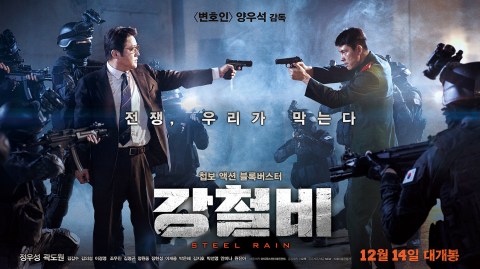
Directed by: Yang Woo-suk || Produced by: Park Joon-ho, Kim Tae-won, Sun Young
Screenplay by: Yang Woo-suk || Starring: Jung Woo-Sung, Kwak Do-won, Kim Kap-soo, Kim Eui-sung, Lee Geung-young
Music by: Kim Tae-seong || Cinematography: Lee Hyung -duk || Edited by: Lee Gang-hee || Country: South Korea || Language: Korean, English, Mandarin, Japanese
Running Time: 139 minutes
When my maternal great grandparents emigrated from Korea to the territory of Hawaii in the early 20th century (a good story for another time), the Korean peninsula was a conquered vassal state of the Japanese Empire. Remnants of that fascist imperial regime contributed to the radicalization of elements of Korean society, which were then divided, heightened, and isolated as a result of the Korean War (1950-1953) following World War II (1939-1945) and the defeat of the Axis powers (i.e. Nazi Germany, Fascist Italy, the Empire of Japan). Remarking on our East Asian pedigree on certain occasions throughout my childhood, my family would often contrast the extremist isolation of North Korea (officially the Democratic People’s Republic of Korea) with the progressive, wealthy, and developed society of South Korea (officially the Republic of Korea), backed during the Korean War by mainland Chinese forces supported covertly by the Soviet Union and United States-led United Nations interventionists, respectively.
All jingoism and geopolitical rivalries aside, I always felt baffled by the honest expectations professed by older generations in Korean cinema (e.g. Shiri [1999], Joint Security Area [2000]), media, and popular culture who seriously considered reunification of the Korean peninsula given the socioeconomic gulf between the two nations. Portrayals of totalitarian North Korea as a paranoid yet crafty, militarized cult never helped convince me, though maybe my outsider status misses cultural nuances of Korean communism that are more evident to those with closer ethnic ties.
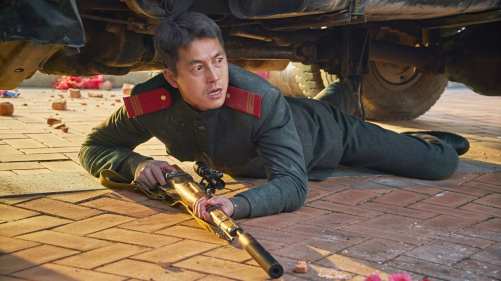
Lead Jung Woo-sung takes cover beneath a vehicle as hostile forces attempt to assassinate North Korea’s Supreme Leader.
Steel Rain, the sophomore feature project of writer-director Yang Woo-suk, is a recent and perhaps my favorite dramatization of the frozen Korean conflict (the war between the split Korean states technically never ended, as no formal peace treaty was ever signed). Fans of Tom Clancy military procedurals and Cold War era thrillers from Red Dawn (1984), The Abyss (1989), The Hunt for Red October (1990), to The Sum of All Fears (2002; OK, some of those are post-Cold War or “Cold War-adjacent”) will find much to like here, where a military coup in North Korea stages a false flag operation to assassinate their Supreme Leader while blaming the US military. Attempting to protect the Supreme Leader (Kim Jong Un, who’s never mentioned by name and whose likeness is never shown in full) is lead Jung Woo-sung, a former Reconnaissance General Bureau agent recruited out of retirement to eliminate members of the disloyal military establishment, but who is soon forced to smuggle the injured, unconscious head of state south past the demilitarized zone. What transpires thereafter is a mix of spy-vs-spy subterfuge, special forces shootouts, international nuclear threats, and most importantly of all, a weird buddy cop dynamic between Jung and costar Kwak Do-won, the South Korean senior presidential secretary for foreign affairs and national security.
The screenplay’s ticking clock of the ever escalating threat of nuclear war between the Koreas, Japan, the United States, and China drives the story forward at a relentless pace over its sizeable 139-minute runtime. Action sequences appear where necessary but not always when you expect them, which keeps the viewer on their toes and further spices up the narrative’s pace. With respect to characterizations, most every performance fits their thriller archetypes like gloves and the opposite character relationship between co-leads Jung and Kwak produces the best chemistry.
The action set-pieces themselves are tightly edited, bloody, and to the point; the choreography isn’t anything super flashy, but everything feels plausible since the camera’s focus is most always on scene geography and character blocking instead of showing off the actors’ athleticism. The cinematic violence, therefore, isn’t as memorable as classics like I Saw the Devil, The Man from Nowhere (both 2010), or even middling flicks like The Wolf Brigade (2018), but it’s arguably integrated into the overall story as well if not better than all those films.
My only significant problems with Steel Rain are some minor segments where Yang’s sociopolitical preaching gets in the way of the story’s tone and plausibility (the film is based on the writer-director’s 2011 webtoon of the same name). Maybe this is my outsider ignorance getting in the way again, but the movie’s borderline naïve optimism with respect to Korean unification in its conclusion sticks out from the apocalyptic tone of the rest of the movie like a sore thumb. That stuff, plus the occasional heavyhanded rant by Kwak’s Chinese, Japanese, or US diplomatic counterparts read like Yang inserting himself too directly into the story, though I appreciate how no one country is made to look like angels or buffoons (*glances at Indian and mainland Chinese blockbusters*).
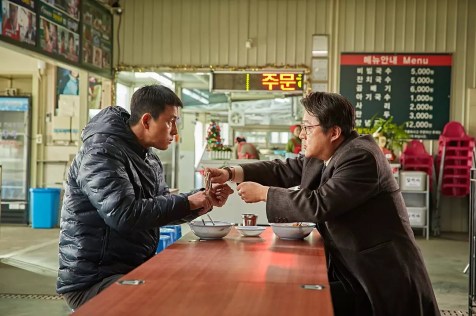
Co-lead Kwak Do-won (right) loosens handcuffs on Jung as the two break for lunch. Hey, no one ever prevented nuclear war on an empty stomach…
My Korean ancestry has given me a semi-unique angle from which to analyze some of the political undertones of modern Korean cinema, the films that deal with their parent peninsula’s division most of all. I don’t pretend this aspect of my identity gives me more of a personal stake in the affairs of Korean unification anymore than my Anglo-Saxon background, but that personal baggage mixes with my opinionated cinephile ideology to create some interesting reactions to the current most consistent national film culture on the planet. If you’re interested at all in modern Korean identity, political thrillers inspired by Cold War-era paranoia, or just a good ole-fashioned action movie, I’d say Steel Rain has more than enough to offer you.
———————————————————-
SUMMARY & RECOMMENDATION: Lengthy yet packed with meaningful narrative detail, Yang Woo-suk’s Steel Rain combines elements of classic spy movies, 1980s Hollywood-style action, and the contemporary Korean approach to dedicated, realistic characterizations regardless of genre into a near seamless whole.
— However… Yang can’t help but use the film as a soapbox on occasion, most of all in the unbelievable epilogue that feels out of place relative to the rest of the movie.
—> RECOMMENDED for your geopolitical brinkmanship needs!
? It sure is convenient the man in charge of the Korean branch of China’s state security happened to be an ethnic Korean.

 Express Elevator to Hell
Discussion
Trackbacks/Pingbacks
Pingback: ‘Kompromat’ (2022): There’s No Place Like Home | Express Elevator to Hell - September 3, 2024