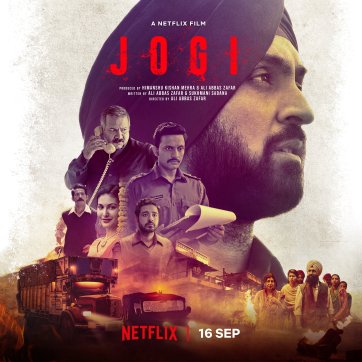
Directed by: Ali Abbas Zafar || Produced by: Ali Abbas Zafar, Himanshu Kishan Mehra
Screenplay by: Sukhmani Sadana, Ali Abbas Zafar || Starring: Diljit Dosanjh, Amyra Dastur, Kumud Mishra, Mohammed Zeeshan Ayyub, Hiten Tejwani
Music by: Julius Packiam || Cinematography: Marcin Laskawiec || Edited by: Steven Bernard || Country: India || Language: Hindi
Running Time: 116 minutes
I’ve remarked to my peers that I believe zombie fiction represents our fear of persecution by large groups of people, be they riots, belligerent protests, or mass brawls at sports arenas, political rallies, etc. The most obvious symbolism that seems to come to mind to most people when watching films like Dawn of the Dead (2004), The Walking Dead (2010-2022), World War Z (2013) or Train to Busan (2016) are the metaphors for infection, but if biological contamination a la COVID-19 is the primary threat behind motion pictures like those, then why do they involve the transformation of disease carriers — sometimes referred to as “infected” — into mindless, ravenous, often rabid individuals? Fear of disease is the driving force behind works like The Andromeda Strain (1971), Outbreak (1995), and Contagion (2011), sure, where human beings are never reduced to bloodthirsty monsters. Conversely, symptoms of animalistic rabidity are the main point of undead fiction, which is one reason why I love screenwriter Alex Garland’s use of the “Rage Virus” in Danny Boyle’s 28 Days Later (2002) to explain their zombie monster’s thematic symbolism through bioengineering.
An effective recent historical drama that recalls the overarching fears of mob violence without the explicit use of undead antagonists is the Netflix Original Film, Jogi, cowritten and directed by established Indian filmmaker Ali Abbas Zafar. Zafar has an established career in mainstream Hindi cinema, also known as Bollywood, credited with blockbuster successes like Gunday (2014; one of the last major starring roles by Priyanka Chopra in an Indian production as of this writing), Sultan (2016; the other, non-Aamir Khan Hindi wrestling movie from that year), and Tiger Zinda Hai (2017; the second film in Yash Raj Films’ burgeoning “Spy Universe“). Since his big-budget theatrical collaborations with Salman Khan in the mid-2010s, however, Zafar has since transitioned to directing web series and streaming exclusive titles like many filmmakers around the globe (see also: J. A. Bayona, Nicolas Winding Refn, Alejandro Iñárritu, Martin Scorsese).
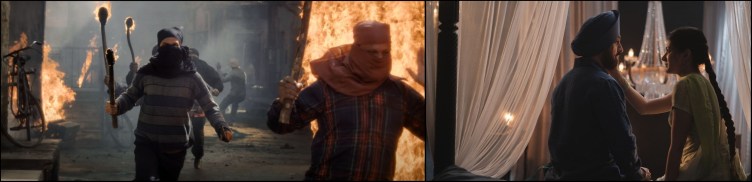
Left: Rioters consist of not just angry civilians, but also convicts released by elected officials to score political points from the violence. Bottom: The primary flashback of the film isn’t bad by any means, but I question its placement in the greater story.
Jogi, the namesake nickname of its lead character (Diljit Dosanjh), dramatizes the 1984 anti-Sikh pogroms that resulted from the assassination of controversial Prime Minister Indira Gandhi by two of her Sikh body guards, itself a retaliation for the earlier Operation Blue Star that Gandhi greenlit to remove various influential Sikh militants from the Golden Temple in Amritsar, Punjab, the holiest site in Sikhism. Though the 1984 riots occurred nationwide, the majority of the ethnic Sikh casualties were in the capital of Delhi where Gandhi was assassinated, and served as inspiration for a key plot-point in last year’s Aamir Khan production, Laal Singh Chaddha (2022).
Zafar’s most recent film is characteristic of numerous Indian Netflix exclusive features that excise many of the superfluous, expensive bells and whistles characteristic of most high-profile Hindi blockbusters, including ones from his filmography, such as extensive song-and-dance numbers that don’t advance the plot, obvious computer generated composite backgrounds, 2.5-3-hour runtimes, and boring, slow-motion fueled fight sequences, all without watering down the indigenous subject-matter, acting style, or charismatic location-photography of the Indian production’s identity (in other words, you can still tell Jogi is an Indian movie). In place of the aforementioned is a well paced 116-minute period drama that focuses exclusively on a fictionalized exfiltration of a Sikh neighborhood within the Delhi metropolis during the three days following Gandhi’s death. Lead Dosanjh and a few key supporting characters (e.g. Mohammed Zeeshan Ayyub as a Delhi police officer with a conscience, Hiten Tejwani as a conflicted Delhi policeman with a personal agenda against Dosanjh, Paresh Pahuja as a local Muslim benefactor, and Kumud Mishra as a corrupt local assemblyman and the main antagonist) operate like chess players throughout this tense cat-and-mouse game of ethnic cleansing and urban riots.
Zafar eschews flashy camerawork in favor of tight editing and broad scene coverage so that the audience knows where everyone is, good guys and bad, within each tense set-piece without letting any one scene drag. These attributes are crucial to the tension in Acts Two and Three, where Dosanjh and Ayyub attempt to smuggle dozens of their Sikh neighbors out of Delhi to Mohali (the state of Punjab is where the vast majority of Sikhs are concentrated) in a lorry and have to navigate everything from roving mobs to hostile traffic stops. The longer the film runs, the more suspenseful its set-pieces grow until a satisfying conclusion that takes advantage of the local scenery’s creative blocking.
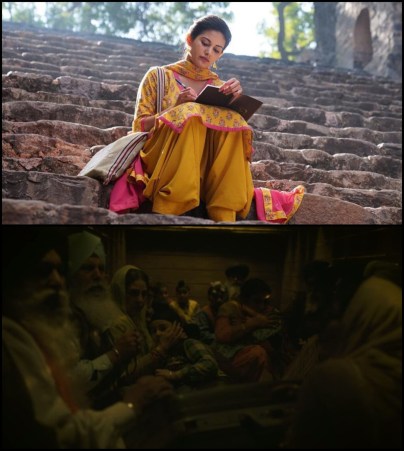
Top: Unlike the harsh shadows and low-key, gritty lighting of the primary narrative, the flashbacks sport soft, bright lighting to exemplify happier times. Bottom: Sikh neighbors huddle inside their secret compartment as they’re smuggled out of Delhi in a truck.
I have few complaints with Jogi other than the placement of a critical flashback in its final act, as well as numerous brief yet intrusive flashbacks to scenes earlier in the film. Besides those minor complaints, though, Jogi is another tight, efficient Indian Netflix exclusive that boasts more entertainment value than blockbusters several times its budget and, with respective to Indian blockbusters, 25-50% its length or longer. Much of its tension derives from its unintentional structural overlap with the zombie film subgenre, capitalizing on the universal human fear of uncontrollable group rage and its connection to a fundamental part of modern Indian history. If you have the stomach to watch an angry, violent political film, I’d recommend Jogi for its efficiency, tastefulness, and fundamental appreciation for genre cinema conventions in place of dramatic cinema’s tendency to preach.
———————————————————————-
SUMMARY & RECOMMENDATION: Chock full of the worst kind of undead — the real kind — and channeling historical events in ways that accentuate its suspenseful storytelling instead of distracting from it, Jogi is another reliable, concise Netflix Original Film from India. Against a national cinematic backdrop of 3-hour productions with either unnecessary action sequences or musical numbers or both, straightforward thrillers like this stand apart. Its lack of extraneous blockbuster bells and whistles like shoehorned comic relief are icing on the cake.
— However... I disagree with the placement of a specific flashback that explains important relationships amongst the film’s main characters; moreover, flashbacks to sequences the viewer already saw are, in general, unwarranted.
—> RECOMMENDED
? What kind of person has moral qualms about wearing disrespectful clothing in a house of worship but not with butchering people in said house of worship?

 Express Elevator to Hell
Discussion
Trackbacks/Pingbacks
Pingback: ‘Kompromat’ (2022): There’s No Place Like Home | Express Elevator to Hell - September 3, 2024
Pingback: Hindi Indies, Volume 2: ‘Haseen Dillruba’ (2021, 2024) & ‘Dhoom Dhaam’ (2025) | Express Elevator to Hell - May 25, 2025