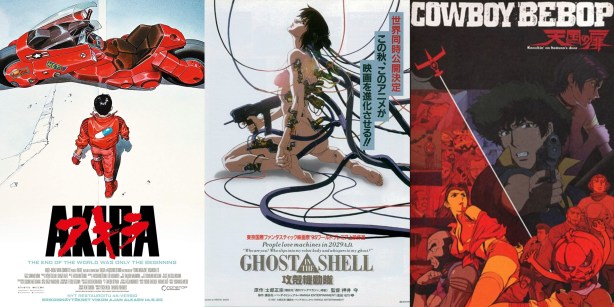
Directed by: Katsuhiro Otomo [1], Mamoru Oshii [2], Shinichiro Watanabe [3] || Produced by: Ryohei Suzuki, Shunzo Kato [1], Yoshimasa Mizuo, Ken Matsumoto, Ken Iyadomi, Mitsuhisa Ishikawa [2], Masuo Ueda, Masahiko Minami, Minoru Takanashi [3]
Screenplay by: Katsuhiro Otomo, Izo Hashimoto [1], Keiko Nobumoto [3] || Starring: Mitsuo Iwata, Nozomu Sasaki, Mami Koyama, Taro Ishida, Tessho Genda, Mizuho, Suzuki, Tastuhiko Nakamura, Fukue Ito, Kazuhiro Shindo [1], Atsuko Tanaka, Akio Otsuka, Iemasa Kayumi [2], Koichi Yamadera, Megumi Hayashibara, Unsho Ishizuka, Aoi Tada, Ai Kobayashi, Tsutomu Isobe, Renji Ishibashi, Mickey Curtis [3]
Music by: Shoji Yamashiro [1], Kenji Kawai [2], Yoko Kanno [3] || Cinematography: Katsuji Misawa [1], Hisao Shirai [2], Yoichi Ogami [3] || Edited by: Takeshi Seyama [1], Shuichi Kakesu, Shigeyuki Yamamori [2], Shuichi Kakesu [3] || Country: Japan || Language: Japanese
Running Time: 124 minutes [1], 82 minutes [2], 115 minutes [3] || 1 = Akira, 2 = Ghost in the Shell, 3 = Cowboy Bebop
My longstanding prejudice against — or at the very least, my general disinterest in — Japanese animation (i.e. anime) has been the primary bulwark against my following of modern Japanese popular culture given the Japanese film industry’s overwhelming dependence on the medium to survive. Perhaps this lack of respect on my part is connected to my middling responses to graphic novels (known as manga in the Land of the Rising Sun) and their storyboarded similarities to anime, but on the other hand, I connected with the comic book-esque 1990s Disney Renaissance Era as a child with no problem.
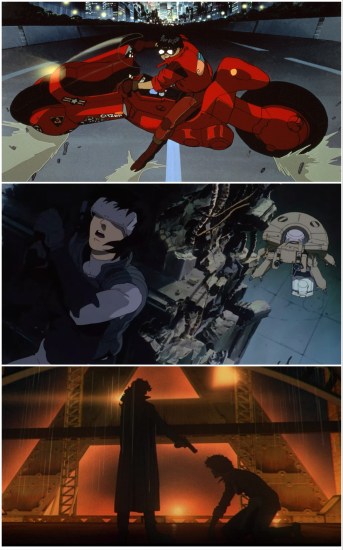
Top: Perhaps the most iconic visual from Akira is the “Akira slide,” which has been referenced in everything from Batman: The Animated Series (1992-1995) to Yu-Gi-Oh (2008-2016) to X-Men Origins: Wolverine (2009) to Nope (2022). Middle: Major Motoko Kusanagi, voiced by Atsuko Tanaka in the original Japanese audio track, battles an advanced mech in Ghost in the Shell. Bottom: Cowboy Bebop: The Movie ends with a banger of a fistfight against killer sunset lighting.
A partial explanation of this anti-Japanese animation bent of mine may lie in my similar disinterest to contemporary Hollywood 3-D animation created entirely through computer generated imagery (CGI). Though I also grew up with the rise of Pixar (e.g. Toy Story [1995], A Bug’s Life [1998], The Incredibles [2004], etc.), I feel that both that particular company and mainstream CGI animation in general have stalled in the decades since, with the vast majority of releases aping the exact same audiovisual style as the original Toy Story regardless of that style’s appropriateness for a given story (for some notable exceptions, see A Scanner Darkly [2006], Beowulf [2007], Love, Death, + Robots [2019-], The Liberator [2020], and the Spider-verse [2018, 2023, 2024] trilogy). Now even mainstream Japanese animation boasts greater stylistic diversity than modern (~2000-2020s) Hollywood animated features, to be sure, but apparently not enough to peak my interest on a consistent basis.
I made an effort over the past couple years to sample a few anime classics to counter this obvious prejudice, works that are considered fundamental to the movement’s popularity both in Japan and overseas that have influenced numerous anime works in the decades since: Cowriter-director Katsuhiro Otomo’s 1988 feature adaptation of his manga, Akira (1982-1990), director Mamoru Oshii’s 1995 feature adaptation of Masamune Shirow’s Ghost in the Shell (1989-1991) manga, and director Shinichirō Watanabe’s feature adaptation of Hajime Yatate’s Cowboy Bebop (1998-1999) anime series. To say I find the creativity of their stories outstripped by their narrative incoherence would be putting it mildly, but the diegetic worldbuilding of all three films are unforgettable and their action style, near unparalleled.
Let’s begin with the earliest of these films, the 1988 Akira feature: Set in a dystopian, then future 2019 where a decrepit, dying Tokyo limps on from an unspecified disaster after a third world war, various gangs clash openly in the streets while organized resistance movements plot revolutionary schemes against an authoritarian government. Our main cast consist of members of all the aforementioned groups, while the narrative concerns human mutation and extrasensory perception that certain members of the population have begun exhibiting since prior to Tokyo’s earlier disaster.
Akira’s animation style is composed primarily of tens of thousands of hand-drawn cels with occasional CGI embellishments to illustrate repeating visual patterns, as well as pre-scored dialogue where character’s lip animations were matched to the cast’s prerecorded voice performances instead of the other way around. These factors explain Akira’s superfluid audiovisual composition and the rawness of its moving bodies when compared to so many contemporary animation, 2D or 3D, most all of which are now designed exclusively within computers. Multiple key animators of the film later brought elements of this style to fellow Japanese studios like Studio Ghibli and Kyoto Animation in the 2000s-2010s.
Next up is the 1995 Ghost in the Shell, which had the biggest impact in the Western world through its influence on the Wachowskis’ Matrix (1999, 2003) films and James Cameron’s Avatar (2009, 2022-) franchise given Shell’s cyberpunk aesthetic and multiple plot-devices involving consciousness-transfer. Similar to Akira, Ghost in the Shell takes place in a futuristic dystopian Japanese metropolis (circa 2029 this time) and combines political thriller and science-fiction action tones into a, frankly, not-so-seamless whole that countless live-action blockbusters, many of them from Hollywood, would adopt in the coming years.
Animation-wise, Shell is a more even mix of traditional hand-drawn animation, computer graphics, and digital audio, with CGI used most prominently on various thermal camouflage FX as well as numerous synaptic visions that portray characters’ physical consciousness on-screen. Manipulations of lens filters also create foreground to background distortions that enhance the imagery’s depth of field, and when combined with the film’s unique lighting techniques against animation cels, produce a unique image quality that enhances realism of movement.
Last but not least is Cowboy Bebop: The Movie, whose animation style and characters feel most similar to Ghost in the Shell, but with a less dour tone and a sort of space western diegesis that recalls Star Wars (1977) more than anything else. The movie, like the anime series on which it is based, is set in a terraformed, developed Mars circa 2079 and follows a motley crew of archetypal bounty hunters who stumble upon an ominous biowarfare plot; as formula dictates, these shabby, reluctant heroes unwind this seedy military industrial conspiracy almost against their will, but inevitably choose to do the right thing in the end, which makes Bebop much lighter viewing than either Akira or Shell.
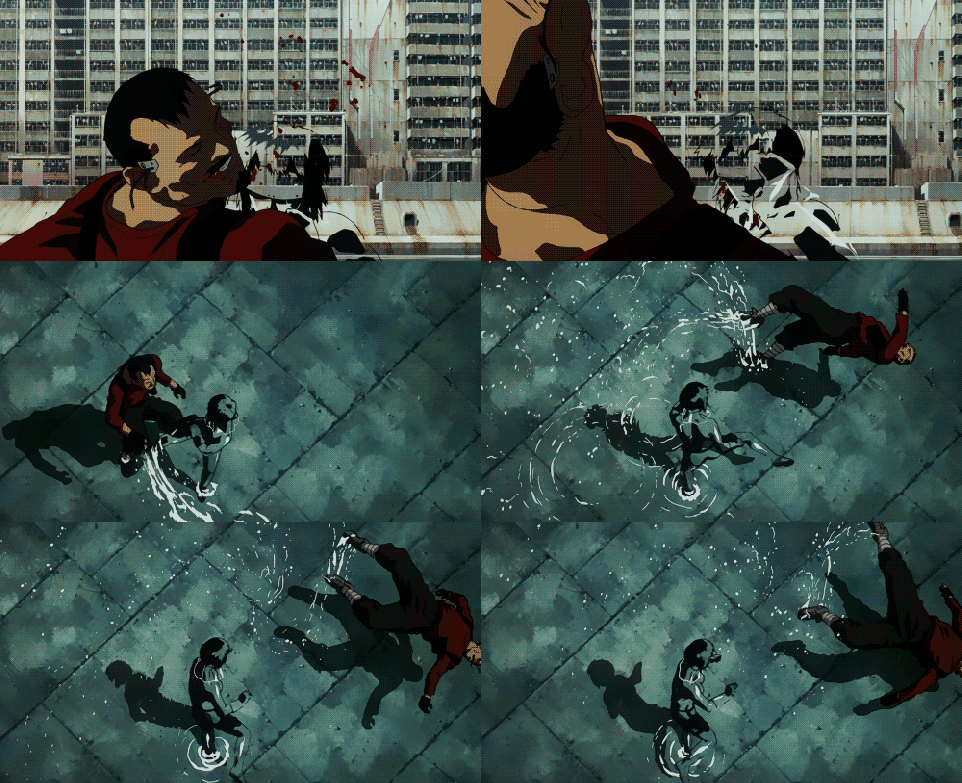
Hand-drawn animation combines with CGI in this action sequence from Ghost in the Shell.
Come to think of it, the only true weaknesses of these movies involve their screenplays, or rather the particular stories they choose to tell. Akira, Ghost in the Shell, and Cowboy Bebop showcase fundamental moviemaking prowess through their impeccable storytelling (i.e. their animation techniques, their special FX, their blend of analog cinematography with digital technology, etc.), although my general discomfort with the bizarre narratives of most popular anime remains on full display across all three of these classics. Given anime’s ongoing popularity as whole, though, I can easily recommend these older titles even if I have problems with their general tone, their stories on paper, and their batshit nonsensical endings.
————————————————————————————————————————————————————————
SUMMARY & RECOMMENDATION: Impressive to watch as they are weird to study, the feature-film versions of Akira, Ghost in the Shell, and Cowboy Bebop represent the height of classical Japanese animation thanks to their creative audiovisual styles and inventive storytelling. You may not remember every character’s name or be able to explain every plot point (… in some cases, most plot points), but damn if these anime worlds aren’t fully realized.
— However… if the goofy performances of most anime voice actors distract you as they do me, or if you’re looking for an easy to follow, coherent narrative, none of the movies analyzed here will supersede those preferences. This is great anime, not transcendent anime, so the likes of me will never get over the less stylish aspects of this medium.
—> All three movies come RECOMMENDED, nonetheless.
? Is what Tetsuo experienced in Akira a “realistic” satirical rendition of the powers of, say, Dragon Ball (1986-1989) characters?

 Express Elevator to Hell
Discussion
Trackbacks/Pingbacks
Pingback: ‘Hell Dogs’ (2022): Decent Action Drowned in Mountains of Exposition | Express Elevator to Hell - July 10, 2023
Pingback: ‘Furies’ (2022) & ‘Kill Boksoon’ (2023): Girls with Guns | Express Elevator to Hell - July 20, 2023
Pingback: ‘Warriors of Future’ (2022): The Expansion of Mainland Blandness | Express Elevator to Hell - August 21, 2023
Pingback: ‘Kiki’s Delivery Service’ (1989): You Can’t Go Home Again | Express Elevator to Hell - August 21, 2023
Pingback: ‘I Am a Hero’ (2015): The Meek Become the Mighty | Express Elevator to Hell - August 25, 2023
Pingback: ‘The Big Four’ (2022): Hilarity Does Not Ensue | Express Elevator to Hell - January 17, 2024
Pingback: Another Korean Genre Sampling: ‘Believer’ (2018) & ‘Ballerina’ (2023) | Express Elevator to Hell - September 1, 2024