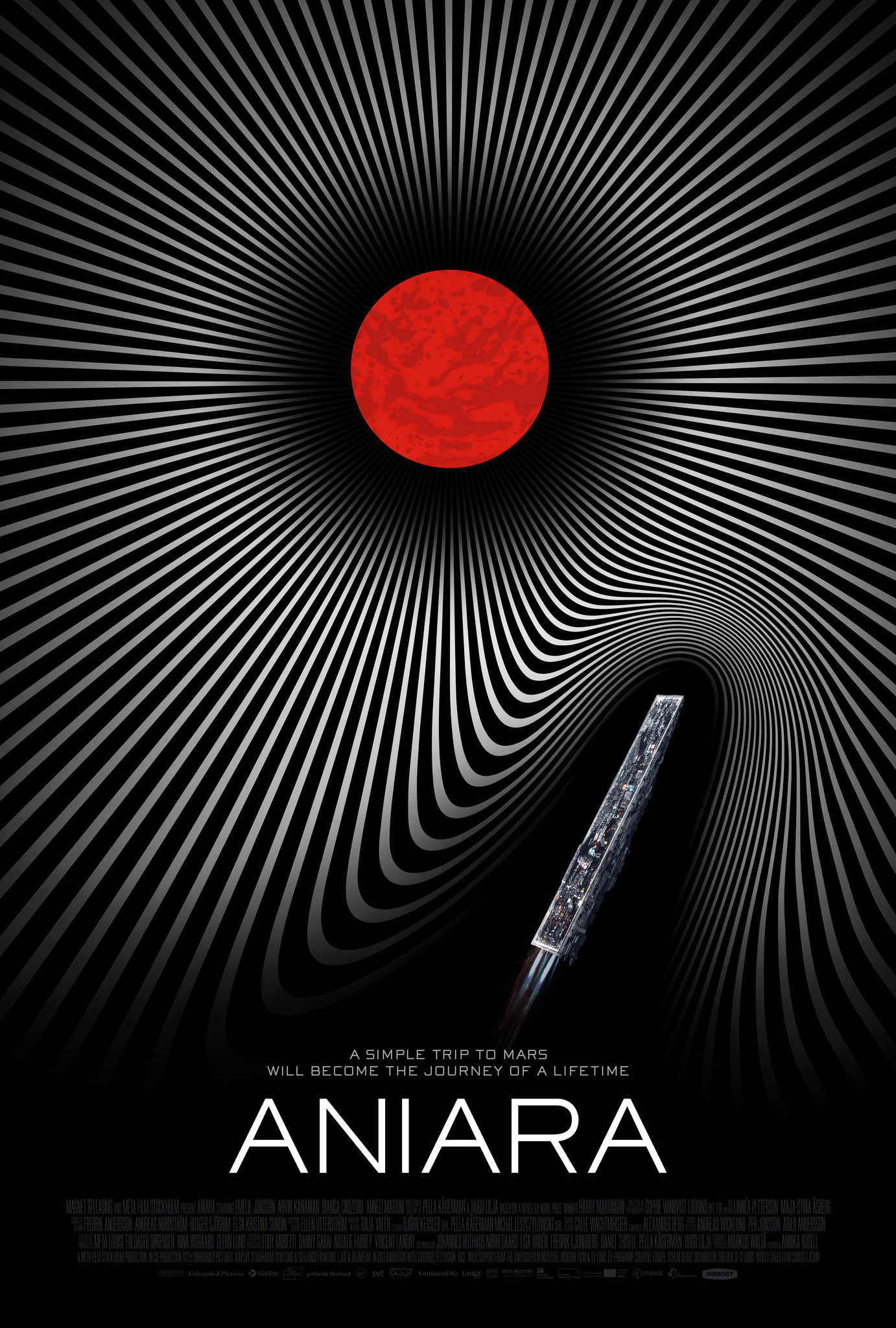
Directed by: Pella Kågerman, Hugo Lilja || Produced by: Annika Rogell
Screenplay by: Pella Kågerman, Hugo Lilja || Starring: Emelie Jonsson, Bianca Cruzeiro, Arvin Kananian, Anneli Martini
Music by: Alexander Berg || Cinematography by: Sophie Winqvist || Edited by: Pella Kågerman, Hugo Lilja, Michał Leszczyłowski || Country: Sweden, Denmark || Language: Swedish
Running Time: 106 minutes
A dynamic I find interesting in modern filmmaking is when a comedian or performer most known for humorous, lighthearted works attempts downtrodden characters in more dramatic projects. Jim Carrey in The Truman Show (1998), Man on the Moon (1999), Eternal Sunshine of the Spotless Mind (2004) et al., Bill Murray in Sofia Coppola’s movies (e.g. Lost in Translation [2003], On the Rocks [2020]), Steve Carell in Foxcatcher (2014), or Ray Romano in The Big Sick (2017) and the Netflix Original Films Paddleton (2019) and The Irishman (2019) often bring specific personality traits to those roles that most actors from “traditional” dramatic backgrounds lack. For a variety of reasons, their combination of wit and unique sense of pathos (e.g. the sad clown persona) lends memorable relatability to otherwise conventional feel-bad roles, particularly if guided by the right director.

Lead Emelie Garbers gives a solid performance as the protagonist of Aniara, but her character is in one ear and out the other as a supposed audience surrogate for slow-motion suffering.
Feel-bad roles in most traditional dark, depressing dramas, on the other hand, tend to wear me out. Without the comic sensibility of a performer well versed in finding humor in the darkest of scenarios, these more traditional existential dramas either veer into the pretentious awards-bait category, which is a separate conversation unto itself, or they descend into the somewhat more interesting yet still one-dimensional dark, artsy genre films with metaphysical or heavy philosophical overtones. The latter types of movies often approach typical genre formulas from a unique perspective — again, recall the comedian’s contributions to traditional dramatic cinema — but when their filmmakers wallow in misery, self-pity, and various flavors of nihilism, you tend to get something like Aniara.
Based on the 1956 Swedish epic poem of the same name by Harry Martinson, Aniara is a memorable yet ultimately repetitive, one-note science-fiction film about a stellar crew whose eponymous ship becomes lost in outer space after collision with space debris. Since the spaceship’s original purpose was to carry refugees from a now desolate, uninhabitable earth to a colony on Mars, the film technically has a post-apocalyptic, dystopian bent to it, as well as broad commentary on humanity’s tendency toward overconsumption and natural resource exploitation. The production has a super-low budget for its genre (€1.95 million, or a little over $2.1 million in 2018), so its depiction of a cosmic voyage, including exterior shots of the titular ship, is impressive. Even when you consider they incorporated extensive footage of a local mall (Stockholm, I assume?) into the “the shopping district” of their stellar craft, you appreciate writer-directors Pella Kågerman and Hugo Lilja’s thrifty creativity; the integration between otherwise mundane residential and commercial settings with the speculative science-fiction setting is seamless.
My only major complaint with the film’s direction is its often incomprehensible handheld cinematography, where freeform tracking shots are so chaotic that the first two acts of Aniara feel like a Jason Bourne (2002, 2004, 2007, 2016) film despite the screenplay having no action sequences. If it wasn’t for this inexplicable choice of camerawork, my lone criticism of the movie would be its redundant and somewhat reductive dreariness, which I implied above and will discuss more in a moment. As the film stands, however, a major barrier to my emotional investment in the first half to two thirds of Aniara is how its story is shot, how cheap it feels despite its clever choice of location-photography and minimalist approach to special FX.
The downtrodden, nihilistic tone of the screenplay may be too much for most audiences even if they can overlook the directors’ bizarre cinematographic choices. I’m all for cinematic exploration of morally decrepit subject-matter with dour endings (see Satya [1998], The Mist [2007], The Crazies [2010], Sicario [2015], Shin Godzilla [2016], Andhaghaaram [2020], 7 Prisoners [2021], etc.), but dark narratives must have some point beyond hopelessness and their characters must have enough agency for their stories to satisfy. Aniara’s biggest problem is not its predictability — you can sense the ship’s microcosm of society is going to fall apart due to despair by the end of Act One — but rather its cast’s morbid, unlikable personalities, personified best by Anneli Martini’s astronomer supporting character. The movie’s feature-length status is also an issue, where the sheer repetition of tragedy after tragedy loses impact 106 minutes in, begging the question as to how much better this science-fiction concept might have worked as a short film or, at most, a 45-minute Black Mirror (2011-) anthology episode.
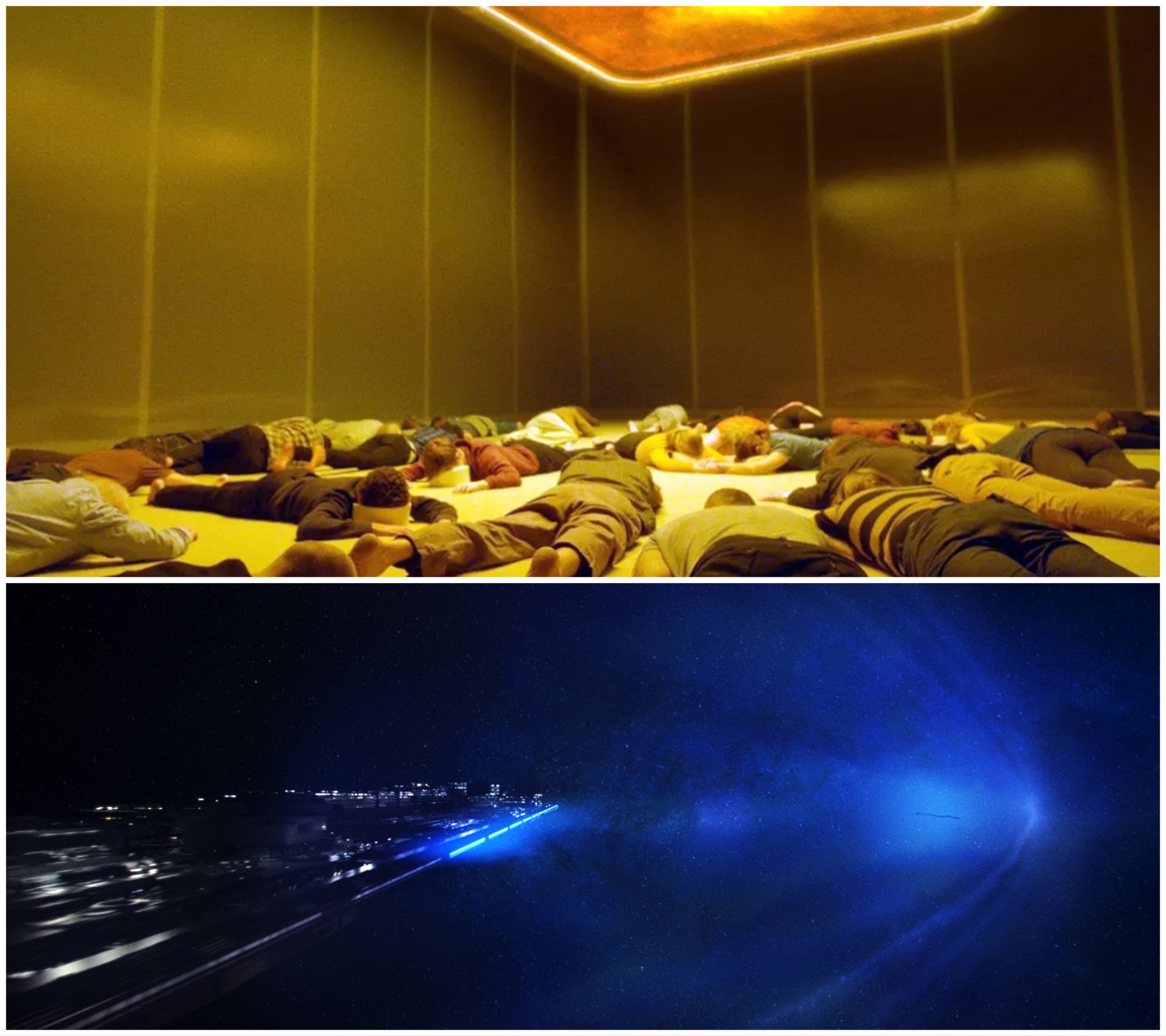
Top: Once the passengers come to grips with their existential crisis, greater numbers overuse the ship’s artificial intelligence, dubbed Mima, as an escape from their directionless lives. Bottom: The few external shots of deep space and our titular ship are impressive, begging the question as to how the directors might handle larger budgets in future genre films.
What probably dooms Aniara for most people is its lack of a likable protagonist with a sense of humor amidst their starship’s tragic voyage. Although this might fly in the face of sci-fi nerd preferences, a unique funny character — not throwaway comic relief, but a character whose comedic presence penetrates the drama around them — might have given Aniara life outside its philosophical navel-gazing. The protagonist embodied by Emelie Garbers is less cynical than most of the supporting roles around her, but given her utter helplessness within the cosmic void, her character’s “arc” feels largely pointless by the film’s third act once the chaotic handheld camerawork has calmed down. With that sort of disempowerment as the central focus of the story, Aniara needed someone with, well, more personality to make sense of the narrative’s disorder.
—————————————————————–
SUMMARY & RECOMMENDATION: Introspective to a fault yet ambitious in narrative scope, Aniara attempts to develop a tragic communal story of humanity dying amongst the cosmos, but given both its distracting cinematography and its unremarkable characterizations, the film’s depressing concept doesn’t work as a feature-film.
— However… while the visual despair of Aniara didn’t resonate with me, its budgetary efficiency with respect to special FX, location shooting, and a creative narrative premise is endearing.
—> NOT RECOMMENDED; I’ve noted a fair amount of praise amongst online cinephiles, anecdotally, for this film, perhaps those more inclined to philosophical discussion than the general population, but Aniara’s intellectualism is empty without a memorable human face to articulate how people approach oblivion beyond hopelessness.
? I imagine that discovering another habitable planet after “only” six million years in space is astronomical good luck?


Truly goes places I didn’t expect it to. Nice review.
Posted by Dan O. | August 23, 2024, 11:55 am