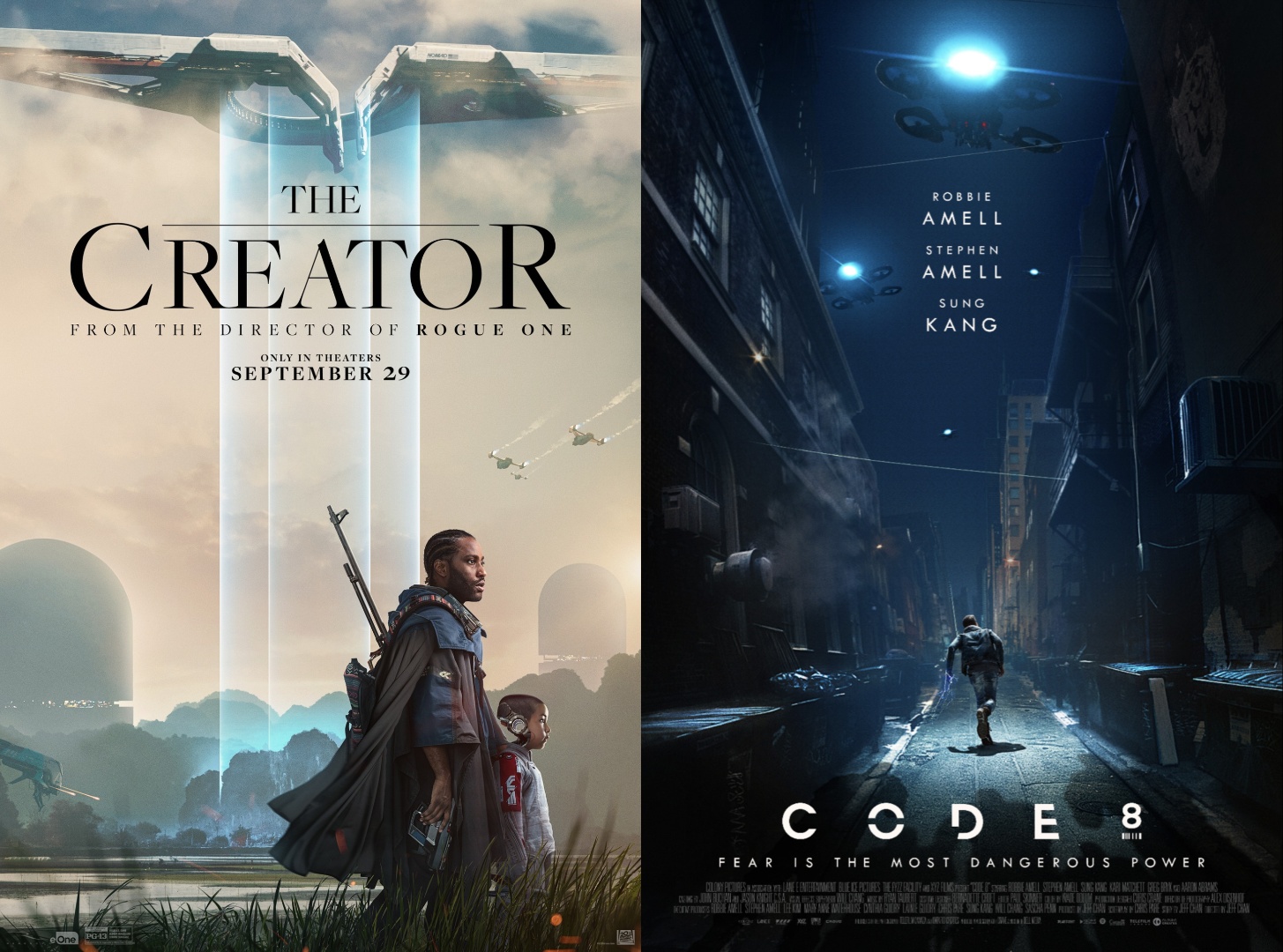
Directed by: Gareth Edwards [1], Jeff Chan [2] || Produced by: Gareth Edwards, Kiri Hart, Jim Spencer, Arnon Milchan [1], Rebecca Bouck, Jeff Chan, Robbie Amell, Stephen Amell, Chris Pare [2]
Screenplay by: Gareth Edwards, Chris Weitz [1], Chris Pare [2], || Starring: John David Washington, Gemma Chan, Ken Watanabe, Sturgill Simpson, Allison Janney [1], Sung Kang, Kari Matchett, Sirena Gulamgaus, Altair Vincent, Alex Mallari Jr., Robbie Amell, Stephen Amell, Aaron Abrams [2]
Music by: Hans Zimmer [1], Ryan Taubert [2], || Cinematography: Greig Fraser, Oren Soffer [1], Alex Disenhof, Marie Davignon [2] || Edited by: Hank Corwin, Joe Walker, Scott Morris [1], Paul Skinner, Matt Lyon [2] || Country: United States [1], Canada [2] || Language: English
Running Time: 133 minutes [1], 100 + 100 minutes = 200 minutes total [2] || 1 = The Creator, 2 = Code 8 & Code 8: Part II
A running theme of the 2023 summer to winter holiday blockbuster lineup, particularly with respect to the higher than usual number of high-profile box office flops that year, was the striking number of tentpole films with absurdly high (e.g. $200 million+) budgets. Once seemingly invulnerable franchise intellectual properties (IPs) such as the Marvel Cinematic Universe (2008-2019) and Indiana Jones (1981-2023), as well as new releases from venerable studios like Pixar, ran face-first into the post-COVID-19 theatrical landscape where streaming had expanded market dominance, audiences apparently tired of the repetitive, FX-driven superhero installments of the 2010s, and production costs inflated due to a combination of pandemic delays, the dual Writers and Screen Actors Guild strikes, and major studio executive egos.
An exception noted by cinephiles of a 2023 high-concept, FX-driven genre film that executed reference-level computer-generated imagery (CGI) into field environments on a respectable (~$80 million) budget was The Creator. Cowritten, coproduced, and directed by Gareth Edwards, who broke into the Hollywood mainstream with Godzilla (2014) and Rogue One (2016), The Creator failed to recoup its somewhat modest production costs perhaps given its original IP status amidst a crowded 2023 theatrical release calendar, but is still hailed as a potential benchmark for efficient large-scale digital FX production for future Hollywood blockbusters. My primary criticism of those adulations is that they overlook Edwards’ recurring heavy-handed storytelling, simplistic characters, and overindulgent runtimes, an ironic resemblance to many established Hollywood franchise IPs that can’t seem to nail the most affordable aspect of their production: Their screenplays.
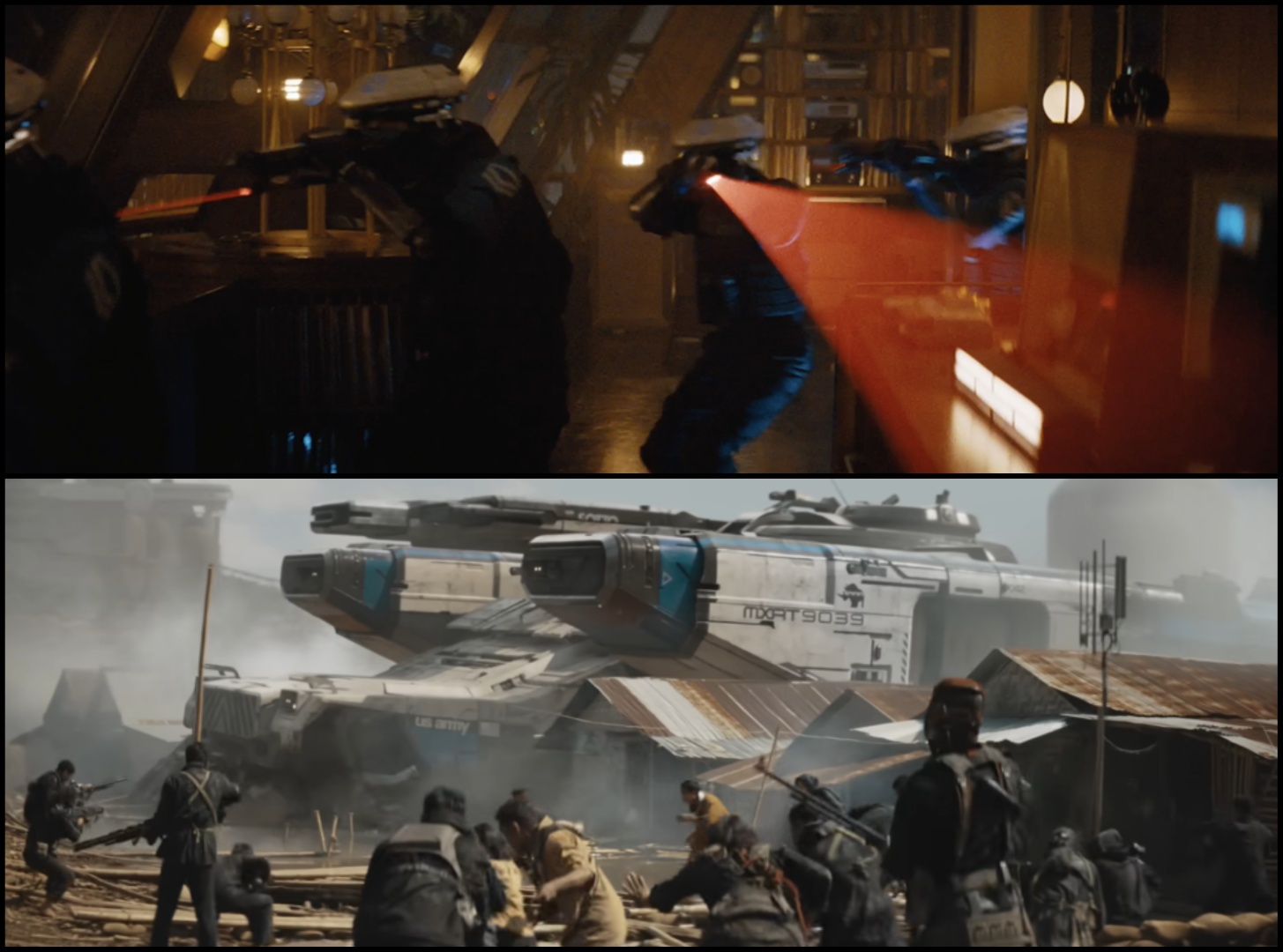
Top: Stunt performers in motion-capture gear act as AI-powered robot police officers in The Creator’s laughably broad ethnocultural region of “New Asia.” Bottom: Great CGI showcases gigantic United States tanks steamrolling a New Asian village early in The Creator’s third act.
The Creator looks even weaker, I argue, when compared against the actual modest budgets of Jeff Chan’s Code 8 and Code 8: Part II ($2.4 million in 2019 and $10 million in 2024, respectively), true independent Canadian genre features that utilize extensive special FX and dynamic, varied action sequences without skimping on character development or resorting to predictable narrative cliches. Though Edwards’ latest film has achieved a sizeable following at least post-theatrical release, I have yet to meet anyone online or off who has heard of Code 8 despite how the former is Avatar (2009) without blue aliens (that’s not a compliment) and the latter is a low-budget X-Men (2000-2020) riff.
With respect to The Creator, I feel it wastes its interesting Blade Runner (1982)-esque premise on a straightforward Pixar narrative formula where “…the heroes were the bad guys all along!” Artificial intelligence (AI) human simulants have become commonplace by the film’s diegetic year 2055, but are blamed for a horrific nuclear attack on Los Angeles. This prompts AI bans and eradication efforts throughout the Western world, which are in turn resisted by the peoples of “New Asia.”
To be blunt, the creative goodwill the film’s opening expository montage establishes is almost wasted on a subsequent prologue establishing John David Washington’s undercover operative in New Asia, where it is clear his protagonist is not there to do good. Any remaining nuance in the film’s social commentary toward xenophobia, acceptance of others, and geopolitics goes out the window by the time Washington’s costar and thuggish diegetic teammate at the time, Marc Menchaca, grabs the pet dog of an innocent Thai villager and threatens to shoot it. By the time Washington discovers the primary MacGuffin character and obvious walking metaphor at the heart of the film’s narrative, Madeleine Yuna Voyles, the rest of the movie’s plot and Washington’s entire arc are telegraphed to anyone who’s seen Avatar, Children of Men (2006), District 9 (2009), or Blade Runner 2049 (2017), though without the subtler characterizations and mature stories of the latter three.
Code 8, by contrast, explores similarly obvious sociopolitical themes but approaches them with relatable characters on all sides of the good guy/bad guy divide. In its world of superpowered individuals, who are treated at best like undocumented immigrants, writer-director Chan explores the relatable motivations as well as often selfish decision-making of every major character. The most meaningful character relationship is of course that between the down-on-his-luck main character, Robbie Amell, and his quasi-mentor and mid-level gangster, Stephen Amell (the two actors are 1st cousins). Not only does their relationship develop via realistic yet unpredictable paths across both films, but their relationships with various minor characters develop in sensible ways as well, and often in conjunction with the movies’ charismatic yet not overdone special FX. Both Code 8 films also wrap at around 100 minutes, far better paced than The Creator’s 133-minute running time.
Put another way, Code 8 earns its social commentary by incorporating its obvious political themes into its narrative organically via relatable, conflicted characters. Those characters don’t always fit into neat heroic or villainous archetypes, while The Creator flaunts the most stereotypical contemporary Hollywood preaching imaginable given obvious “twist” villains, a caricatured supporting cast, on-the-nose dialogue, and a simplistic, safe ending telegraphed from a mile away.
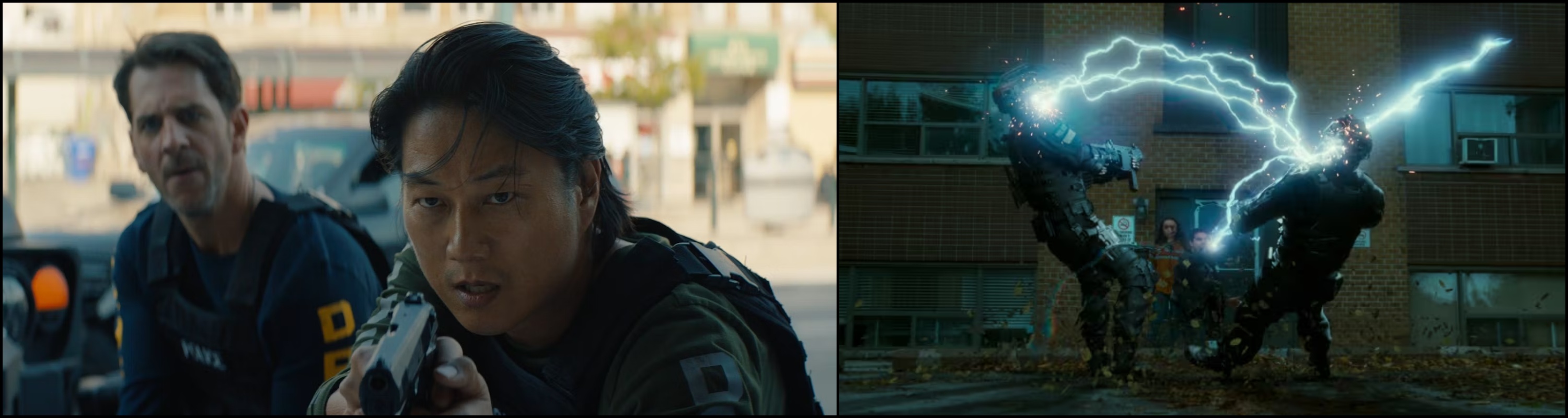
Left: Sung Kang (right) and Aaron Abrams (left) storm a drug lab harboring product mined from the spinal fluid of “powered” individuals in Code 8. Right: Lead Robbie Amell fries multiple robot Guardians (more stunt guys performing motion-capture) in Code 8: Part II.
The Creator’s laudable technical achievements, from its impressive CGI to its memorable location-photography, are further undone by the movie’s overextended length, which feels like the most irritating characteristic of Hollywood blockbuster filmmaking from the 2010s through today. To be sure, I don’t hate Gareth Edwards as a filmmaker (I still defend Godzilla, for the most part), nor do I believe Code 8 deserves attention over fellow transgressive takes on superhero-adjacent material like Watchmen (2009) or The Boys (2019-2026), but I argue true genre filmmaking budgetary efficiency needs to be put into perspective in this 2020s post-pandemic landscape. One of the original IPs discussed today makes the most of its considerable production limitations to tell a memorable story through special FX, while the other uses its considerable although not absurd blockbuster resources to show off special FX through its forgettable story.
——————————————————————————————————————————————————————————
SUMMARY & RECOMMENDATION: The Creator makes obvious that Gareth Edwards’ tendency toward heavy-handed social commentary and dry characters is a feature of his filmmaking style and not a bug, regardless of his creativity with CGI (see also Monsters [2010]). Jeff Chan, on the other hand, doesn’t so much reinvent the indie genre film wheel as update it with modern FX that take a backseat to the script’s multilayered, realistic characters. I gave a shit about the characters of Code 8 in part because I could not foresee the outcomes of decisions crucial to their development, while I could predict the character development of John David Washington et al. from the 40-minute mark of The Creator.
— However… the Thailand location-photography and identifiable cyberpunk aesthetic of The Creator remain commendable, and I suspect certain audiences may find Code 8’s thematic overlap with The X-Men franchise too distracting.
—> Regardless of their mainstream profiles, I remain ON THE FENCE with respect to the longwinded Creator and RECOMMEND both parts of Code 8.
? Did the AI robots in fact welcome Yuna Voyles “as the new Nirmata” or just ignore her when the USS Nomad broke apart in orbit?

 Express Elevator to Hell
Discussion
Trackbacks/Pingbacks
Pingback: ‘The Substance’ (2024): Respect the Balance | Express Elevator to Hell - January 5, 2025