
Directed by: Park Hee-gon [1], Lee Hae-young [2] || Produced by: Shin Bum-soo [1], Jung Chang-hoon, Park Un-kyung [2]
Screenplay by: Park Hee-gon, Kim Dong-hoo [1], Lee Hae-young [2] || Starring: Shin Hye-sun, Kim Sung-kyun [1], Sol Kyung-gu, Lee Hanee, Park So-dam, Park Hae-soo, Seo Hyun-woo [2]
Music by: Jang Young-gyu [1], Dalpalan [2] || Cinematography: Baek Yoon-seok, Lee Seon-yong [1], Ju Sung-lim [2]|| Edited by: Han Eon-jae, Han Young-gyu [1], Yang Jin-mo [2] || Country: South Korea || Language: Korean
Running Time: 101 minutes [1], 133 minutes [2] || 1 = Don’t Buy the Seller, 2 = Phantom
One of my biggest pet-peeves in filmmaking is not just feature-films that are too long — often referred to on this blog as “longwinded” — but films that, regardless of their absolute length, overstay their welcome. What I mean by this is that every given narrative film has as optimum runtime or range of runtimes over which their story hits hardest, their pacing is smoothest, and the narrative overall feels the most satisfying to sit through. Most contemporary horror films seem to have settled on a ~90-minute median runtime where each act clocks in at about half an hour, for example, whereas most bigger-budgeted, FX-driven blockbusters have coalesced at around 110-130 minutes (re: two hours) over the decades since Star Wars (1977, 1980, 1983) first released.
Two recent (2023) Korean films that exemplify the pitfalls of otherwise concise, effective genre movies overstaying their welcome are Park Hee-gon’s social media stalker/serial killer thriller, Don’t Buy the Seller, and Lee Hae-young’s Phantom, a seedy, melodramatic, almost graphic novel-esque period spy-action movie set during the 20th century Japanese colonization of Korea. Both films I watched over long-distance (~13-14 hour) international flights last month to kill time and might recommend to most viewers (see below) were it not for their bloated, drawn out conclusions.
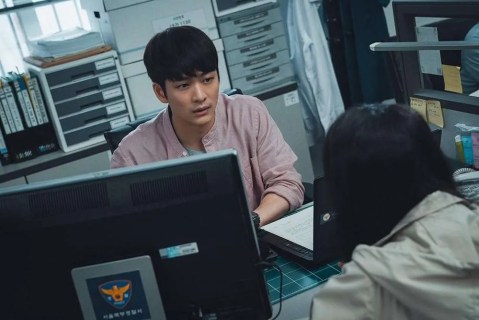
K-pop and K-drama celebrity Kang Tae-oh (left) guests stars as a cyber investigation detective helping lead Shin Hye-sun (right) combat an Internet stalker in Don’t Buy the Seller.
Don’t Buy the Seller (Korean = 타겟, or “Target”) recalls the likes of technology-oriented thrillers of decades past (e.g. Cam [2018], The Imposter, Disconnect [both 2012], The Net [1995]) about criminals, including serial murderers, who manipulate or outright steal their victims’ identity (e.g. Possessor [2020], Taking Lives [2004]). Within Korean cinema, Don’t Buy is perhaps most comparable to Unlocked (2023) also from last year, where a serial killer hacks into prospective victims’ hardware (e.g. smartphones) and social media accounts in order to socially isolate them; so, perhaps we have a “twin film” situation here similar to Dante’s Peak and Volcano (both 1997), A Bug’s Life and Antz (both 1998), or Mission to Mars and Red Planet (both 2000).
Flashy cinematography is visible across Don’t Buy only in fits and starts, but memorable instances of framing and character blocking allow a clever 1st Act misdirect of the serial killer antagonist’s reveal in keeping with the movie’s themes of identity. Great editing and impressive vehicular camerawork showcase a memorable 3rd Act chase sequence that should’ve been the climax of the film, while the portrayal of Internet browsing and texting are more of a mixed bag; the latter is nowhere as smooth as the portrayal of online culture in, say, Ingrid Goes West (2017), but the number of shots of people texting on tiny screens is minimized while full-screen depictions of security camera footage, for example, is used where appropriate.
Don’t Buy’s biggest problem, however, as with Phantom, is that it stretches out its ending for no reason at all. The aforementioned car chase set-piece is action-packed entertainment and contrasts with the rest of the movie’s slow-burn, claustrophobic, pedestrian environment in a positive way. How the movie proceeds after that 3rd Act exclamation point is clunky at best and feels like padding to justify another action sequence, an elongated fistfight between protagonist Shin Hye-sun, one of the movie’s acting highlights, cyber crimes detective Kim Sung-kyun, and serial killer Im Seong-jae, which transforms the latter into a sort of physically dominant supervillain inconsistent with his portrayal earlier in the film.
Even more drastic in terms of forcing additional false endings where they don’t belong is Phantom, a kind of pulpy, hyper-stylized period action flick set during the 1930s occupation of the Korean peninsula by the Empire of Japan. Though the movie gets over its initial hurdle in premise for me — I don’t like movies based on colonization or cultural revolutions as a general rule, as they tend to oversimplify heroic and villainous characters into caricatures (e.g. Michael Collins [1996], The Patriot [2000], V for Vendetta [2005], Spy [2023])— the film’s 3rd Act contrasts so much with its first two thirds that Phantom feels like two different movies. The first two acts sketch this broad portrait of an authoritarian Japanese-Korean vassal state, where a handful of probable suspects (Sol Kyung-gu, Lee Hanee, Park So-dam, Seo Hyun-woo) thought to be connected to an assassination attempt on the Japanese resident-general (governor) are interrogated in an almost Clue (1985)-like mansion. Where the first two acts unfold patiently with sporadic upticks in violence (a scrappy fistfight here, a brutal shootout there), the 3rd Act barrels past the reasonable endpoint of the primary storyline after said mansion is destroyed so that secondary villain Sol can deliver a series of heavy-handed speeches about how great imperialism is if his fellow Koreans would just give it a try.
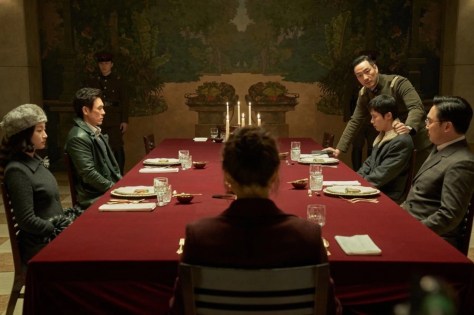
Ironically, some of the tensest moments of Phantom are not the bombastic shootouts toward the end of the 3rd Act, but rather primary antagonist Park Hae-soo’s (background center right) interrogations of his costars.
While other, smaller weaknesses further prevent my outright recommendation of either film (e.g. several unnecessary supporting characters in Don’t Buy the Seller, some questionable computer generated imagery [CGI] in Phantom), my primary gripes with both pictures are their overextended conclusions. Even an otherwise solid movie overstaying its welcome is one of my biggest cinephile turnoffs, with only the greatest/my favorite movies (e.g. The Lord of the Rings [2003], Alien [1979, 1986]) able to overcome that barrier. To be clear, neither Don’t Buy the Seller nor Phantom are bad movies by any stretch of the imagination, as considerable filmmaking craft exists within both projects, yet that craft is kneecapped to a large degree like a fun party guest staying way past their host’s bedtime.
———————————————————-
SUMMARY & RECOMMEDATION: With memorable lead performances and formidable villainy, this duo of Korean genre movies have personality to match their potent action cinematography (e.g. diverse camerawork, capable editing, memorable set-piece choreography) and make the most of their presumably modest budgets.
— However… Don’t Buy the Seller could’ve trimmed a minor character or two and shaved most everything that follows its car chase centerpiece, while Phantom transforms from a whodunit mystery with memorable action flourishes and noticeable yet forgivable bad CGI into another predictable revolutionary “epic.”
—> I remain ON THE FENCE with respect to both films.
? Does anyone else think Park Hae-soo and Sol Kyung-gu don’t look Japanese at all? On the other hand, I applaud their command of multiple languages on screen.

 Express Elevator to Hell
Discussion
Trackbacks/Pingbacks
Pingback: ‘Exhuma’ (2024): Better Left Buried | Express Elevator to Hell - May 17, 2024
Pingback: ‘The Endless Trench’ (2019): In It for the Long Haul | Express Elevator to Hell - June 3, 2024