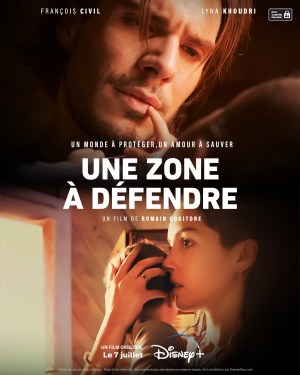
Directed by: Romain Cogitore || Produced by: Hugo Sélignac, Nicolas Dumont
Screenplay by: Romain Cogitore, Thomas Bidegain, Catherine Paillé || Starring: François Civil, Lyna Khoudri, Nathalie Richard, Bellamine Abdelmalek
Music by: Mathieu Lamboley || Cinematography: Julien Hirsch || Edited by: Florent Vassault || Country: France || Language: French
Running Time: 103 minutes
Plenty of well known crime dramas contain notable romances — Goodfellas (1990), Heat (1995), Infernal Affairs (2002), etc., all have one or more romantic subplots — but far fewer make their romances the foundation of their script and meld their crime drama aesthetics with the narrative structure of a love story. What most stuck out to me about Romain Cogitore’s A Place to Fight For (French = “Une zone à défendre”) when researching it, by contrast, was its classification as a romantic thriller. The fourth feature of Cogitore and his second collaboration with lead François Civil after his debut, 15 Lads (2011; “Nos résistances,” or Our Resistance), one of Civil’s first leading roles, A Place to Fight For (henceforth, A Place) melds the genres of the crime drama, the thriller, and the romantic drama through distinctive cinematographic style as well as respectable political restraint given its screenplay’s socially charged backdrop.
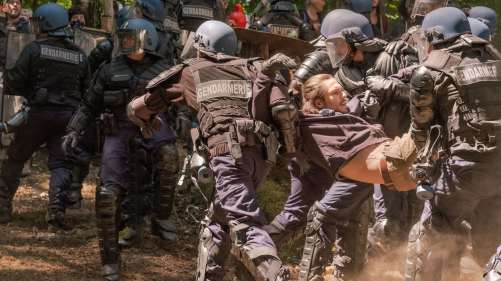
Protagonist François Civil (center right) is carried away by riot police in the extended prologue of A Place to Fight For.
A Place follows Civil as an undercover federal police officer who infiltrates a sophisticated eco-activist group known as Zone A Défendre (“Zone to Defend” or ZAD, from which the film takes its title) while the latter group protests the building of a dam in an undeveloped forest. Inspired by the real-life ZAD groups who occupy land selected for development through militant protests, the film defines its stylistic perspective through its wide-angle lens outdoor photography combined with tracking shots that stick to Civil like glue. Cinematographer Julien Hirsch doesn’t adhere to the ambitious, elongated oners of Emmanuel Lubezki (e.g. Y Tu Mama También [2001], Children of Men [2006], Gravity [2013], Birdman [2014], The Revenant [2015]) or Matias Boucard (e.g. Athena [2002]) thanks to a plethora of jump-cuts throughout, but this almost third-person point-of-view cadence feels documentarian given the forested backgrounds, rural iconography, and general lack of identifiable urban French landmarks (for the opposite trend, see Amélie [2001] or John Wick 4 [2023]). These well composed yet handheld-dominated techniques extend to the sequences of protests with riot police — a feature of French cinema as well as French society, it appears — and a memorable woodland car chase, with the latter partially captured on what appears to be drone footage.
With respect to the movie’s central romance, Civil and female lead Lyna Khoudri form two sides of the heart of this story, where Civil’s undercover operative becomes intimate with his French-Algerian costar almost by accident during the film’s extended prologue before Civil is transferred to another assignment for 18 months. When Civil returns to the ZAD commune for additional reconnaissance, he discovers a 9-month old infant boy under Khoudri’s parental supervision, which complicates his assignment. The realistic performances of our co-leads contrasted against the hyper-charged political protests around them generate drama that feels earned, and any subsequent social commentary about the lifestyles of the ZAD communes or the efficacy of undercover law enforcement operations comes across as natural byproducts of the situations in which the principal characters find themselves. Everything else, including the considerable number of extras to the myriad of brief yet memorable supporting roles throughout the film, are in service to that aforementioned dynamic. One senses that a side goal of Catigore may have been to humanize both sides of the environmental protest divide, but my ultimate takeaway from A Place’s narrative is the human drama at its core.
Last to discuss are the soundtrack and running time of the movie, which tie A Place together into a well dressed package that sounds great and doesn’t overstay its welcome. Viola de gambas and other distinctive string instruments dominate the picture’s soundscape without replicating the generic, forgettable orchestral scores of so many larger, bigger budgeted movies and gel with the rural country aesthetic of Hirsch’s visuals. This music, in turn, paces itself with the narrative intensity of the main characters such that its melodies grow more complicated the longer the external political situation worms its way into the principal love story.
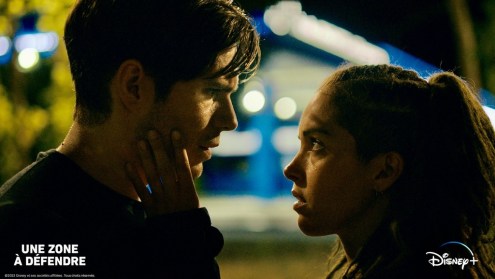
Female lead Lyna Khoudri (right) confronts Civil in the film’s unpredictable third act.
At 103 minutes long, A Place to Fight For makes me reminisce about a time not too long ago in Hollywood history when not only did major studios produce moderate budgeted, financially successful theatrical dramas, thrillers, and various high-concept genre films (re: stuff besides blockbusters) on a consistent basis, but also kept the majority of them under two hours long. A film that’s part investigative procedural thriller and part romantic melodrama only exists today, at least in the United States media ecosystem, on streaming (A Place to Fight For is Disney +/Hulu’s first French original film), and while it doesn’t move artistic mountains, it feels like a breath of fresh air a la the better Netflix Original movies I’ve watched since the late 2010s.
——————————————————————————————————————————————————————————–
SUMMARY & RECOMMENDATION: How do you refresh the crime drama while also making it palatable to most male and female audiences? As it turns out, you can add a quality, mature romance on which to anchor your main character’s arc and endow your procedural plot with relatable human emotion. Memorable documentarian aesthetics, a distinctive outdoor location-shoot, creative music, and sensible feature-length editing take care of the rest.
— However… this isn’t really a complaint, but that ending is straight out of A History of Violence (2005). I know what you did!
—> A Place to Fight For comes RECOMMENDED for those who like undercover cop stories mixed with meaningful melodrama. It’s like Avatar (2009) in a way, but relatable and smart.
? Wait a minute, this stuff about undercover police fathering children with activists is real?

 Express Elevator to Hell
Discussion
Trackbacks/Pingbacks
Pingback: ‘Old People’ (2022): For They Are Great in Number | Express Elevator to Hell - September 2, 2024
Pingback: ‘Kompromat’ (2022): There’s No Place Like Home | Express Elevator to Hell - September 3, 2024
Pingback: ‘Mayhem!’ (2023) & ‘Lost Bullet 3’ (2025): More French Ultraviolence | Express Elevator to Hell - March 21, 2026