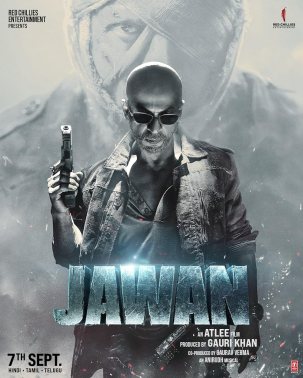
Directed by: Atlee || Produced by: Gauri Khan, Gaurav Verma
Screenplay by: Sumit Arora, Atlee, S. Ramanagirivasan || Starring: Shah Rukh Khan, Nayanthara, Vijay Sethupathi, Deepika Padukone, Priyamani, Sanya Malhotra
Music by: Anirudh Ravichander || Cinematography: G. K. Vishnu || Edited by: Livingston Antony Ruben || Country: India || Language: Hindi
Running Time: 169 minutes
Pathaan (2023) represented a sort of reckoning for both renowned Hindi cinema icon Shah Rukh Khan (SRK) and the greater Hindi film industry, also known as Bollywood, itself. Increasingly in competition with its Dravidian-language film industry neighbors to the south (i.e. South Indian Cinema) for box office dollars both at home and in the South Asian diaspora, Bollywood’s international relevance felt like it faded, at least to me, during the past decade (i.e. the late 2010s-early 2020s). Aamir Khan’s production house released a hit every now and then, yes, but he hasn’t headlined a profitable tentpole since Secret Superstar (2017); Salman Khan’s last big hits were in 2015 (Bajrangi Bhaijaan and Prem Ratan Dhan Payo); and SRK took a four-year hiatus from moviemaking from late 2018-early 2023 after a series of critical disappointments, the box office flop that was Zero (2018), and the COVID-19 pandemic. Put another way, if the spirit animals of contemporary popular Hindi cinema, the King Khans, weren’t doing well, then their industry couldn’t be expected to be red hot, either.
Then 2023 arrived with not one (Pathaan), not two (Jawan), but three (Dunki) profitable SRK-vehicles, the former two of which are now the sixth and fifth highest grossing Indian movies of all time, respectively, as of this writing (January 2024). In hindsight, perhaps the direct antagonistic comparison between northern Hindi cinema and the southern regional Dravidian cinemas is more of a theoretical exercise for cinephiles rather than a realistic depiction of the modern state of Indian filmmaking. Perhaps different Indian film industries don’t compete with one another so much as feed off each other.
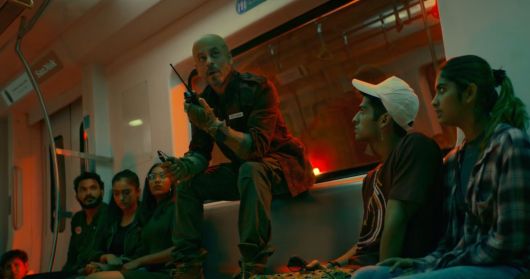
Shah Rukh Khan sports an obvious bald cap for his opening act heist of government trolling and social media lectures.
Regardless of how connected one regional South Asian film culture is to its neighbors’ success, I have seen little narrative innovation or even reliable directorial execution in the recent 2023 wave of SRK hits. Whereas contemporary South Indian production libraries seem diverse enough to mix and match straightforward genre fare with classical song-and-dance or melodramatic romances, contemporary mainstream Hindi films appear content to rehash the bland superhero — or superhero-adjacent — antics of Hollywood blockbusters, only with shoddier digital FX, longer runtimes, and even preachier monologues (to be fair, South Indian blockbusters sometimes do the same… ).
As bland and generic as Pathaan felt, released at the start of 2023, Jawan (“Soldier”) recalls the hamfisted political commentary of My Name is Khan (2010), the cheesy characters of Kuch Kuch Hota Hai (1998) and Ae Dil Hai Mushkil (2016; Karan Johar, anyone?), the on-the-nose dialogue of Munna Bhai M.B.B.S. (2003), and the dull action of Dhoom 3 (2013), or rather a combination of my most disliked filmmaking styles in all of Bollywood. The film’s script revolves around three extended set-pieces and one long flashback sequence, the former of which showcase longwinded speeches by Khan’s Robin Hood-esque vigilante hero about government corruption related to (1) the debts of impoverished farmers to the Ministry of Agriculture, (2) the lackluster infrastructure of public hospitals that primarily service the rural poor, and (2) polling stations and electioneering. These preaching seminars involve different convoluted heists that further illustrate how ingenious Khan’s main character is, like a sort of action hero version of George Clooney from the Ocean’s Eleven (2001, 2004, 2007) movies mixed with a low-level Marvel (2008-2019) side character (again, note the Dhoom 3 connections). None of the heist strategies are particularly impressive or clever, nor is the action cinematography much to write home about when the on-screen violence spikes.
With regards to the aforementioned flashback, the movie’s few non-linear time-jumps are meant to build suspense for the reveal of SRK’s dual cast roles that don’t generate much narrative drama for the main plot. The flashback’s main purpose is to pad the movie’s overall running time, like the colorful yet superfluous musical numbers, though as an expensive standalone short film, it’s not as tiresome or as preachy as the rest of the movie.
The remainder of Jawan is a random assortment of my general complaints with most big budgeted tentpole blockbusters, but Indian blockbusters in particular and Hindi ones most of all: The film is way too damned long (169 minutes), the supporting cast (e.g. Diana Mariam Kurian, also known as “Nayanthara,” Priya Vasudevan Mani Iyer, also known as “Priyamani,” Sanya Malhotra, etc.) are flat lines, and the villain, an anemic Vijay Sethupathi, is forgettable.
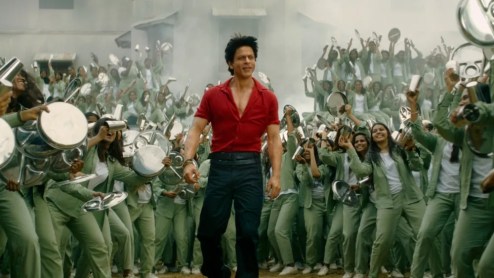
I appreciate how SRK has kept himself in such good shape at the age of 58, as well as the color contrast between him and the background dancers, but damn are these song numbers in one ear and out the other.
Looking back on it, I think I prefer Pathaan, a film that I do not like, to this movie given how at least the former has a charismatic, if underutilized villain in John Abraham. Jawan, by comparison, is just an expensive, hollow, bloated rehash of past Hindi action movies that were, themselves, derivative of Western high-concept action flicks that weren’t the most original movies in the world to begin with. In both its by-the-numbers direction (some slow-motion photography here, some shutter speed manipulation over there, high-key lighting blasted over the musical sequences, etc.) and its preachy, hamfisted script, Jawan showcases that while Hindi blockbusters maintain their lucrative edge well into the 2020s, that doesn’t mean they’ve gotten any better as actual movies.
———————————————————
SUMMARY & RECOMMENDATION: Star Shah Rukh Khan, principal screenwriter Sumit Arora, and co-writer-director Arun Kumar (“Atlee”) selling the same old song and dance isn’t problematic on paper, but their presentation of most every generic Indian action movie cliche, just with extra on-the-nose dialogue and extra forgettable set-pieces, doesn’t keep my interest past the 90-minute mark. Unlike, say, Jailer (2023), I don’t see an edit of this film that’s any more entertaining, nor does anything here approach the efficient pacing, creative action sequences, or memorable actor chemistry of an S. S. Rajamouli picture.
— However… Jawan’s flashback sequences are somewhat more interesting than the parent narrative, and there are no obnoxious comic relief characters here, thank God.
—> NOT RECOMMENDED
? I want to interview someone who genuinely thought this movie was interesting.

 Express Elevator to Hell
Discussion
Trackbacks/Pingbacks
Pingback: ‘Animal’ (2023): Sound & Fury, Signifying Nothing | Express Elevator to Hell - January 27, 2024
Pingback: Telugu Reviews, Volume 10: ‘Eagle,’ ‘Hanu-Man,’ & ‘Ooru Peru Bhairavakona,’ (2024) | Express Elevator to Hell - April 30, 2024
Pingback: ‘The Three Musketeers’ (2023): Burning Castles & Drunken Sword Fighting | Express Elevator to Hell - May 1, 2024
Pingback: ‘Shaitaan’ (2024): The Enigma That Is Indian Horror | Express Elevator to Hell - May 29, 2024
Pingback: ‘Ratsasan’ (2018) & ‘V’ (2020): What Genre(s) Are Serial-Killer Movies? | Express Elevator to Hell - May 30, 2024
Pingback: ‘Maharaj’ & ‘Maharaja’ (2024): South Asian Social Justice on Screen | Express Elevator to Hell - July 31, 2024
Pingback: ‘Outside’ (2024): Stage Plays Should Stay on Stage | Express Elevator to Hell - November 30, 2024
Pingback: ‘Kill’ (2023): The Best Indian Action Film… Ever? | Express Elevator to Hell - December 8, 2024
Pingback: ‘Pushpa’ (2021, 2024): The Rise & Rule of Telugu Blockbusters | Express Elevator to Hell - March 20, 2025