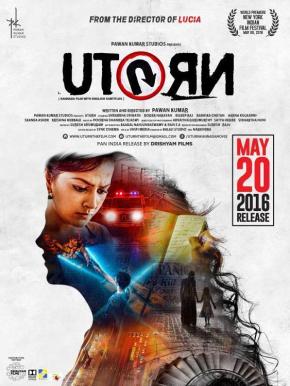
Directed by: Pawan Kumar || Produced by: Pawan Kumar
Screenplay by: Pawan Kumar || Starring: Shraddha Srinath, Roger Narayan, Radhika Chetan, Dileep Raj
Music by: Poornachandra Tejaswi || Cinematography: Advaitha Gurumurthy, Satya Hegde, Siddhartha Nuni || Edited by: Suresh Armugam || Country: India || Language: Kannada
Running Time: 121 minutes
The northern Indian Hindi language film industry, intermittently referred to as Bollywood (a play on the words “Bombay” [present day Mumbai] and “Hollywood”), is dependent, to a certain degree, on intellectual property (IP) remakes, reboots, and re-imaginings from earlier decades as well as other industries like any successful, popular filmmaking culture. Some of the most potent, lucrative sources of IP material for Hindi filmmakers to mine are the Telugu, Tamil, Kannada, and Malayalam-language production houses just south of Mumbai’s parent state of Maharashtra, known collectively as South Indian Cinema (SIC). While SIC as a whole, but Telugu cinema in particular, has grown in size and profitability in recent years (see S. S. Rajamouli’s Baahubali [2015, 2017] and RRR [2022] or Prashanth Neel’s K. G. F. [2018, 2022]) compared to Bollywood, its diverse ethnoregional background has provided a mosaic of creative to formulaic narrative premises that can be repackaged and resold for north Indian Hindi-speaking audiences, who form the bulk of the country’s population.
Many of these popular South Indian films are remade in other languages by their original director, such as Murugadoss Arunachalam’s Ghajini (2008), starring Aamir Khan, which was a Hindi-language redo of the 2005 Tamil film of the same name that Arunchalam also wrote and directed (both films were, in turn, “inspired by” Memento (2000), the sophomore feature of Christopher Nolan). Another example of that phenomenon is U Turn, a Kannada-language supernatural thriller written, directed, and produced by Pawan Kumar, and a feature that was later remade no less than seven times in various languages from India to the Philippines, including under the same name in Tamil and Telugu in 2018 by Kumar himself and in Hindi by Ekta Kapoor last year (2023).
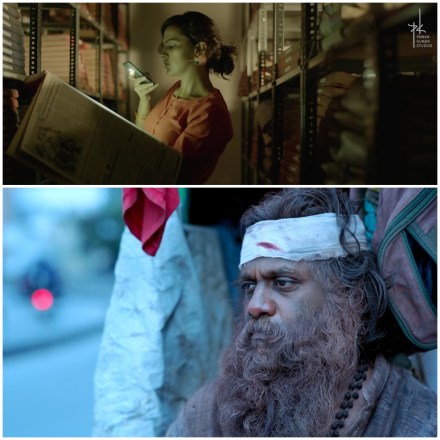
Top: Lead Shraddha Srinath investigates an inexplicable series of murders of civilians linked only by their unethical disregard for traffic laws. Bottom: Kennedi Gopalan portrays a homeless vagrant whom Srinath pays to record motorists who take illegal U-turns off a local freeway in Bangalore.
Dissecting the film’s creative premise, restrained length (121 minutes, disciplined by Indian and even Hollywood standards these days), and assured direction, it’s easy to understand how appealing the material is for other directors to sample. The story follows the burgeoning investigative journalism career of protagonist Shraddha Srinath, a rookie intern at the Bangalore branch of The Indian Express whose pet-project studies how motorists illegally move makeshift concrete dividers that partition a local flyover to allow themselves a U-turn shortcut off the freeway (these Bangalore citizens often don’t bother moving those dividers back to their original position, thereby creating traffic hazards). Long story short, a series of murders of those traffic lawbreakers prompt criminal investigations by the city police, who soon interrogate Srinath over her indirect professional connection to the victims; the higher the body count climbs, the weirder the story grows as the film’s tone transitions from an otherwise straightforward whodunit mystery thriller into a near horror movie with distinct supernatural overtones.
Kumar directs the adventure with sensible dramatic flair, having his character actor-dominated cast act like normal people placed in bizarre, at times extraordinary situations with almost zero melodrama. U Turn’s weirdest sequence tests this rule, where two suspects held in police custody become seemingly possessed and attack each other in an extended, gory set-piece, but even here Kumar avoids tonal clash and every sequence fits within the greater story. Once the third act embraces the paranormal plot-points earlier sections of the film only foreshadowed, Kumar uses various handheld point-of-view tracking shots previewed in the opening title sequence to circumvent tedious, expensive special FX and maintains a haunting, memorable aesthetic distinguishable from many louder, more abrasive ghost stories.
U Turn as a whole is so consistent that even the ending credits’ documentary footage, a series of real-life traffic camera clips of people creating the same traffic hazards as illustrated by the characters in U Turn’s fictional narrative, fit as a thematic exclamation point to the film. Its entire cast work well together, its cinematographic style is memorable without calling attention to itself, and the story wraps at a reasonable length without feeling the need to bloat itself with unnecessary action scenes, set-pieces, or musical numbers. Though I might lament the absence of a notable soundtrack in Indian movies given the inherent colorful nature of South Asian song and dance, many (most?) purebred genre movies don’t need extra flowery embellishments; so, I argue U Turn gets by just fine without the impressive stereotypical soundscapes of an M. M. Keeravani or A. R. Rahman. The movie’s premise and direction stand tall on their own, so much so that they’ve been redone over half a dozen times since the film’s debut.
———————————————————————————————————————————————————————
SUMMARY & RECOMMENDATION: A realistic ghost story, even if defined in the loosest sense, makes the paranormal, supernatural, superstitious, or whatever you wanna call it, feel scarier to most audiences, I argue, than the loud, over-the-top, FX-driven nonsense of mainstream horror like The Conjuring (2013, 2016, 2021) or whatever Exorcist (1973)-ripoff IP is trendy these days. One also shouldn’t pigeonhole Pawan Kumar’s supernatural thriller into a generic spooky urban legend, either, as its journalistic procedural format, led by a capable Shraddha Srinath in her sophomore acting performance, lends U Turn its most identifiable tonal attributes and paces its scares, twists, and character arcs just right.
— However… an extended “fight sequence” about halfway through the movie, though necessary for the story, stretches narrative credulity and is the closest the film comes to breaking its genre formula.
—> RECOMMENDED
? In all seriousness, those traffic footage clips after the main story may be the scariest moments in the whole movie.

 Express Elevator to Hell
Discussion
Trackbacks/Pingbacks
Pingback: ‘Kill’ (2023): The Best Indian Action Film… Ever? | Express Elevator to Hell - December 8, 2024