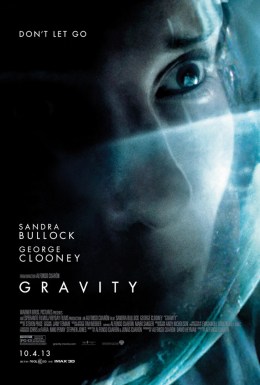
Directed by: Alfonso Cuaron || Produced by: Alfonso Cuaron, David Heyman
Screenplay by: Alfonso Cuaron, Jonas Cuaron || Starring: Sandra Bullock, George Clooney, Ed Harris, Paul Sharma
Music by: Steven Price || Cinematography: Emmanuel Lubezki || Editing by: Alfonso Cuaron, Mark Sanger || Country: United Kingdom, United States || Language: English
Running Time: 90 minutes
When Alfonso Cuaron’s Gravity released last fall, I admit I did not buy the hype surrounding the movie’s lauded special FX and its critically praised “thrill-ride” story. Films that are hailed as special-FX “experiences,” movies that place special emphasis on turning their plots and characters into theme park rides, turn me off, especially in the wake of the childish James Cameron-adventure that was Avatar (2009). That is more or less what I thought Gravity was after skimming the reviews and taking in the general fan-reaction regarding the film’s visuals.
As it turns out, I was partially correct in my pre-judgments. Cuaron’s latest critical and commercial success is, like Avatar, a film that relies heavily on computer-generated FX to create its spectacle and inspire a cinema-of-attractions-type “awe” in its viewers. To the film crews’ credit, the special FX are impressive. It would be hard for anyone in their right mind to knock Gravity on its visuals or sound-design. Everything from a technical perspective is well done.
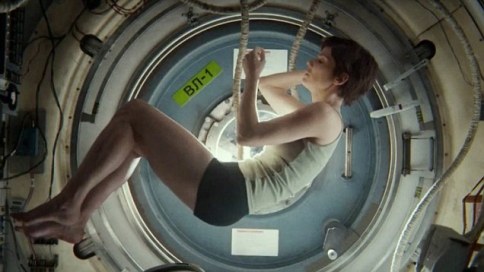
The fetus in the womb
With that in mind, Gravity does disprove my prejudices to a large extent by using its vivid imagery to construct deep symbolism. The good looks of Cuaron’s picture are not just for show, as they would be in most other special FX-heavy films like Cameron’s Avatar or a typical superhero blockbuster. More importantly though, Gravity does sport competent characters that undergo interesting arcs. The film shares motifs with shipwreck and wilderness survival narratives like Cast Away (2000), Life of Pi (2012), 127 Hours (2011), and Rescue Dawn (2006), in that it examines the limits of human endurance in the face of isolation and catastrophe. In many ways, Gravity is a logical extrapolation from the classic survival stories of the past, transplanting the thrills of man (or woman) against the odds of mountain cliffs, unforgiving oceans, and treacherous jungles to the eerie vacuum of zero G.
Cuaron’s film succeeds because it combines effective, albeit minimal, character development with complex imagery. The movie is a similar experience to my always-favorite and frequently referenced action movie, The Raid (2012). Both films utilize sparse yet effective plots and characters in combination with potent spectacle to create masterful thrill rides. In Gareth Evans’ Raid, the spectacle was impeccably choreographed and filmed martial arts; in Gravity, the attraction is symbolic CGI. If you’re paying attention, you’ll pick out things like the resemblance between protagonist Sandra Bullock and a fetus in a womb in one nuanced shot, and the evolutionary symbolism when Bullock swims out of a drowning spaceship and slowly crawls onto, and then finally stands upright on, land.
With all that said, I’m not as in love with Cuaron’s Oscar-nominated picture as most audiences are. Reasons why have to do with Bullock’s performance and how repetitive it is to hear her panting, screaming, and complaining for 90 minutes throughout this space-adventure. Gravity would have been a cinematic explosion if its central character had more nuance and/or “acted” less; so Bullock’s Academy Award-nomination for Best Actress makes little sense to me.
Another complaint has to do with the movie’s tendency to talk down to its viewers. To say the film’s explanation of its primary theme is heavy-handed might sound harsh, but George Clooney’s description of Bullock’s entire emotional conflict and character arc, word-for-word in monologue, comes across as clumsy. This continues when Bullock herself explains in monologue her character’s arc, just to make sure we get the message. In general, the medium of film is meant to show, not tell, and when a movie as visually complex as Gravity dumbs itself down to the point where it has to flat-out tell you the whole point behind its story, it feels condescending.
In the grand scheme of things, I am reluctant to knock down Gravity too much for its mediocre protagonist and condescending plot when it is so powerful in all other areas. Alfonso Cuaron did an outstanding job crafting such an entertaining survival thriller set in space; I am on board with Cuaron’s directing nomination, even if I have reservations about the general praise for Sandra Bullock. If you’re looking for a “thrill-ride”-type cinematic experience, you can do much worse than Gravity.
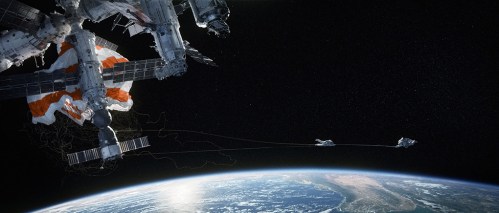
Don’t let go!
————————————————-
SUMMARY & RECOMMENDATION: Gravity’s deep visuals are executed with confidence and grace courtesy of Alfonso Cuaron’s expert direction. The film is flashy and intelligent… in a visual sense. While second fiddle to the movie’s technical aspects, Cuaron’s writing paces the adventure for maximum excitement.
— However… Sandra Bullock is unappealing as a space-survivalist. Her mannerisms and line-delivery grow tiresome by the story’s conclusion. Much of the dialogue from the entire cast could have gone, as far as I’m concerned. The film’s tendency to talk down to its audience is annoying, particularly in its final act.
—> ON THE FENCE; the film is worth a rental, if not Academy Awards domination.
? I know where the Russians store their vodka! — George Clooney. That’s neat and all, but what about where the Chinese store their rice liquor?

 Express Elevator to Hell
Its an EVENT!!!
Posted by Tim The Film Guy | January 27, 2014, 4:56 pmIt’s a SPACE PARTAY!!!
Posted by The Celtic Predator | January 27, 2014, 11:22 pm