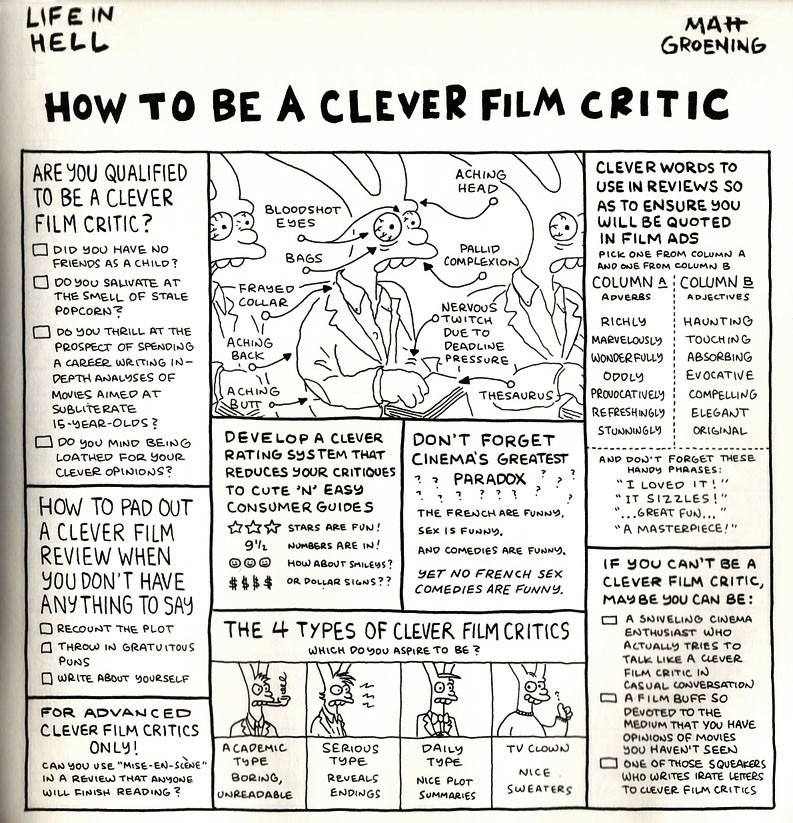
A common assertion on numerous film podcasts, forums, news comment-sections, and especially YouTube videos, is the assertion that evaluations of film quality are subjective. Put another way, casual movie-goers argue that reviews of movies are based entirely on people’s opinions, and because opinions are the subjective reasoning of people’s personal biases, history, and experience, therefore critical analysis of films are entirely within the eye of the beholder, and no single person’s review of film is superior to anyone else’s.
I think this philosophy is heavily flawed. It is a half-assed, lazy rationalization for most people’s inability or unwillingness to study cinema and put legitimate effort into understanding and appreciating its craft. Simply put, I believe this ideology to be one of the most poisonous and troublesome attitudes in film culture today, along with anti-genre snobbery and forcing one’s political agenda into film analysis.
Filmmaking and film criticism are not “subjective” — or at least they shouldn’t be. Advocating that art and art criticism are based purely on individual knee-jerk reactions of creativity and interpretations of such creativity, respectively, devalues the art and all who work to understand it. In fact, this claim asserts that there is no point in understanding the art at all. Why bother contemplating, let alone studying or practicing film if all artistic output is without meaning, if none of it is beautiful? What is the point of appreciating beauty if all that beauty is simply within one’s own mind? This philosophy ignores the craft and painstaking care (or lack thereof) taken by filmmakers to make films, and film-lovers to understand and critically think about them; it disrespects film and film criticism because it argues that there is in fact no craft at all!
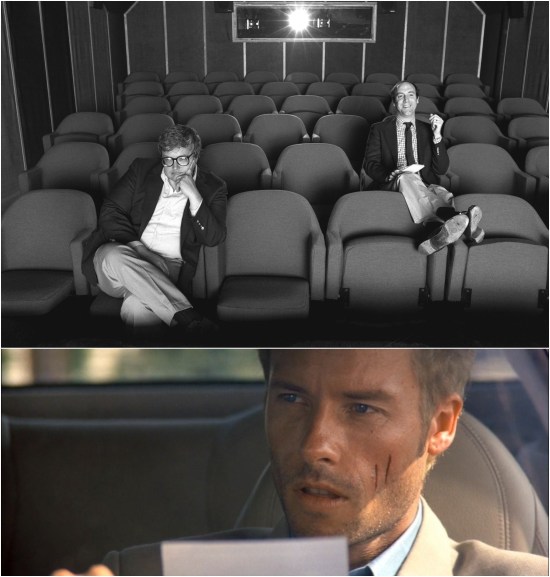
Top: The film critic’s task, then, like the ones faced by their peers in dealing with the other arts, is to explain as clearly as possible what it is that makes a particular film tick. Bottom: I have to believe in a concept of cinematic art outside my own mind. When I close my eyes, is the movie still there? Are people still dedicating their lives to painstakingly create, innovate, study, and revolutionize film? Are they? Yeah…
While no filmmaker or film academic is entirely free from biased perception of the world around them, some are clearly “more free” than others and are better able to dissociate their personal views and experiences from limiting their understanding of other people and their artistic expression. These individuals are not only more empathetic than the average person, but they are also far less apathetic and ignorant; reviews that take time to evaluate a project free from personal bias and understand the artwork on its own terms are superior to both those that either (a) critique a film on whether it agrees with their subjective world-view, or (b) merely make positive or negative evaluations of said work like, “I liked it,” or, “I hated it,” and attempt no further explanation of their views.
For that is what a true review is: An assessment of a film that is as free as possible from personal biases, which is backed by rational arguments, concrete examples (i.e. evidence of quality), and detailed explanation. A good reviewer/critic/cinephile (whatever snobbish name you wish to put upon them) does not only tell you whether a movie sucks or not, they explain why, and in detail.
For there is the primary difference between individuals who claim filmmaking (and by extension, all art) is merely in the eye of the beholder and those of us who claim artistic merit is something more — we differ in the effort exerted in our thought processes and evaluation of films. Simply put, we put more effort into deciding whether or not we like a film. We work harder to decide how good a film is. We try harder and think harder because we care more; we care a lot more about film and understanding filmmaking than the average person, who by contrast couldn’t give a shit. It’s hard to give a shit when you believe everything about a discipline is subjective. Why would you?
Asserting that film analysis, criticism, and creativity are subjective is as unforgivable as one who claims to be the definitive, all-knowing, objective judgement of film without making any coherent, logical defense to back up those claims. Cries of film subjectivity are the siren songs of those who cannot muster the energy to argue their interpretation of cinema, or who cannot understand why they react to films the way they do. People who say “movies are subjective” or are just one person’s point-of-view, are either lazy, uneducated, apathetic, or some combination thereof.
Claiming that film content and cinematic quality are subjective is the lamest, laziest, most copout answer one can make in film criticism. Similar to how people of faith propose to explain away the existence of a higher power by saying, “God works in mysterious ways,” allegations of film’s subjectivity are worse than a bad or nonsensical argument against or for a particular film. It is not even an argument. It is a non-answer, a half-hearted, throw-your-hands-up-in-the-air straw-man defense for people too lazy or ignorant to defend their position. If movies really are “subjective” and free from all criticism, then none of this matters — film theory, film craft, film narrative, film academia, characterizations, auteur-ownership, none of it is worth anything. Don’t bother discussing or analyzing these films, people; nobody cares! It’s all subjective, so fuck it…
Alleging that cinematic quality and craftsmanship are subjective is akin to giving everyone gold stars for trying in little league soccer or an A for effort in academia. Everyone’s opinion is valid, you’re all special; we wouldn’t want anyone’s feelings to get hurt or God forbid encourage people to actually explain their feelings about movies.
One appreciates the validity of film objectivity more and more with the passage of time. Look at examples of long-term consensus and divisiveness within both professional film criticism and academia as well as pop culture. A consensus of a film’s artistic merit and cultural impact over a period of time is the true measure of that film’s legacy, its historical significance, and its artistic worth as film. After 30+ years of dedicated fandom, critical analysis, and Hollywood revolution, Star Wars‘ (1977, 1980, 1983) quality speaks for itself. Conversely, a film that stirs heated controversy or remains divisive years after its release speaks to that project’s notable positive and negative merits. A movie like, say, Man of Steel (2013), which continues to split fans down the middle years after its release, partially vindicates both its haters and supporters. A film that has been long forgotten, on the other hand, implies said film never possessed much artistic merit or innovative craft to begin with, despite whatever hype glorified its initial release (i.e. it was overrated). Finally, consider the inverse of the latter situation: Films that were financially and/or critically punished upon release, but were subsequently re-evaluated in warmer light as they gained cult status or influenced future generations of venerable filmmakers (e.g. most of John Carpenter’s filmography).
That’s how we abide.
I’m not making this stuff up, folks. These are actual trends that occur in pop culture and film academia.
This leads me to my final example of film criticism validity: Splitting hairs versus disparate quality. It may be futile to determine whether a cinematic landmark like Citizen Kane (1941) is really “better” or “worse” than an American New Wave classic like The Godfather (1972), but much, much larger contrasts in cinematic craft exist in excess and speak to the very real nature of objective cinematic quality. For instance, compare either of the former to anything Adam Sandler has ever done, or any blockbuster from the Marvel Cinematic Universe, or any of The Fast and the Furious films, or Transformers: Age of Extinction (2015). My assertion that Fight Club (1999) is a better piece of cinematic art than Iron Man 3 (2013) isn’t my opinion, but a demonstrable, real-world phenomenon.
In other words, while it may be impossible to prove with 100% certainty the precise cinematic quality of all films relative to each another, that doesn’t mean cinematic quality doesn’t exist, nor that we shouldn’t try to determine if it does or does not exist in the first place. If we don’t, then we devalue the art of cinema, we advocate that the artistic merit of film exists only within our minds; and if the history and proliferation of cinema has taught us anything, it is that the power of film is anything but.
 Express Elevator to Hell
Your specific example of Fight Club is interesting. I think that movie has merit, but the failing of that movie is leaving the destruction and stuff still feeling cool and somewhat righteous. It’s slightly too subtle for the audience to realize the movie actually is saying, “wait a second, don’t do this”.
There are cases of people starting actual fight clubs or doing violent things against capitalism citing the movie. Not that it’s a huge number or anything, but think about what that means of the number of people walking around with the wrong interpretation of the film?
Posted by Vaga | October 22, 2023, 12:22 amI wouldn’t think of interpretations of film as “right” or “wrong” so much as “logical (evidence based)” or “illogical (inconsistent, nonsensical, etc.).” With respect to FC, I thought Fincher did an effective job illustrating the dark side of Durden’s philosophical nihilism and anarchy (e.g. Robert Paulson’s violent death, the mindless groupthink of the underground fight club, Jack almost getting himself neutered by those cops, etc.).
In other words, I’d argue people taking FC’s escapist philosophy as an excuse for extremism is an example of them missing rather obvious narrative subtext. The fact that that film has influenced so many people in so many ways, though, is evidence, I argue, of its storytelling prowess.
Posted by The Celtic Predator | October 24, 2023, 6:23 pmWhile there is objective merit to any movie, I also believe that the tastes are also important. One personal example woupd be “Barbie” from 2023 by Greta Gerwig. While critics talk about how good the movie is, while I can recognise the movie’s qualities, I found the movie really obnoxious, couldn’t continue watching it.
And honestly, the main reason why I think art is subjective is not because art has no objective merit, but that movie discussions ,for example, are an open discussion. If movie discussions were truly objective, then we would just ask an expert to watch the movie and the discussion would be over . I would argue that treating a movie’s quality objectively is much worse for discourse, because what’s the point of giving your take? What’s the point of writing a review sharing your perspective on the movie if it’s “wrong”. What’s the point of expressing your respect for a movie and try to explain why you thought it was really good, if critics who went to film school and review movies for decades said the movie is trash? Well, the experts had the verdict, your review is wrong and it’s all pointless.
You wouldn’t write about how you think 1+1=3, right? It is objectively wrong. But you would write about a movie being an underrated gem. And for this, I got two examples: The Punisher 2004, and Shrek Forever After, movies that when they came out, they were pretty much labeled as unispired and derivative by critics, now forever sitting with a rotten critic score on Rotten Tomatoes. I think that these movies are really good, and they have a lot of qualities, but what’s the point of saying that if the movie’s objective quality was decided?
And I can write essays on why these two movies are really good, but also acknowledge
Posted by OrezuCucurez | April 24, 2025, 10:23 amThat’s a relatively nuanced take. My primary response to your comment is that I’m not sure we’re in much disagreement (not that we have to agree, of course). I don’t see films as mathematical formulas that must be broken down like a statistics or calculus course, yet at the same time, cinematography, editing, and overall visual storytelling have clear, established formulas that must be followed for their moving pictures to have the maximum *intended* impact on their viewers. Sure, those rules may be broken, as I’ve written elsewhere on this site, but they must be broken *purposefully* in order for them to most effectively serve the greater story of a given film.
My general disagreement with your comment is your articulation of film critics, journalists, students, et al. as “experts.” Correct me if I’m wrong, but at no point in my original essay did I argue that formally educated or professional film commentators are somehow “better” or more experienced at film criticism than the Average Joe. They certainly *can* be, yet they can also be limited by personal biases and lazy prejudices like any individual. I don’t discourage discussion of films’ merits, but rather welcome them, especially between “professional” and “amateur” cinephiles.
A better metric, if we are to choose any, for measuring filmmaking effectiveness is TIME. Like most artistic media (not just film, but music, fine arts, literature, etc.), I’ve found that the good stuff tends to bubble to the surface over time even if the generic, mainstream, and often ineffective mass of forgettable art projects tends to overshadow the former upon initial release.
Posted by The Celtic Predator | April 24, 2025, 3:40 pm