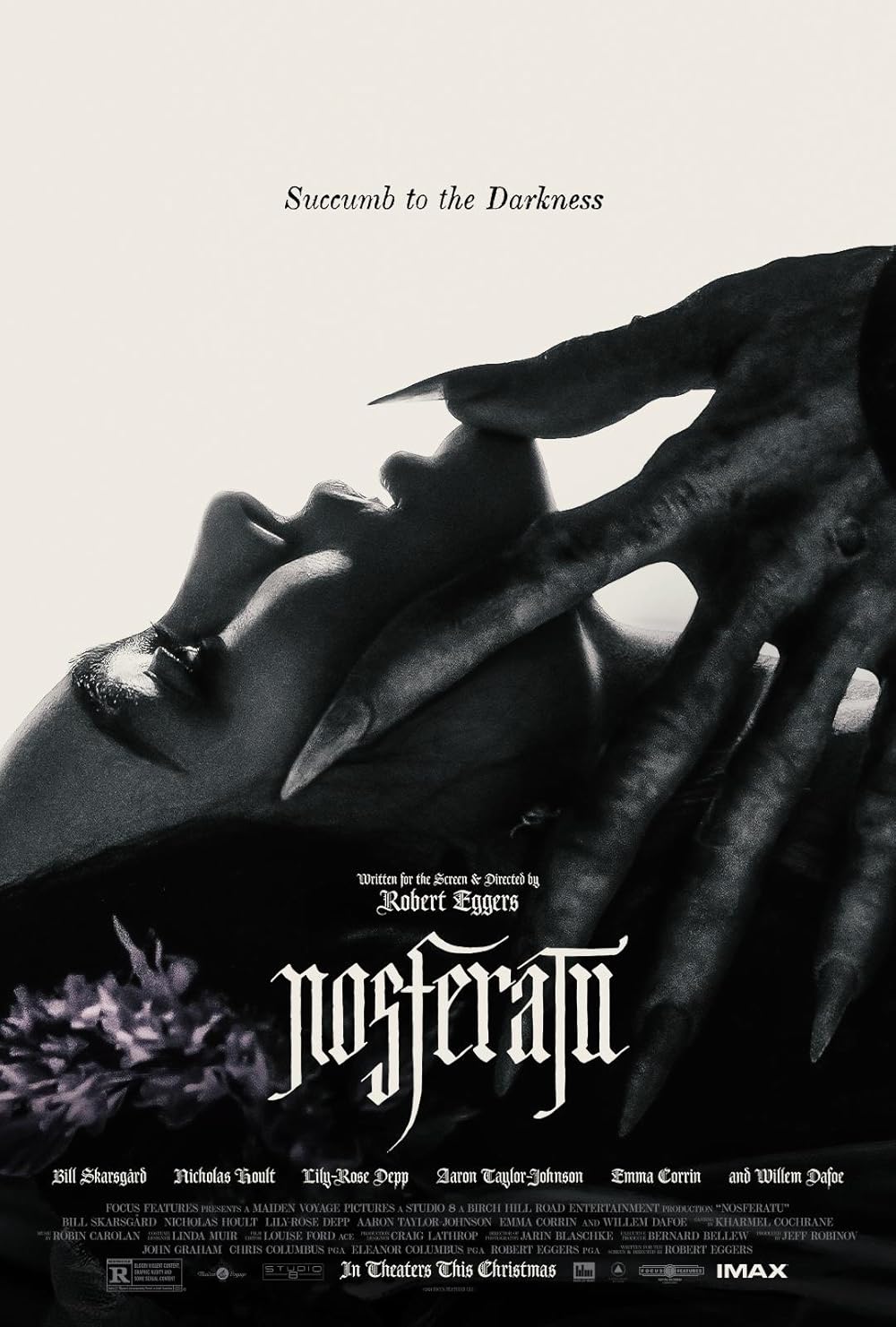
Directed by: Robert Eggers || Produced by: Jeff Robinov, John Graham, Chris Columbus, Eleanor Columbus, Robert Eggers
Screenplay by: Robert Eggers || Starring: Bill Skarsgård, Nicholas Hoult, Lily-Rose Depp, Aaron Taylor-Johnson, Emma Corrin, Willem Dafoe
Music by: Robin Carolan || Cinematography: Jarin Blaschke || Edited by: Louise Ford || Country: United States || Language: English
Running Time: 132 minutes
The original Nosferatu (1922) by F. W. Murnau is one of the earliest examples of copyright disputes and artistic plagiarism in mainstream cinema. Although my go-to example of filmmakers ripping each other off without due credit is Sergio Leone’s rendition of Yojimbo (1961) by Akira Kurosawa, A Fistful of Dollars (1965), Nosferatu is almost certainly the most recognizable case study of international copyright infringement in film given the ubiquity of its source material: Bram Stoker’s Dracula (1897).
This off-brand German Expressionist Dracula, once legally mandated to be destroyed by a lawsuit from the Stoker estate, survived for over a century until it entered the public domain in 2019. Several remakes of Nosferatu achieved their own level of notoriety, the most well known of which may be Werner Herzog’s 1979 work of a similar name (Nosferatu the Vampyre), which featured the megalomaniacal Klaus Kinski as the main antagonist and creature of the night, Count Orlok.
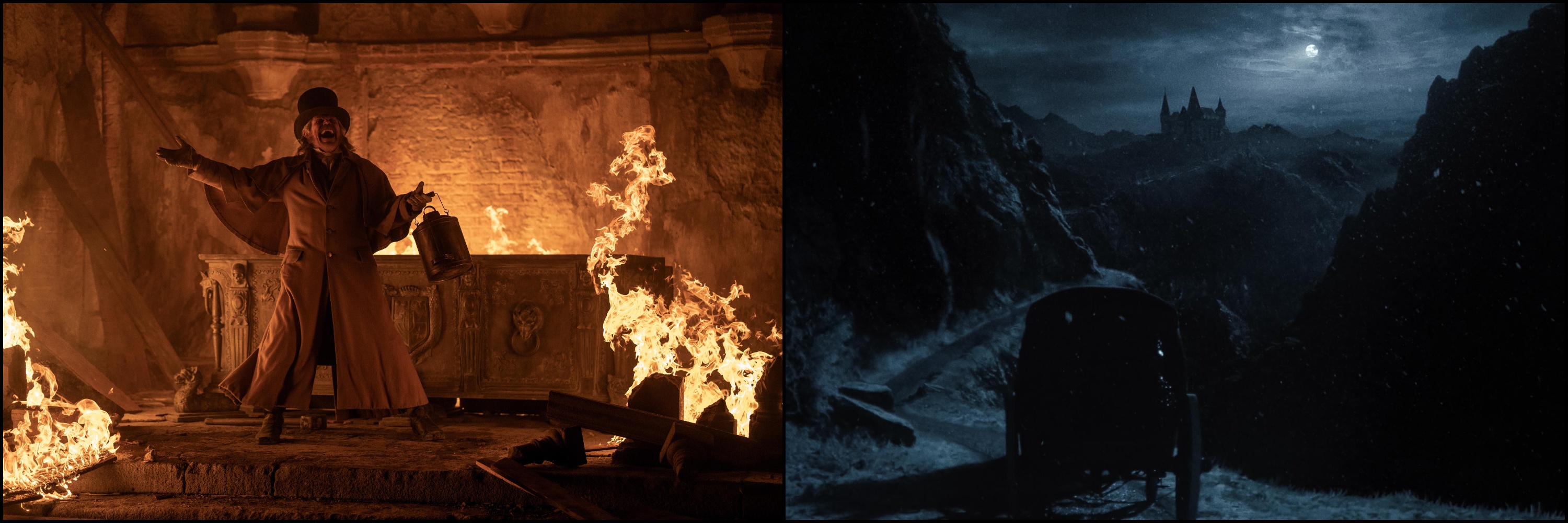
Nosferatu is powered by fiery orange and cool blue colors like few other films, where its nighttime cinematography almost appears monochromatic except when illuminated by fire (left) or moonlight (right).
Enter Robert Eggers, one of the most notable auteur genre filmmakers in Hollywood, whose interest in adapting the property dates back at least to the immediate fallout from his horror feature debut, The Witch (2015). Known for his personal interests in pagan cultures, Western folklore, and the historical accuracy of his narrative diegeses, Eggers blends awards-friendly drama and great acting-direction with somewhat mainstream genre flavors like horror and action. Nosferatu (2024) represents arguably his greatest cinematographic achievement yet thanks to his fourth collaboration with director of photography Jarin Blaschke, as well as a continuation of his strengths at cinematic world-building and composition of complex, relatable characters.
If you are at all familiar with the basic premise of the Dracula mythos (Francis Ford Coppola’s Dracula [1992] and Stephen Sommers’ Van Helsing [2004] are my classy and schlocky favorites, respectively), the general framework of this latest Nosferatu won’t surprise you: A newlywed couple (Lily-Rose Depp and Nicholas Hoult) become the targets of an ancient undead nobleman (Bill Skarsgard) when the husband (Hoult) travels to said nobleman’s Transylvanian estate to sell him property in the couple’s hometown. After arriving in the Carpathian Mountains of Transylvania, Hoult gets more than he bargained for after Skarsgard interrogates him over the location of his wife and Hoult finds himself trapped in Skarsgard’s castle.
While that premise is enticing enough, it is characteristic of most any incarnation of Nosferatu or direct adaptation of Stoker’s novel. What best defines Robert Eggers’ take on the material is his affection for the story’s 19th century Romantic aesthetic and his utter command of narrative tone. Blaschke adapts the property’s German Expressionist roots for the modern age thanks to a desaturated celluloid palate. Combined with exceptional sound-design, the overall mood of melodramatic dread and foreboding permeates most every sequence, daytime or night, and takes advantage of excellent set-design and outdoor location-photography from the Czech Republic.
In other words, Nosferatu looks and sounds great; but do its conventional story and characters hold up? I would argue so, as the stellar main cast (Willem Dafoe, Aaron Taylor-Johnson, Emma Corrin, Ralph Ineson, plus the aforementioned) all perform well above their batting averages, handling the peculiar period dialogue and oddball vocabulary quite well. Eggers treats all their characters with respect and pigeonholes no one, not even Skarsgard’s Count Orlok, as one-dimensional stereotypes.

Daytime sequences of Nosferatu offer considerable tonal relief from the ominous darkness of its nighttime scenes.
I even appreciated the pacing of Nosferatu at a reasonable 132 minutes. Although most contemporary horror films seem to average well under two hours, this Gothic horror story’s distinct and memorable locations, reasonable number of characters, succinct conclusion, and total lack of sideplots make the longer than average runtime work.
In the end, it is ironic how Robert Eggers’ latest, most successful film (Nosferatu grossed ~$156 million on a $50 million budget as of this writing) is an adaptation of an “established intellectual property (IP)” despite his reputation for acclaimed original screenplays (e.g. The Witch [2015], The Lighthouse [2019], The Northman [2022]). At the same time, Nosferatu is itself perhaps the oldest mainstream example of an unsanctioned remake of an even more famous IP, but none of these properties themselves could be described by most audiences as trending sensations in the 2010-2020s. Nosferatu is a recognizable IP, sure, but I would argue that Eggers himself is the main attraction here. Much like with Christopher Nolan and his increasingly obnoxious “mind-bending” plot-devices, Eggers’ attention to audiovisual detail and oppressive Gothic atmosphere may have gained enough of a reputation to overshadow the source-material of this creature of the night.
————————————————————————————————————————————————————————-
SUMMARY & RECOMMENDATION: Beautiful in tone as its characters are reliable, Nosferatu (2024) is an admirable modern take on a classic tale that takes advantage of its writer-director’s penchant for horror mythology and historical detail. Its story beats will be familiar even to audiences that have never seen nor read a Dracula-adaptation, but its seductive, patient cinematographic execution is anything but.
— However… I did not have a problem with the runtime, but audiences with little patience for slower horror may balk at Nosferatu’s romanticism. I found this film much more accessible than your standard obtuse, self-important A24 picture, yet I concede many viewers may not.
—> This classy yet decrepit bloodsucker comes RECOMMENDED.
? Regardless of how the likes of Mark Kermode attempt to explain it, I still say this entire story was Lily-Rose Depp’s fault.

 Express Elevator to Hell
Discussion
No comments yet.