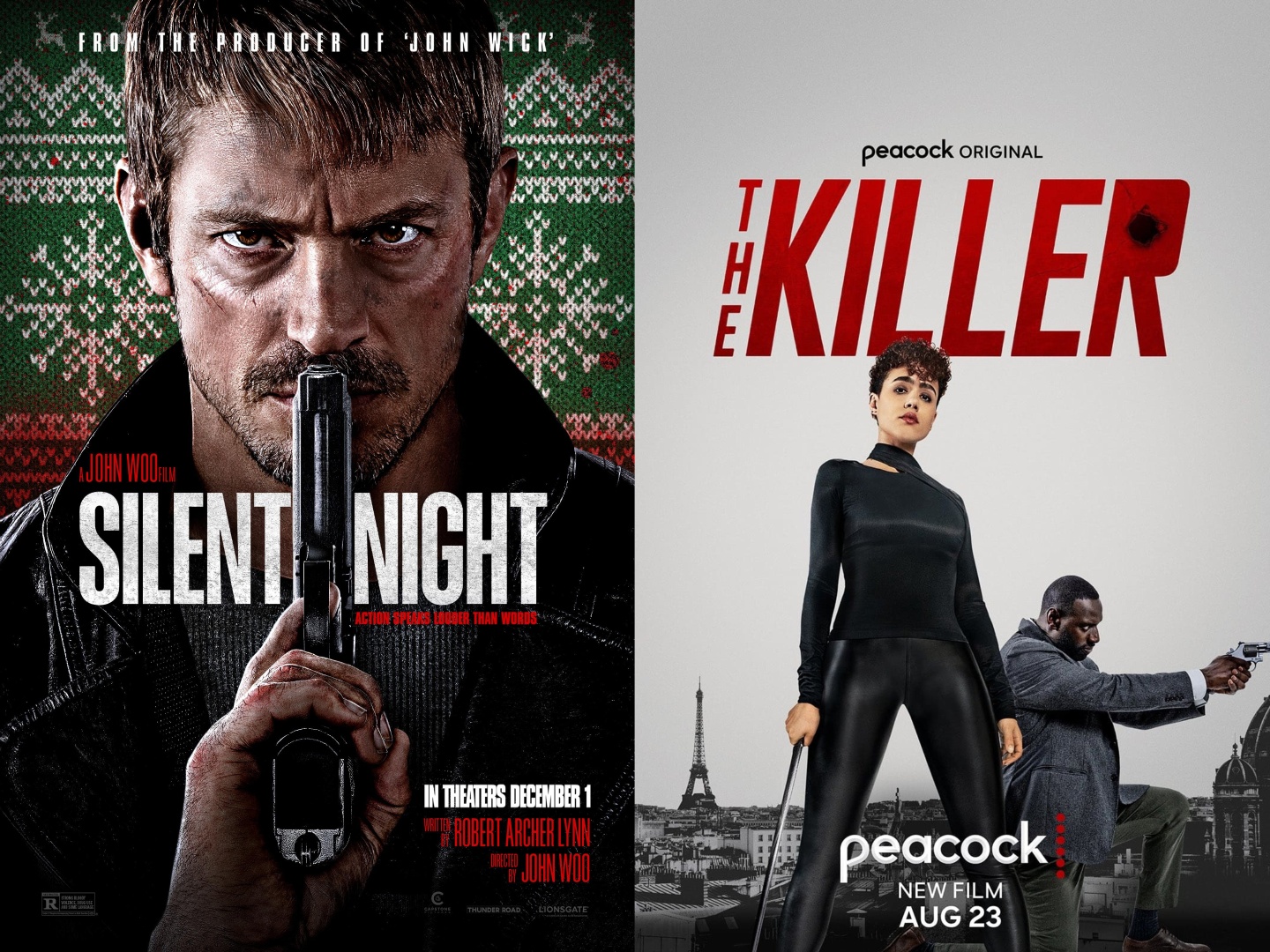
Directed by: John Woo || Produced by: Christian Mercuri, Basil Iwanyk, Erica Lee [1], John Woo, Lori Tilkin deFelice [1, 2], Charles Roven, Alex Gartner [2]
Screenplay by: Robert Archer Lynn [1], Brian Helgeland, Josh Campbell, Matt Stuecken [2] || Starring: Joel Kinnaman, Scott Mescudi, Harold Torres, Catalina Sandino Moreno [1], Nathalie Emmanuel, Omar Sy, Sam Worthington, Diana Silvers, Eric Cantona, Saïd Taghmaoui [2]
Music by: Marco Beltrami || Cinematography: Sharone Meir [1], Mauro Fiore [2] || Edited by: Zach Staenberg || Country: United States || Language: English
Running Time: 104 minutes [1], 126 minutes [2] || 1 = Silent Night, 2 = The Killer
Some of the earliest international, non-English language genre films I enjoyed as a young adult were the Hong Kong action films of John Woo. Although his filmography spans multiple decades across the Cantonese island nation, Hollywood, and mainland China, Woo has maintained his signature melodramatic style of over-the-top characters and elaborate slow-motion action sequences. He has produced his share of duds throughout his career in different languages, yet is versatile enough to adjust his directorial sensibilities and screenplay preferences to different national film cultures without compromising his core artistic vision. Along with Johnnie To, he is one of the few Hong Kong auteurs to have outlasted their now declining Cantonese film culture as it is absorbed into the Mandarin Chinese-dominated mainland.
I have previously covered Woo’s stint in mainland China after a lucrative yet inconsistent first trip to Hollywood (Face/Off [1997] remains his best English-language feature and one of my favorites of his), including his subsequent, obvious stylistic throwback to his earlier Hong Kong classics in the multilingual Manhunt (2017), which was distributed internationally by Netflix. What surprised me more than his debut on streaming platforms, though, was his subsequent return to Hollywood with the almost dialogue-free Silent Night (2023) and later remake of one of his most famous features, The Killer (1989), a year later.
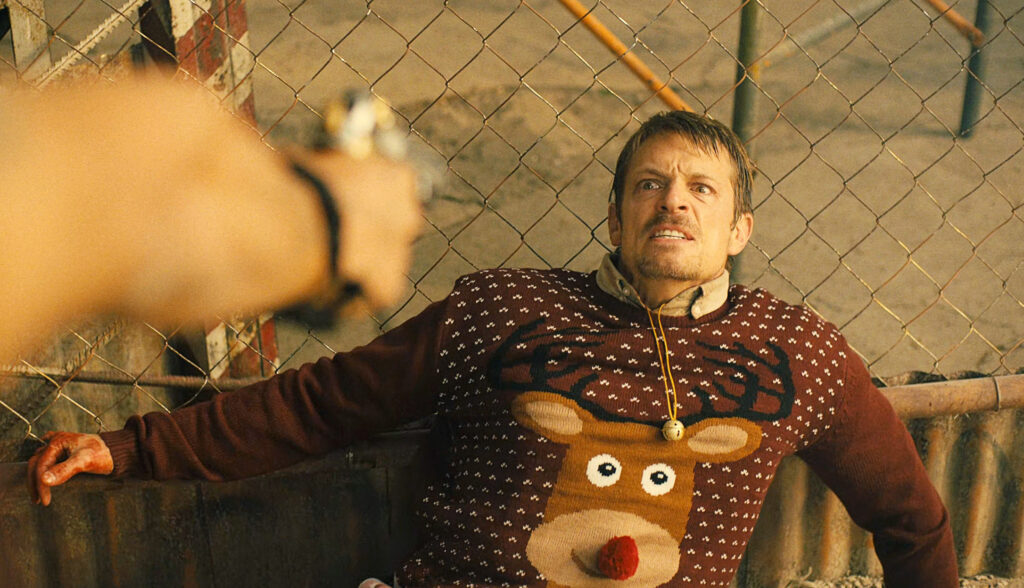
In addition to losing his diegetic son, Joel Kinnaman is shot in the voice box and left for dead in Silent Night’s memorable opening sequence.
Tackling the better of his two newest American films first, Silent Night is more or less Woo’s take on the stereotypical revenge-driven action tropes now most associated with the John Wick (2014–2023) franchise: Our main character suffers a tragic loss when their close friend, family member, or companion is murdered by one or more antagonists, prompting the protagonist’s killing spree. Silent Night’s spin on that gimmick is how scumbag gangsters shoot Joel Kinnaman’s lead in the throat after inadvertently killing his son (Alex Briseño) in the prologue, thus robbing him of his ability to speak; that action-packed opening takes place on Christmas Eve, with the bulk of the brisk, well paced 104-minute story taking place over the following year until the next Christmas Eve, hence the movie’s winter holiday-themed title.
While the removal of most any dialogue beyond police radio chatter feels contrived in certain instances, the lack of unnecessary monologues or supporting castmembers hones Silent Night to its bare essentials and exemplifies Woo’s talent for visual storytelling (e.g. use of mise-en-scène to visualize internal character emotions, admirable physical performances conjured from Kinnaman and Catalina Sandino Moreno’s female lead, efficient scene-geography and actor blocking throughout). Woo furthermore dedicates the first two acts of his film to emotional buildup after the initial prologue action sequence, taking his time to establish Kinnaman as a relatable figure, elaborate upon his training regime and reconnaissance of the main antagonists, and accentuate narrative tension. If only Silent Night had a halfway charismatic bad guy (Harold Torres does what he can, but the lack of dialogue hurts his screen presence), the movie would be an easy recommendation.
Much of what makes the follow-up to Silent Night and John Woo’s latest film as of this writing, The Killer (2024), such a disappointment relative to Silent Night and the earlier Manhunt is how sanitized and overstuffed it feels by comparison. I don’t harbor animosity toward The Killer (2024)’s obvious stylistic echoes of the 1989 classic, as I generally welcome auteur filmmakers revisiting their earlier works (e.g. Robert Rodriguez’s El Mariachi [1992] and Desperado [1995]; Sam Rami’s Evil Dead [1981] and Evil Dead II [1987]). Woo also makes considerable effort to distinguish his remake from the original with a change in not just language (English and French), but also location (Paris, France) and gender (Nathalie Emmanuel takes over Chow Yun-Fat’s titular hitman).
No, what cools my reception toward The Killer are its forgettable, ineffective action sequences and lackluster pace, the latter mostly a function of bad characterizations and poor acting. The Killer has zero reason to last over two hours, bloated with extraneous secondary villains (e.g. former professional footballer Eric Cantona, French model Aurélia Agel, Saïd Taghmaoui, etc.) and Sam Worthington’s latest forgettable performance as the main antagonist. Woo fairs much better with his heroic characters (Emmanuel and Omar Sy form a dynamic duo by story’s end a la Chow and Danny Lee from the original), but they too don’t have enough scenery to chew to lend flavor to their character development.
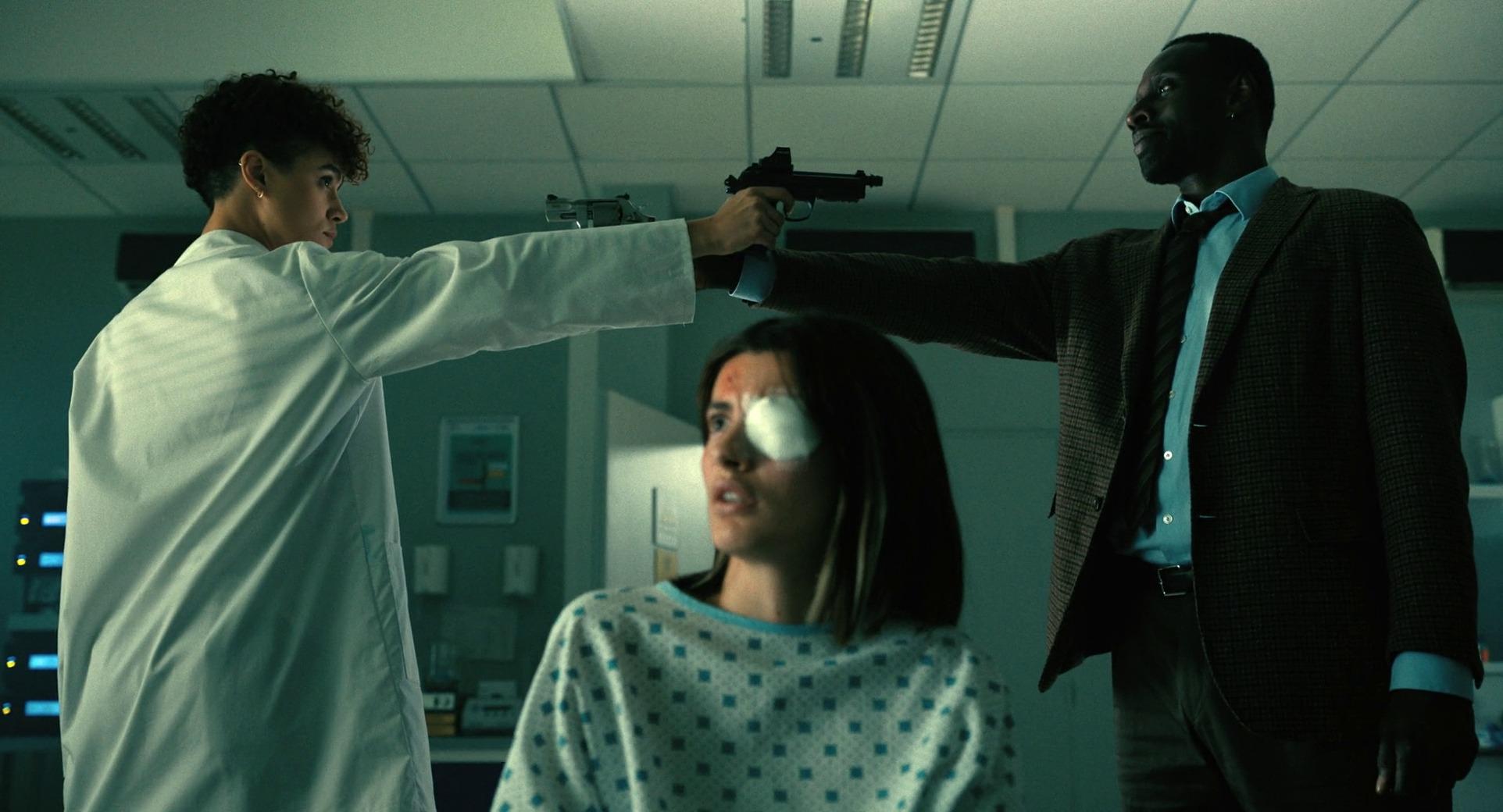
Nathalie Emmanuel and Omar Sy make for respectable leads in The Killer, but their narrative backdrop and supporting cast (e.g. Diana Silvers, center) let them down.
To that end, The Killer (2024) feels misguided in its attempts to channel the over-the-top balletic violence of Woo’s Hong Kong filmography. Silent Night, by contrast, modernizes Woo’s love for bloody, excessive combat by minimizing the slow-motion (it punctuates the action rather than dominates it a la Woo’s or Zack Snyder’s earlier movies) and simplifying the choreography without skimping on gore.
Overall, I am pleased that John Woo continues to find work across multiple film industries, and was as surprised as any to learn that he returned to Hollywood after multiple working sprees in his native East Asia. He still retains his distinct auteur voice after all these days, even if his film-to-film execution is as spotty as any veteran in the business (see also Ridley Scott). Woo has never had the consistency of an S. S. Rajamouli or Sanjay Bhansali in India, nor a Quentin Tarantino or pre-Avatar (2009) James Cameron in Hollywood, but he never “sold out” in the traditional sense. I am far happier to experience his Christmas-oriented Silent Night than whatever the hell The Killer (2024) is trying to be, but neither work feels compromised by the major film studio machine.
——————————————————————————————————————————————————————————–
SUMMARY & RECOMMENDATION: Silent Night goes too far with its dialogue-free gimmick, but its contemporary action style melds with John Woo’s penchant for emotional character melodrama. His remake of The Killer, on the other hand, is too long, has far too many forgettable characters, and recalls its 1989 stylistic inspirations unsuccessfully.
—> Silent Night is on par with or perhaps a tad below the “lesser” John Wick movies (e.g. Chapter 3 [2019]) and that series’ many offshoots (e.g. Atomic Blonde [2017]), so one could easily recommend it to most action fans while being ON THE FENCE for all other audiences. The Killer (2024), on the other hand, is NOT RECOMMENDED and has almost left my head less than a couple weeks after watching it.
? I could’ve sworn that Silent Night took place in southern California instead of Texas, but does the difference matter?

 Express Elevator to Hell
Discussion
Trackbacks/Pingbacks
Pingback: Hindi Indies, Volume 2: ‘Haseen Dillruba’ (2021, 2024) & ‘Dhoom Dhaam’ (2025) | Express Elevator to Hell - May 25, 2025