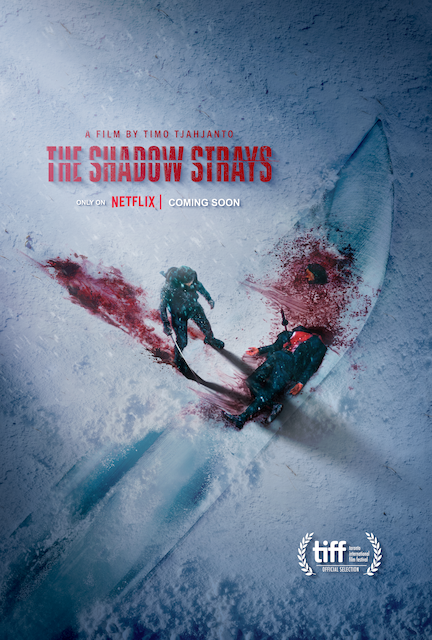
Directed by: Timo Tjahjanto || Produced by: Timo Tjahjanto, Wicky V. Olindo, Anne P. Ralie
Screenplay by: Timo Tjahjanto || Starring: Aurora Ribero, Hana Malasan, Taskya Namya, Agra Piliang, Andri Mashadi, Chew Kin Wah, Naomi Hitanayri Christy, Mawar Eva de Jongh, Adipati Dolken
Music by: Fajar Yuskemal || Cinematography: Batara Goempar || Edited by: Dinda Amanda || Country: Indonesia || Language: Indonesian, English
Running Time: 143 minutes
One of the more disappointing, not to mention irritating, Netflix Original Films I saw in the last several years was Tim Tjahjanto’s action-comedy, The Big Four (2022). Although it received positive reviews like most high-profile Indonesian genre cinema of the 2010s, I found its comedic style so juvenile and uncinematic as to ruin the movie’s live-action Looney Tunes (1930-1969)-style of violence. Non-visual humor (e.g. colloquialisms, drug-induced goofiness, popular culture references, obnoxious sound FX) tend not to translate across cultures and, frankly, self-aware comedy does not appear to suit the Indonesian hardcore genre auteurs that are Tjahjanto, frequent professional collaborator Kimo Stamboel, Joko Anwar, et al.
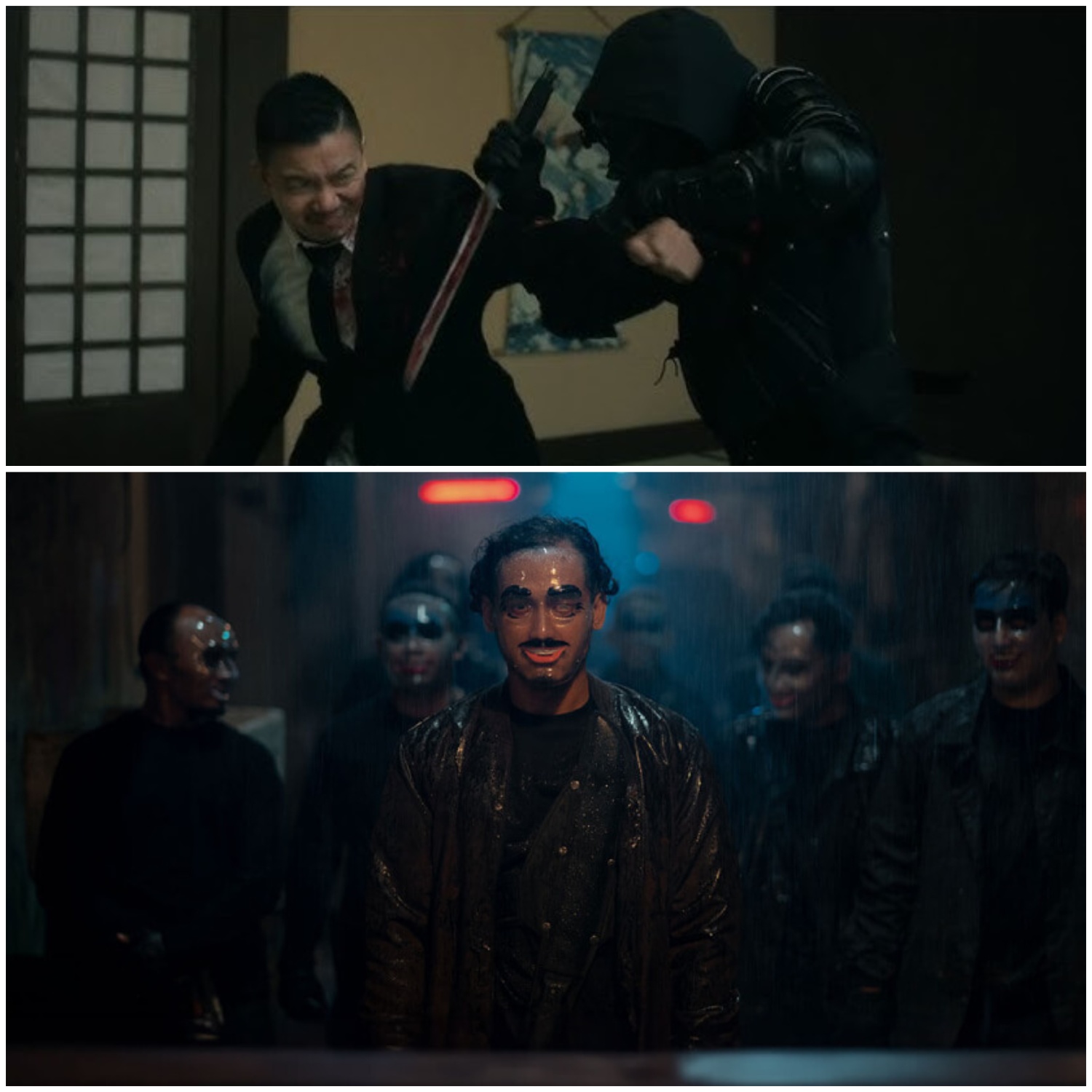
Top: One of The Shadow’s best action sequences is its prologue, where two veritable ninjas dismember an entire yakuza clan. Bottom: Tjahjanto does a good job portraying a despicable cast of bad guys who are fun to root against without being pushovers. Certain films should take notice…
My running hypothesis that contemporary Indonesian action, horror, and thriller filmmaking are best when ultra-serious to a fault continues with The Shadow Strays. As bloody as it is relentless, Tjahjanto’s latest action movie provides additional evidence that the man is a much better director than he is a writer. All of his movies, good and bad, live off the incredible action choreography, brutal stunts, sheer athleticism, and pacing of his action set-pieces, the latter of which is a function of how restrained his screenplays are by their final drafts. Better paced, more self-contained features like Killers (2014) and The Night Comes For Us (2018) struggle with overacting and unnecessary one-on-one fistfights like all his movies, but they have the self-restraint to not overstay their welcome and revolve around semi-relatable leads; their banger set-pieces, which outclass even Korean action movies, on average, take care of the rest. His lesser movies, like the aforementioned Big Four, May the Devil Take You (2018) and Headshot (2016), either overthink their stories into convoluted messes or disregard them altogether, not even bothering to construct a halfway logical series of events where the parent narrative feeds into the elaborate horror or action set-pieces.
The Shadow Strays, Tjahjanto’s latest hyperviolent action movie and his most graphic novel-inspired work yet, combines multiple overused tropes of the genre to rather impressive effect. He mixes the “girls with guns” cliche without oversexualizing his lead or half-assing the fight choreography, throws in a dash of stylized comic book costumes that don’t break the story’s immersion or overpower his lead characters, and freshens the overused Lone Wolf and Cub (1970-1976)-premise with a simple gender inversion.
The Shadow follows its eponymous group of assassins, who feel like a combination of Sam Fisher from Splinter Cell (2002-2013) and Mortal Kombat’s (1995, 2021) Scorpion, charged with — what else? — eliminating various high-profile government, corporate, and organized crime targets in brutal ways; but its story really begins with lead Aurora Ribero “straying” from her sociopathic lifestyle after a glorious opening brawl with dozens of yakuza enforcers. In contrast with most Lone Wolf and Cub-devotees (e.g. John Woo’s The Killer [1989], The Professional [1994], Road to Perdition [2002], Logan [2017], the Sandor Clegane/Arya Stark subplot from Game of Thrones [2011-2019], The Witcher, The Mandalorian [both 2019-2023]), all of which feature a male lead harboring an often female ward, The Shadow flips those genders in an interesting way that dovetails with Ribero’s minimal if satisfactory character growth with diegetic mentor Hana Malasan. The movie is built atop basic screenplay ingredients executed in mostly satisfying ways, and has enough of an emotional center to make you care about the action showcase that is its main selling point.
The Shadow’s problems have to do with the minimal screentime of Ribero’s juvenile male costar, Ali Fikri, whose family becomes the target of numerous shady characters connected to local Jakarta politicians, gangsters, and crooked cops, as well as the movie’s bloated running time (143 minutes). Fikri shows decent acting chops for a child performer, but his crucial development is crowded by too many secondary villains and at least one pointless fistfight in the film’s prolonged finale (the superfluous, awkward throwdown between the 5′ 3″ Ribero and 6′ 7″ Daniel Ekaputra comes to mind). Less egregious mistakes like awkward exposition and bad computer generated fire are kept to a minimum, but the number of obvious entire sequences that should’ve been cut makes The Shadow Strays almost as frustrating as it is exciting.
Club set-pieces have more or less become staples of the modern action genre, and The Shadow doesn’t disappoint in that department.
As the movie stands, Timo Tjahjanto has crafted his version of the 2.5 hour Raid 2 (2014) by Gareth Evans, an ultraserious, super-bloody epic that mixes a variety of action styles (e.g. hand-to-hand combat, melee weaponry, gunplay, a few vehicular stunts) in memorable locations, but lacks rigorous structural editing. He has avoided the awkward intentional comedy of The Big 4 in favor of the in-house blood-fueled rage that made 2010s — and now 2020s — Indonesian action cinema famous. Between the incredible choreography of Muhammad Irfan and the chaotic yet always controlled cinematography of Batara Goempar, The Shadow Strays is worth a watch for action fans based on its physicality alone, but its overall exaggerated, graphic novel-visual style and memorable gender-flip of an iconic action movie trope make it easily recommendable to all genre cinephiles with a Netflix subscription.
————————————————————————————————————————————————————————-
SUMMARY & RECOMMENDATION: As tenacious as any Indonesian action film of the previous decade, The Shadow Strays ventures enough outside its writer-producer-director’s comfort zone to keep you guessing where its narrative will end, but knows to concentrate on its immaculate cinematic violence before all else. Tim Tjahjanto paces his film just well enough to make you overlook its narrative filler, dull exposition, and bloated supporting cast.
— However… the 143-minute runtime becomes a problem by the third act, while the limited development of a character key to the story’s forward momentum is inexcusable.
—> The Shadow Strays still comes RECOMMENDED, warts and all, even if I desperately want a 110-minute cut of this.
? Given how cool and effective those ninja costumes were in the prologue, why did the filmmakers clothe Ribero in a hoodie for the rest of the movie?

 Express Elevator to Hell
Discussion
Trackbacks/Pingbacks
Pingback: ‘Furiosa’ (2024): A Longer-Winded ‘Mad Max’ Saga | Express Elevator to Hell - January 12, 2025
Pingback: The ‘Bourne’ Trilogy (2002, 2004, 2007): Action in the Edit | Express Elevator to Hell - April 8, 2025
Pingback: Time in the Joint: ‘Cell 211’ & ‘Black Warrant’ (2025) | Express Elevator to Hell - May 21, 2025