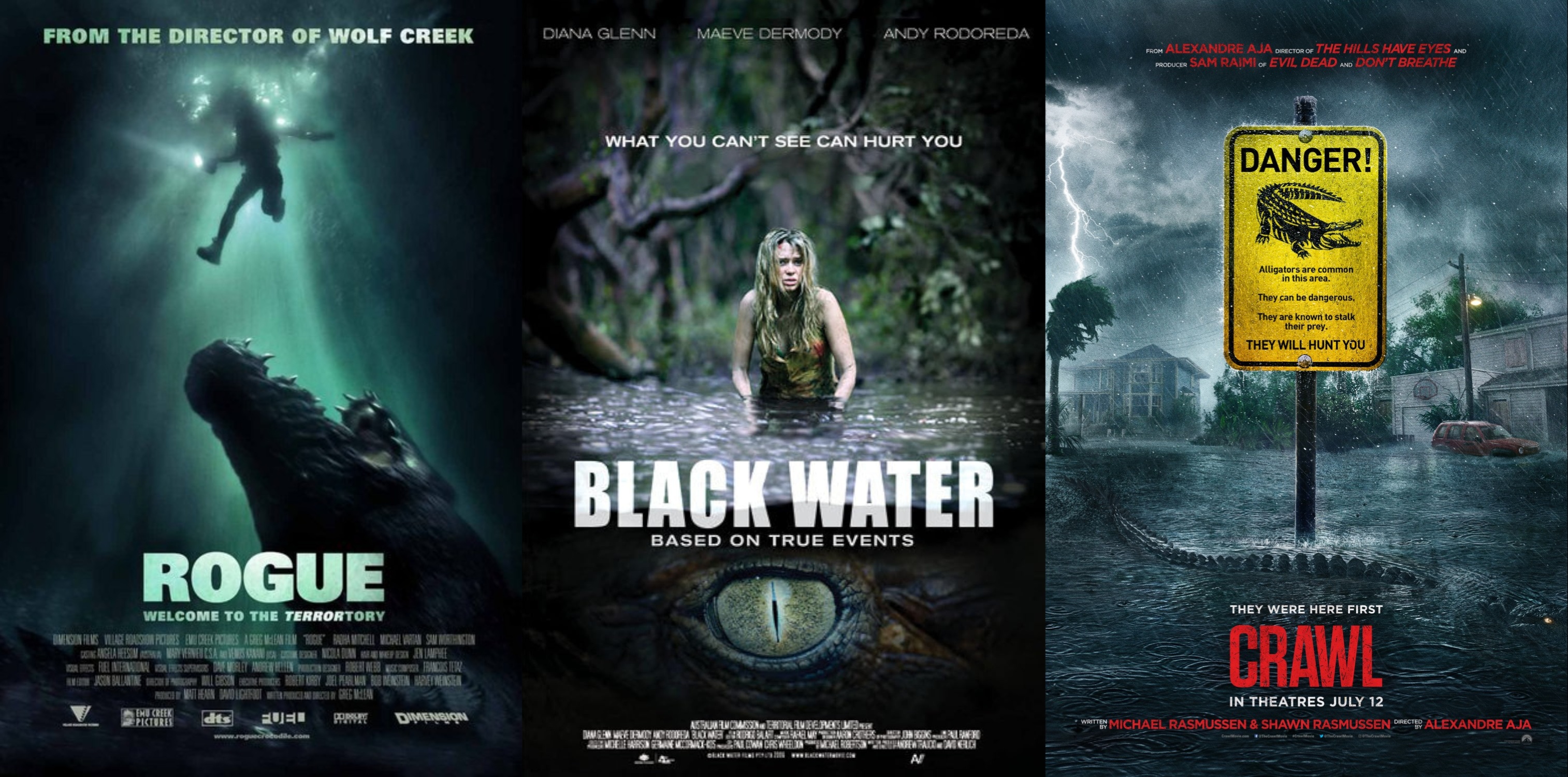
Directed by: Greg McLean [1], David Nerlich, Andrew Traucki [2], Alexandre Aja [3] || Produced by: Matt Hearn, David Lightfoot, Greg McLean [1], David Nerlich, Andrew Traucki, Michael Robertson [2], Craig Flores, Sam Raimi, Alexandre Aja [3]
Screenplay by: Greg McLean [1], David Nerlich, Andrew Traucki [2], Michael Rasmussen, Shawn Rasmussen [3] || Starring: Michael Vartan, Radha Mitchell, Sam Worthington [1], Diana Glenn, Maeve Dermody, Andy Rodoreda [2], Kaya Scodelario, Barry Pepper [3]
Music by: Frank Tetaz [1], Rafael May [2], Max Aruj, Steffen Thum [3] || Cinematography: Will Gibson [1], John Biggins [2], Maxime Alexandre [3] || Edited by: Jason Ballantine [1], Rodrigo Balart [2], Elliot Greenberg [3] || Country: Australia [1, 2], United States [3] || Language: English
Running Time: 92-87 minutes || 1 = Rogue, 2 = Black Water, 3 = Crawl
For those who don’t know, my professional career has little to nothing to do with filmmaking or the arts in general, although fascination with film has been a part of my personality and upbringing since I was a small child. What feedback exists between my cinephilia, higher education, and still burgeoning professional life has to do with charismatic, sharp-toothed animals to which I have always been drawn. It is no coincidence that my childhood favorite movies mostly consisted of Godzilla (1954-), Jaws (1975), Tremors (1990-2004), Jurassic Park (1993), et al. in between outdoor hikes looking for animals and watching nature documentaries on the Discovery Channel.
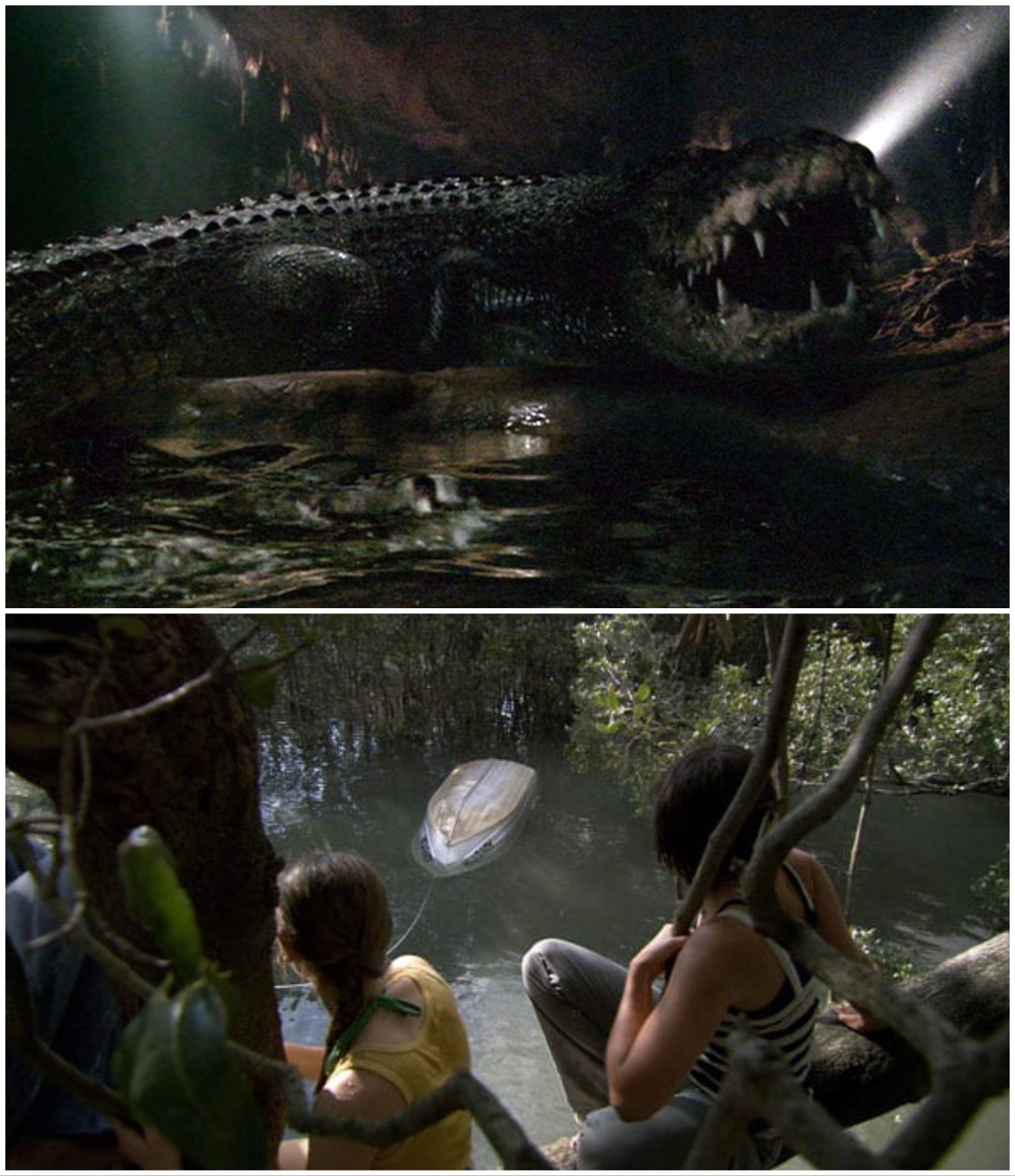
Top: Like Crawl, Rogue’s digital FX work thanks to (1) low-key lighting throughout the film and (2) realistic movement animations clearly modeled on actual wildlife. Bottom: Our three principal characters of Black Water (Maeve Dermody, Diana Glenn, and Andy Rodoreda) hide in mangrove trees after their boat is attacked and capsized by an unknown assailant.
Enter Rogue, Black Water, and Crawl, three creature-features that center around crocodylians (the group of archosaurian reptiles that includes true crocodiles, alligators, gharials, and caimans), which happen to be the animals on which my graduate career has focused (I studied American alligators [Alligator mississippiensis] in southeastern Texas from 2019-2023). Earlier this year, in fact, I participated in the 27th Working Meeting of the Crocodile Specialist Group in Darwin, Australia, near where the first two of these three featured movies are set. Rogue and Black Water both “star” the intimidating saltwater crocodile (Crocodylus porosus) as their main antagonist (for those who are lost, recall the animals Steve Irwin worked with in the adjacent Australian state of Queensland) and take advantage of the Northern Territory’s (NT) iconic tropical floodplains to establish their tone.
Rogue in particular reads as the most traditional monster movie of the bunch, where a small cast of characters are trapped in an isolated location (an island within a coastal river) as a large (7.6 meter-long), well rendered beast stalks them while the screenplay’s ticking clock (the encroaching tide that will submerge their island by nightfall) escalates narrative stakes. The computer generated imagery (CGI) on the titular croc looks well above the digital FX batting average of the mid-2000s, aided by low-key lighting (e.g. nighttime and subterranean sets), minimal exposure of the animal outside of water, and realistic movement animations. Aside from the aforementioned screenplay tropes, Rogue’s stripped-down story boasts effective if straightforward characters bolstered by good dialogue and a considerable number of then unknown, but later famous castmembers (e.g. Aussie natives Sam Worthington, Radha Mitchell, and Mia Wasikowska). Top to bottom, I reckon most would consider this to be Greg McLean’s best movie relative to the haphazard grindhouse throwbacks that are his Wolf Creek (2005, 2013) movies and the heavy-handed Belko Experiment (2016).
Black Water, by contrast, is the super-low budget equivalent of the same lone monster-premise. While Rogue was no blockbuster at $25 million in 2007, Black Water was made for an alleged $700,000 that same year and an even smaller cast (five total actors, with three holding the vast majority of the film’s screentime). The movie takes place in the NT a la Rogue, but most of its coastal mangrove backdrops were shot in the Sydney suburbs with actual NT crocodiles shot and composited into the footage in post-production. As a result, Black Water’s location-photography can’t compare to Rogue’s, which was shot on-location in the NT, but the former’s near seamless integration of dangerous live animals into separate locations is reference-level, on par with the low-tech editing of Mel Gibson’s Apocalypto (2006). The repetitive, visually ugly scale of Black Water’s story leaves something to be desired, but its intimate horror is probably scarier to most people.
Last but not least is Crawl by Alexandre Aja, the French auteur behind the grisly new millennium horror film, High Tension (2003), as well as one of my favorite Netflix Original Films, Oxygen (2021). Shot by longtime collaborator, Maxim Alexandre, and set in peninsular Florida, USA during a Category 5 hurricane, Crawl benefits the most of these three features from modern special FX technology (CGI has come a long way since 2007) despite its modest budget ($15 million in 2019 gets you far more creative output than the $25 million of Rogue). Like McLean’s monster-movie, Crawl paces its tight 87-minute runtime for maximum suspense, making the most of its tiny cast (“final girl” Kaya Scodelario and costar Barry Pepper are the sole human figures of 80-90% of the narrative) performing in a single location with another ticking clock (their house fills with water over time thanks to the encroaching cyclone). The alligator action escalates without screenwriters Michael and Shawn Rasmussen blowing their wad until the final act, somehow finding a middle ground between elaborate action sequences and cryptic predatory ambushes that feel believable.
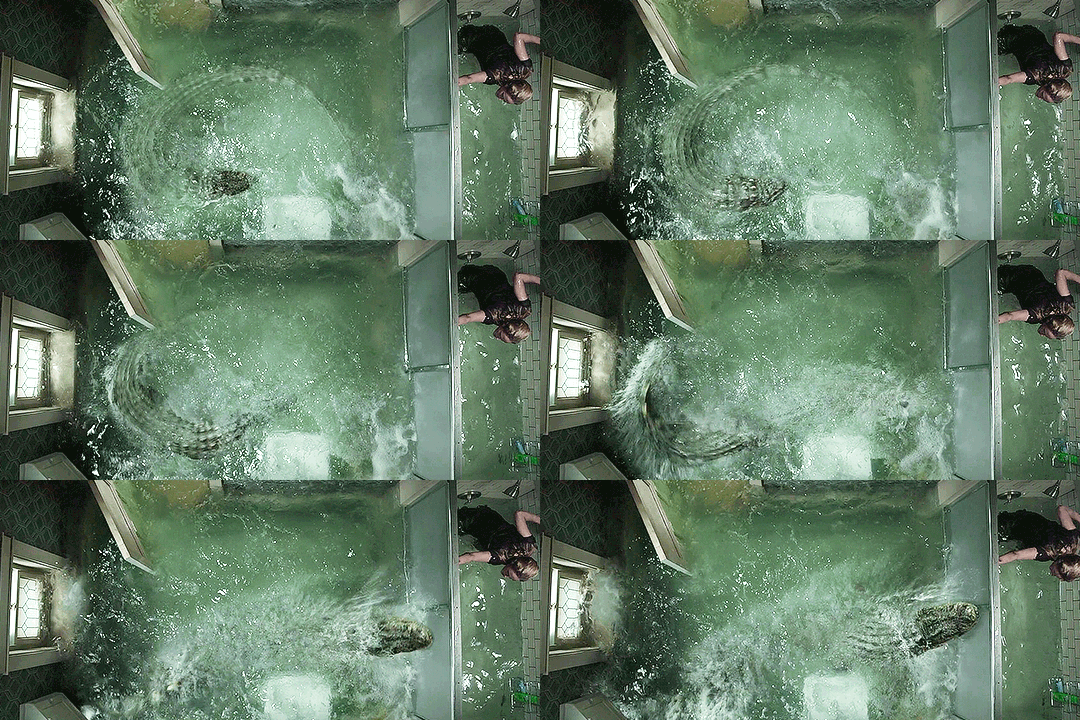
Instead of supersizing its animal antagonists, Crawl keeps its alligators at a realistic size (~3-4.5 meters, or ~10-14.5 feet) but ups their aggression to manic levels.
Looking back on the history of crocodylian monster movies in particular, it is a wonder how dull, cornball films such as Lake Placid (1999) gained such mainstream traction Stateside while far more effective and entertaining movies like Rogue and Black Water flopped at the international box office. How Alexandre Aja’s Crawl performed as well as it did from both a financial and artistic perspective was a small miracle in the FX-heavy, franchise-dominated theatrical environment of the 2010s, because that original intellectual property has now earned a sequel the old-fashioned way as of late 2024. Smart direction of FX and background photography, limited casts, and brisk running times define all three of these features, exemplifying how (1) what you film is often not as important as how you film it; and (2) tight creative focus on simple, straightforward premises can make films feel as “big” as you want them to be.
——————————————————————————————————————————————————————————–
SUMMARY & RECOMMENDATION: A lifetime of amateur to professional interest in vertebrate predators, but crocodylians in particular, has left me hungry for quality creature-features starring those riparian predators; Rogue, Black Water, and Crawl are similar yet distinct croc adventures that take advantage of small casts, limited or single locations, and succinct, well paced runtimes (all 92 minutes and under) to create relatable horror thrill rides. The special FX techniques these directors use to realize their predator antagonists vary, but their consistency puts many bigger (e.g. Prey, RRR [both 2022], Brotherhood of the Wolf [2001]) and similarly (e.g. Under Paris [2024], The Green Knight [2021]) budgeted movies with comparable amounts of creature FX to shame.
— All three movies come RECOMMENDED, with the added biteforce of large crocodylian entertainment.
? I applaud Rogue for having the balls to (gasp!) kill a dog and not dwell on it.

 Express Elevator to Hell
Discussion
Trackbacks/Pingbacks
Pingback: ‘Infested’ (2023): Arachnophobia or Xenophobia? | Express Elevator to Hell - December 29, 2024
Pingback: Hindi Indies, Volume 2: ‘Haseen Dillruba’ (2021, 2024) & ‘Dhoom Dhaam’ (2025) | Express Elevator to Hell - May 25, 2025