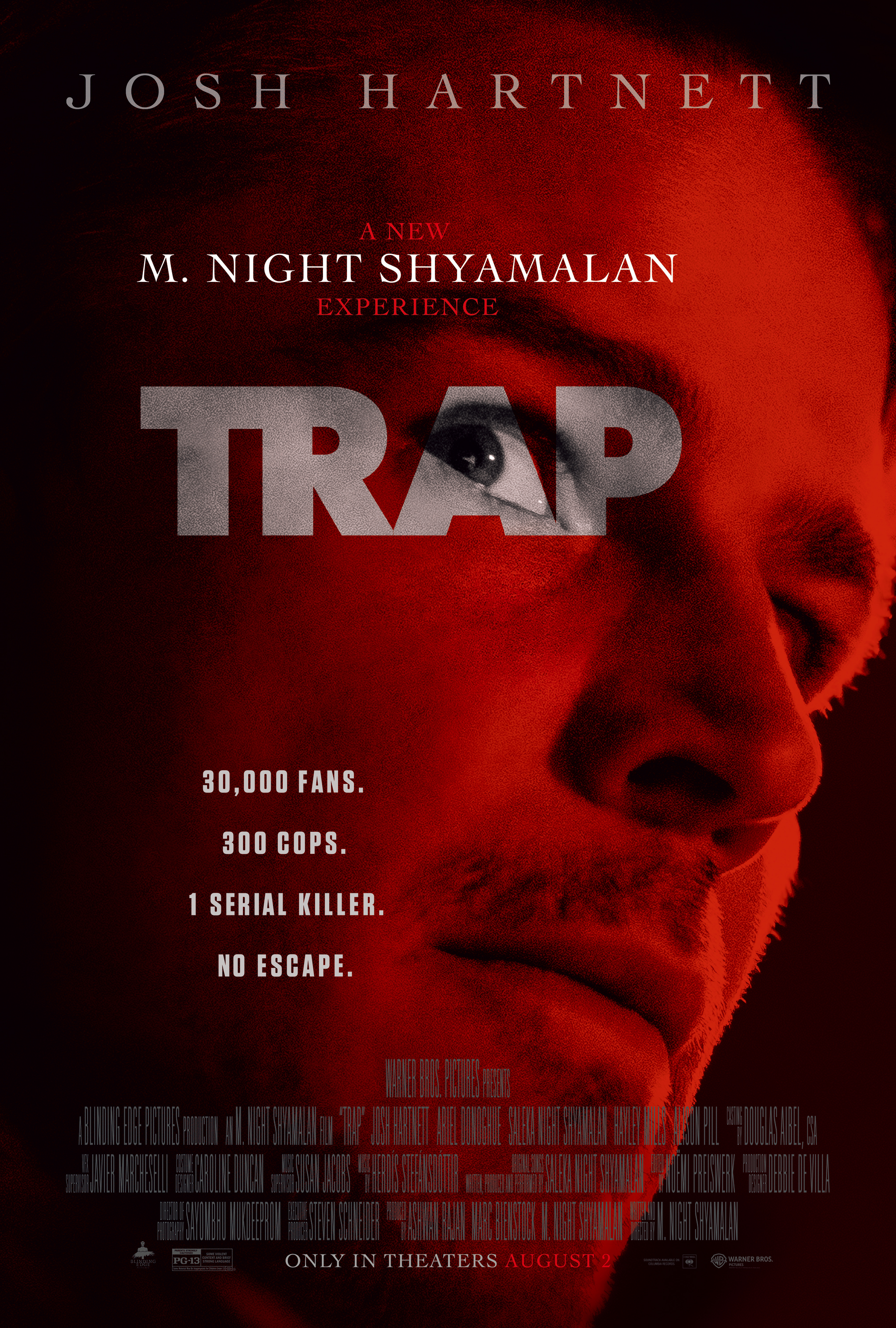
Directed by: M. Night Shyamalan || Produced by: Ashwin Rajan, Marc Bienstock, M. Night Shyamalan
Screenplay by: M. Night Shyamalan || Starring: Josh Hartnett, Ariel Donoghue, Saleka Night Shyamalan, Hayley Mills, Alison Pill
Music by: Herdís Stefánsdóttir || Cinematography: Sayombhu Mukdeeprom || Edited by: Noëmi Preiswerk || Country: United States || Language: English
Running Time: 105 minutes
Ever since the release of The Visit (2015), Manoj Nelliyattu “M. Night” Shyamalan has been on something of a winning streak (see Split [2016], Glass [2019], Old [2021], Knock at the Cabin [2023], which released since), if not an outright career resurgence. That artistic comeback followed his longwinded, now infamous midcareer downturn from Lady in the Water (2006) through After Earth (2013), which brought the thriller auteur down to earth from his Academy Award-winning heights of The Sixth Sense (1999) and its immediate successors (e.g. Unbreakable [2000], Signs [2002]). The up-and-down roller-coaster rhythm of the man’s overall career trajectory to this date is the stuff of cinephile legend, and in my assessment makes the man’s directorial personality almost as interesting as his better movies.
As I sat in the theatre for his latest movie with a friend, I remarked that if Shyamalan had started his career in the 2010s-2020s, he would likely have produced smaller, dramatic critical darlings that explored “the immigrant experience” in America or coming-of-age narratives where protagonists were “torn between two worlds.” Much of this hypothetical, alternative Shyamalan filmography might recall the aesthetics of movies like Brooklyn (2015), Moonlight (2016), Crazy Rich Asians (2018), Minari (2020), After Yang (2021), et al., which are all… fine, but lack the unabashed genre styles that might connect them to audiences outside their narrative’s precise lived experiences. At the most optimistic, a modern young Shyamalan might produce features akin to Get Out (2017), His House (2020), Everything, Everywhere, All at Once (2022), Polite Society, or It Lives Inside (both 2023), all of which embrace some measure of genre creativity but are still defined by hyperspecific subcultural insecurities to which Midwestern small-towners like me have a difficult time relating. I shudder to think of a talent like Shyamalan writing, producing, and directing something on the level of Never I Have I Ever (2020-2023), for example.
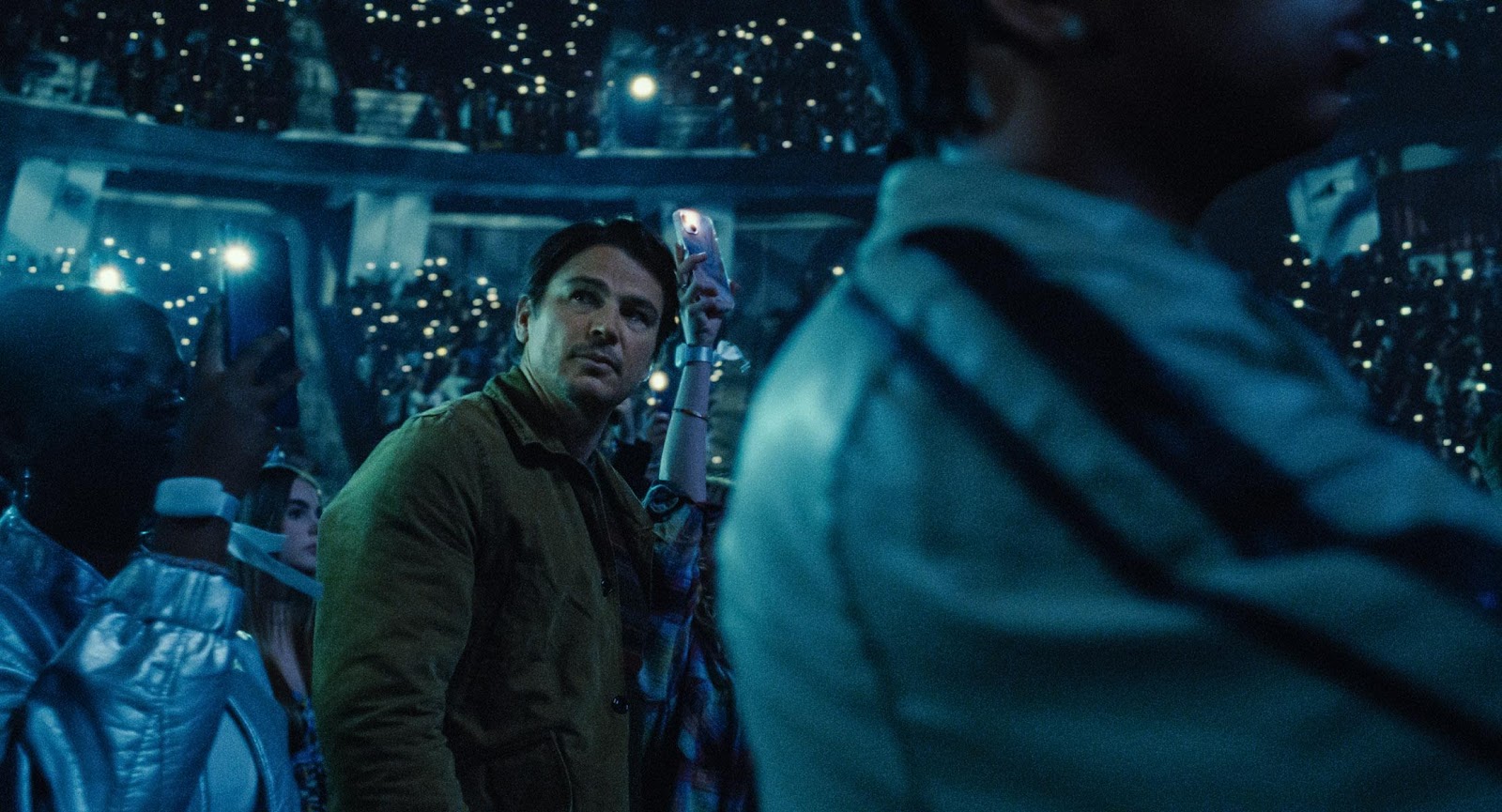
Lead Josh Hartnett surveys his surroundings not long after he and his daughter (Ariel Donohue) enter a concert arena with higher than average security activity.
This longwinded preface brings me back to Trap, his aforementioned latest theatrical feature and one of my favorite divisive releases of his in a while. To say that a new Shyamalan thriller has polarized both critics and audiences is like noting that comic book fans have strong opinions about Todd Phillips’ Joker films (2019, 2024) or that general audiences don’t take well to dark, introspective horror movies distributed by studios like Neon (e.g. Possessor [2020], Infinity Pool [2023], Longlegs [2024]) or A24 (e.g. The Witch [2015], Hereditary [2018]). Whenever Shyamalan releases another thriller in this third wave of his career, you can expect about half of all cinephiles to praise Shyamalan’s eclectic, weird cinematographic choices, inventive scene blocking, and memorable lead performances, while the other half derides the same movies as poorly edited, melodramatic crap.
What won me over with regards to Trap is (1) its unique, memorable premise that is perfect for Shyamalan’s thriller sensibilities and (2) lead Josh Hartnett’s charismatic, enigmatic performance. A frequent criticism of much of Shyamalan’s work are his movies’ inconsistent supporting performances, and that problem persists here (see a notable guest appearance by one of the writer-director’s daughters, Saleka Night Shyamalan), but the characterizations of Trap are dominated by the emotional range of Hartnett as well as his character’s delicious personality. Hartnett portrays a notorious serial-killer and family man chaperoning his daughter (Ariel Donoghue) to a concert headlined by Saleka, an R&B singer-songwriter in real life and diegetic popstar by the stage name of “Lady Raven” in the world of the film. Unbeknownst to either Hartnett or Donoghue, however, the concert is used by federal law enforcement as cover to locate and apprehend Hartnett, who must outwit his would-be captors without revealing his “extracurricular activities” to his daughter.
So many great elements of this premise overwhelm most any alleged plot-holes various Internet commentators have complained about, at least in my assessment. The problem-solving survivalism of Hartnett drives the plot forward, as charismatic infiltrations of both law enforcement and concert venue staff exercise Hartnett’s chameleonic performance while increasing narrative tension from scene to scene; in other words, the way that Hartnett must hide in plain site to navigate his social gathering is engrossing. The weird, off-kilter tone of the film adds to Trap’s nonstop suspense and suggests a subjective interpretation of the story via Hartnett’s monstrous protagonist, exemplified in various single-shots where characters speak directly to camera and often passive-aggressively threaten each other.
Skipping past additional directorial strengths like tight pacing, funny dialogue exchanges, an efficient runtime (105 minutes), and a satisfying, surprisingly emotional conclusion, my only major criticism of the movie besides Saleka’s performance is how the majority of the third act takes place outside the chief concert setting. Shyamalan makes the most of this transition with several fun disguises from Hartnett and minor screenplay twists, but the taught, self-contained location of the titular concert hall is perhaps the movie’s greatest asset.
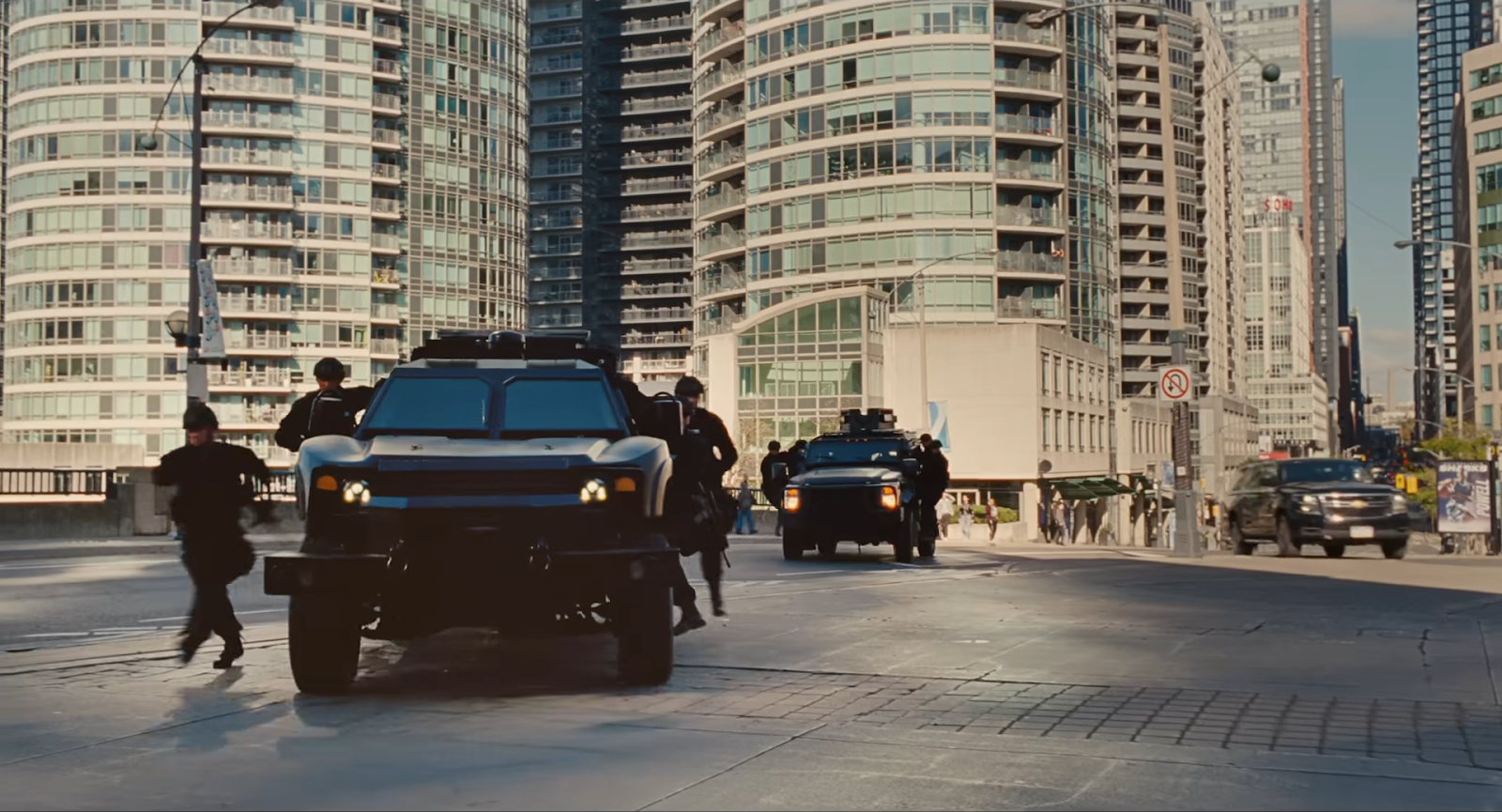
SWAT officers patrol the exterior of the concert venue, which was shot outside the FirstOntario Center in Toronto.
For a medium as empathetic as filmmaking, I have long found the “stark,” “powerful,” “intimate” dramas about particular subcultures, including slice-of-life and coming-of-age stories about immigrants in Western countries, difficult to follow. I never felt that way about M. Night Shyamalan’s genre-focused thrillers, despite their alleged shortcomings (e.g. corny supporting performances, unbelievable plot developments, self-important directorial cameos, etc.). Every Shyamalan thriller I’ve seen, including his weaker ones, entertains from start to finish, never overstays its welcome, and features memorable lead performances that no other actor’s director could conjure. His thrillers have personality to match their suspense, in other words, refusing to rest on the laurels of their director’s upbringing to show you something you’ve seen a million times before. Trap exemplifies this dynamic to a tee.
——————————————————————————————————————————————————————————–
SUMMARY & RECOMMENDATION: Josh Hartnett’s long awaited return to mainstream Hollywood filmmaking spearheads one of M. Night Shyamalan’s most entertaining thrillers in years, with a nontraditional protagonist sneaking his way through a creative — and mostly single-location — premise like a wolf among sheep.
— However… Saleka Shyamalan’s notable guest star role is as forgettable as her voice is smooth, while the film’s mazelike charm loses much of its luster once the story abandons its principal setting.
—> RECOMMENDED
? In all seriousness, that Lady Raven soundtrack for the movie is rather effective!

 Express Elevator to Hell
Discussion
Trackbacks/Pingbacks
Pingback: ‘Old People’ (2022): For They Are Great in Number | Express Elevator to Hell - September 2, 2024