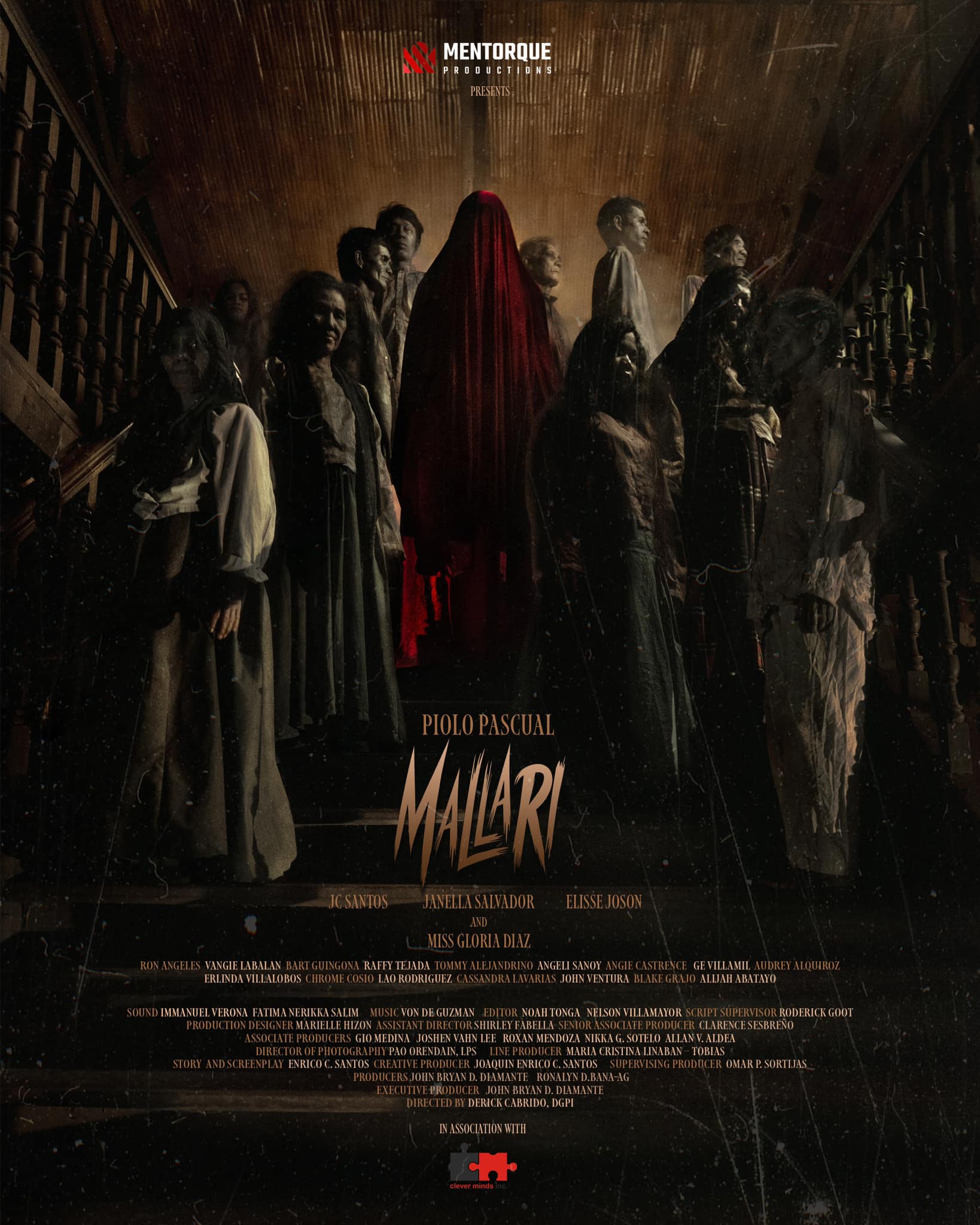
Directed by: Roderick Cabrido || Produced by: John Brian Diamante, Ronalyn Bana-ag
Screenplay by: Enrico Santos || Starring: Piolo Pascual, Janella Salvador, JC Santos, Elisse Joson, Gloria Diaz
Music by: Von de Guzman || Cinematography: Pao Orendain || Edited by: Noah Tonga || Country: Philippines || Language: Filipino, Kapampangan, Spanish, English
Running Time: 130 minutes
Southeast Asia, with the exception of Indonesia, is one of several regional blind spots for me in terms of cinematic literacy (sub-Saharan African cinema is another). What tends to limit my exploration of a given film industry is a combination of two recurring factors: (1) Limited marketing or distribution of films from a given culture, online or off, and (2) underwhelming quality of the few films I do sample from an underrepresented region. European cinema (French, German, Italian, Spanish, etc.) make splashes in notable Western film festivals and are well received by United States industry awards shows, while East Asian Cinema seems to have a reliable following amongst certain niche or sidestream American communities and have plenty of internationally recognized film festivals of their own. Latin American cinema is close enough to the United States that it appears to benefit from the cultural umbrella of the Anglo-Hispanic region of Los Angeles and greater southern California, and several auteurs (e.g. Guillermo del Toro, Alejandro Gonzalez Iñárritu, Alfonso Cuarón, Fede Álvarez, José Padilha) have achieved moderate to major success within Hollywood. Popular South Asian Cinema rarely makes inroads in Western film festivals or awards circuits, but its industrial output is unmatched and its ever growing diaspora may have helped expand its contemporary global cultural reach. From Burma to Vietnam to Thailand to Malaysia, however, I’ve never felt much encouragement from other cinephiles to explore the cinema of Southeast Asia aside from a few exceptions (e.g. Ong Bak [2003], Maria [2019], The Death Whisperer [2023]), none of which I found interesting.

In a scene meant to horrify yet provokes unintentional humor, lead Piolo Pascual holds the head of his ancestor’s corpse before his love interest (Janella Salvador). The film has lost much of its narrative momentum by the time we get to this shot, anyway.
The latest Southeast Asian picture to disappoint me is Mallari by Roderick Cabrido. Longwinded, especially for a horror film (130 minutes), poorly acted, and too dependent on borderline incoherent nonlinear storytelling, this ambitious Filipino supernatural horror picture overcomplicates its somewhat interesting premise of a family curse stretching back centuries into the Spanish colonial era. The common filmmaking mistakes of too many supporting characters, inconsistent cross-cutting techniques, and mediocre narrative pace drag down what otherwise might be a memorable, multigenerational fable about familial sin and patriarchal insecurity.
In other words, Mallari commits the prototypical Hollywood blockbuster sin of depending on an overzealous, disorganized screenplay that distracts from rather than accentuates the movie’s respectable genre direction. The end result is a movie that confuses as much as it entertains.
Mallari follows the family of the eponymous surname across three time periods: year 1812 under Spanish rule, year 1948 a couple years after independence from the United States, and the modern day of 2023. Although the movie is ostensibly about a guy (Piolo Pascual) in the present day trying to save his fiancé (Janella Salvador) from a terminal illness predicted through the former’s visions, our male lead’s fear of losing his loved one is just the inciting incident. In truth, Mallari is about three generations’ struggle with a vague, esoteric curse stemming from local occultists’ worship of a demon in the rural countryside. This curse is a combination of a Faustian bargain the Mallaris make in order to keep various ill family members alive, as well as an Exorcist (1973)-style possession dynamic where different Mallari patriarchs in each of the three main time periods become monstrous serial-killers to pay their supernatural debt.
While this plot-device isn’t too complicated on paper, how screenwriter Enrico Santo splits his script’s focus across three timelines with lead Pascual triple cast as the lead in each of them muddles everything. For one, the narratives of each temporal setting are told out of order and from multiple perspectives, which leads to narrative repetition and unclear plot-progression. Two time-periods alone would’ve been a considerable undertaking, but three is sheer overkill given the number of forgettable supporting characters in each and the overall lengthy runtime. Most frustrating of all may be Pascual’s limited range across his triple cast roles, as every character more or less feels the same thanks to both his performance and the limited arcs of all three roles.
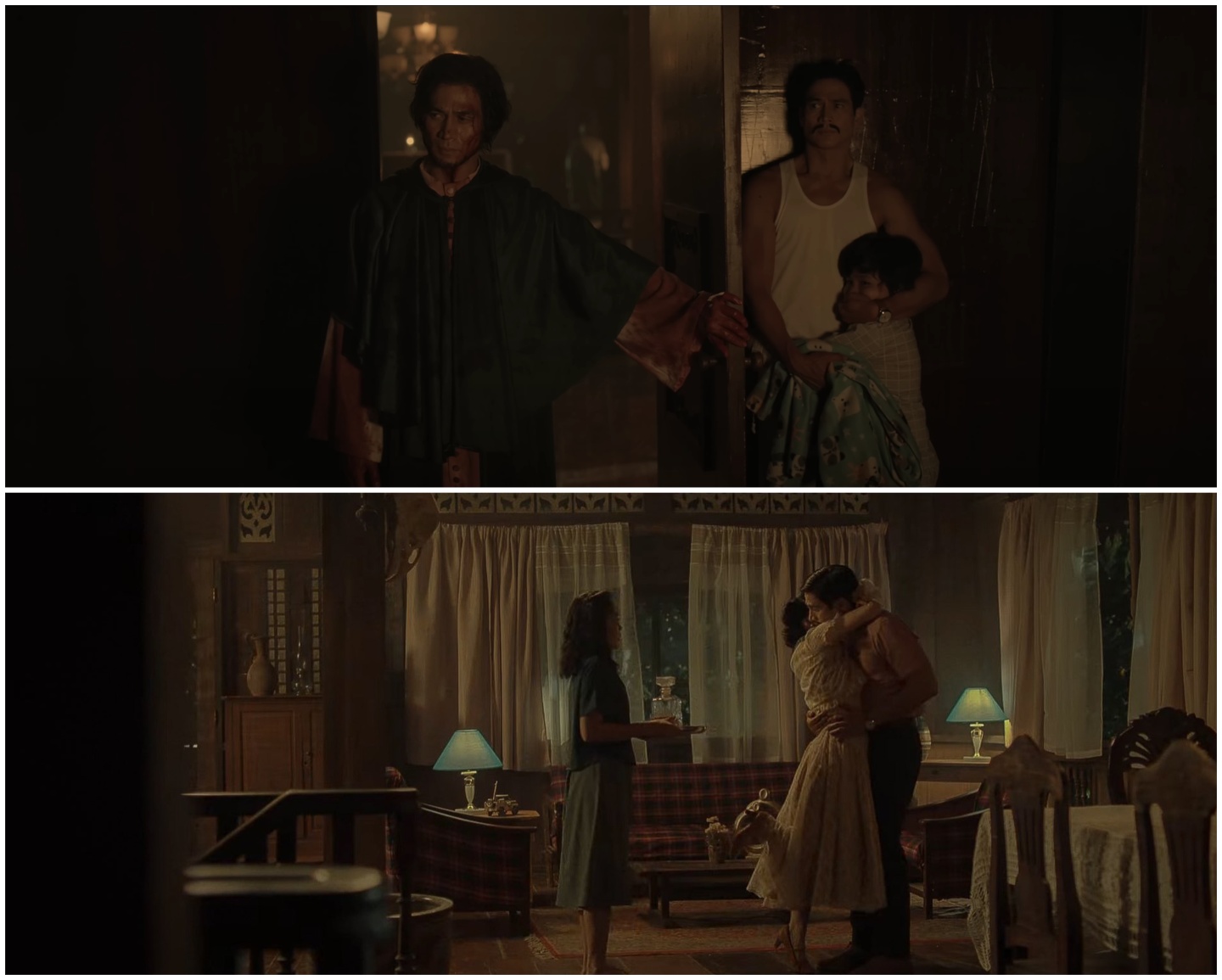
Top: Piolo Pascual portrays two of his three roles in this shot, where a murderous 1812 version (left) searches for the “astral projections” of his 1948 descendant (center right) and the child cast version of his 2023 descendent (far left). Confused? Bottom: In the 1948 timeline, Pascual interacts with two of too many characters in his subplot alone.
Put another way, Mallari needed a powerhouse lead performance from Piolo Pascual and super-stylish direction from Roderick Cabrido to make this obtuse narrative format work. The film as it stands features nice surrealist visuals, particularly at night, a couple fun dialogue exchanges here and there, and the overall production-design appears to punch well above the movie’s budget (minus the shoddy digital FX), but nothing memorable stands out. Most all of the memorable aspects of Mallari are its bad parts, namely its confusing nonlinear story and underwhelming main character(s). Films like this are the reason most cinema of Southeast Asia hasn’t left an impression on me; plenty of good ideas exist, but the screenplay and directorial execution are lacking, limited to merely a bunch of images and concepts that “look cool” but don’t produce a cohesive story.
——————————————————————
SUMMARY & RECOMMENDATION: Like Ong Bak, Maria, and The Death Whisperer before it, Mallari likely plays well with native audiences but has little to offer international viewers beyond some nice countryside backdrops. Too many characters, poor editing choices, and a lackluster, repetitive lead performance by star Piolo Pascual doom this film to horror mediocrity despite the recent successes of similarly longwinded horror extravaganzas like The Empty Man (2020) and Terrifier 2 (2022).
— However… when it comes to nighttime scares and creepy gore, Mallari shows promise so long as it doesn’t mess with computer generated imagery.
—> NOT RECOMMENDED
? What is the point of saving your family members if they have to cannibalize people you’ve killed year after year? Not much of a bargain, if you ask me…

 Express Elevator to Hell
Discussion
Trackbacks/Pingbacks
Pingback: ‘Bangkok Breaking’ (2024): Over-the-Top in Every Way | Express Elevator to Hell - November 24, 2024