
Directed by: Denis Villeneuve || Produced by: Mary Parent, Denis Villeneuve, Cale Boyter, Joe Caracciolo Jr.
Screenplay by: Jon Spaihts, Denis Villeneuve, Eric Roth || Starring: Timothée Chalamet, Rebecca Ferguson, Oscar Isaac, Josh Brolin, Stellan Skarsgård, Dave Bautista, Stephen McKinley Henderson, Zendaya Coleman, Chang Chen, Sharon Duncan-Brewster, Charlotte Rampling, Jason Momoa, Javier Bardem, Florence Pugh, Christopher Walken, Léa Seydoux, Souheila Yacoub
Music by: Hans Zimmer || Cinematography: Greig Fraser || Edited by: Joe Walker || Country: United States || Language: English
Running Time: 320 minutes
If you spend much time on r/BoxOffice or Dan Murrell’s YouTube channel (my guess is you don’t as a normal person with a life), you may have noticed that, collectively in 2023, the Hollywood box office stumbled for a second time this decade after the coronavirus pandemic of late 2019-2021. Different commentators have different hypotheses as to why the domestic (United States + Canada) film industry appears to have changed so much since the end of the 2010s, but explanations range from the major film studios attempting and ultimately failing to outmuscle Netflix in the streaming wars post-pandemic, audience boredom with the latest incarnations of established blockbuster formula (i.e. the decline in brand trendiness of franchises like the Marvel Cinematic Universe [2008-2019, 2021-], the DC Extended Universe [2013-2023], The Fast and the Furious [2001-], Transformers [2007-2017], various Disney and Pixar animated movies, etc.), and, of course, the 2023 Hollywood labor disputes. Combined with the traditional calendar “dead zones” for theatrical releases (i.e. January-February) following the winter holiday season, box office returns for numerous major tentpole features either disappointed (e.g. Aquaman 2 [2023]), outright flopped (e.g. The Marvels [2023]) or were postponed altogether (e.g. Godzilla x Kong [2024]) throughout the back half of 2023 into the start of 2024.
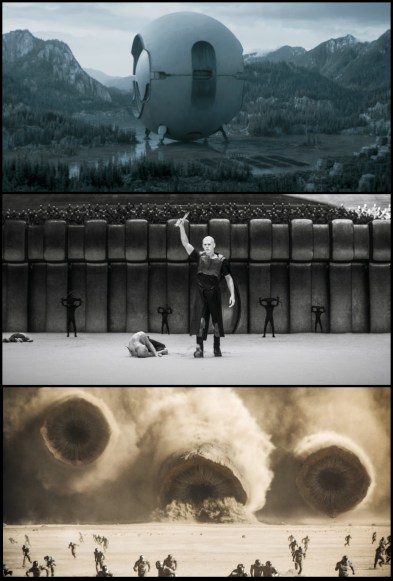
From the lush coastal mountains of Caladan (Norway, top) to the infrared monochrome nightmare of Giedi Prime (middle) to the harsh arid deserts of Arrakis (Jordan and the United Arab Emirates, bottom), Dune’s great looks aren’t just for show.
Enter Denis Villeneuve and his two-part theatrical feature adaptation of Dune (1965), the seminal futuristic science-fiction novel by the bearded Washington state writer, Frank Herbert, the first installment of which released in late October 2021 towards the end of the coronavirus pandemic. To me, the only thing more mind-boggling than Legendary Pictures’ (Dune’s production company) and Warner Bros’ (Dune’s distributer) decision to greenlight the first half of their split adaptation of Dune while unsure of its profitability (recall the box office flop that was Villeneuve’s Blade Runner 2049 [2017]) was how much money the 2021 installment made after all that controversy. Despite its simultaneous release on then HBO Max and in theatres in the United States, the weird, untested source material, and how unfinished Part I (2021) felt without an immediate follow-up (The Lord of the Rings‘ [LOTR; 2001-2003] near standalone theatrical installments are how it’s done), the 2021 film made over $400 million (~$434 million with theatrical rereleases) and won more Academy of Motion Picture Arts and Sciences awards (re: Oscars) than any other film that year, ensuring the fate of Part II (2024).
The actual quality of both theatrical Dune installments (they constitute a singular narrative), on the other hand, was never in doubt to me given Villeneuve’s filmography since Incendies (2010), his last French-language picture set in his native Quebec. Put another way, the French-Canadian auteur is so consistent that he’s spoiled cinephiles with the quality of his last seven (7!) films much the way Chad Stahelski has with the John Wick (2014–2023) series, even if his box office receipts thus far have paled in comparison to the average Hollywood tentpole blockbuster. The last Quebecois to be this dominant in any profession was Georges St-Pierre.
To the surprise of no one, therefore, Dune is a powerful, memorable science-fiction film that combines the heady philosophical themes of its psychedelic source-material with its special FX-heavy blockbuster format a la Peter Jackson’s LOTR. I wouldn’t put this dual-part adaptation on the same level as that trilogy either as a fan of the Dune novels (1965-1985; I read the series’ first three books through Children of Dune [1976]) or as a cinephile in general, but the sheer cinematographic dedication to immersive worldbuilding along with rigorous editing of such a bloated, unwieldy narrative within Dune is impressive.
Much has been made of the Dune franchise’s deconstruction of the “chosen one” monomyth, how it plays as a cautionary tale about the dangers of religious fanaticism, charismatic leaders, and societal elites’ cutthroat battle for political power. While interesting from a thematic standpoint, the true power of this third cinematic incarnation of Dune (the first was David Lynch’s 1984 film; the second was the 2000-2003 television miniseries by the SyFy channel), is how it portrays those themes through memorable, relatable characters against a massive backdrop of reference-level location-photography (Scandinavia to the Levant to the Arabian Peninsula), diverse lighting schemes (day and nighttime hot desert colors to monochrome industrial surrealism), and relatable action set-piece choreography.
Greig Fraser’s charismatic cinematography fits the diegetic tone of an alien world bent to the will of ruthless human ambition much the way the action sequences are paced to how those alien worlds limit the capabilities of our human characters. For all the esoteric mumbo-jumbo about prophecy, fate, religious extremism, politicking, etc. within the story, Dune is most memorable, I argue, for how screenwriters Villeneuve, Jon Spaihts, and Eric Roth show their main characters’ atypical development through dramatic yet never longwinded sequences of violence that feel grounded in reality rather than overwhelmed by digital FX.

Do you often dream things that happen just as you dreamed them? — Charlotte Rampling (right). Not exactly. — Timothée Chalamet (left). Questions of fate, social engineering, and foresight pervade the world of Dune.
Whether riding atop a massive sandworm, firing missiles in low planetary orbit, or knife fighting in a throne room, Dune’s narrative stakes appear real and its tension between its major characters, palpable. I won’t handwave the sheer length of this adventure (320 minutes), which rivals that of some limited series, yet the “kill your darlings”-approach to the final theatrical edit is admirable given the grand scale of this science-fiction diegesis, including its massive ensemble cast. Dune, in other words, is the right yet still unexpected big-budget, high-concept blockbuster to perhaps “rescue” Hollywood from its post-COVID-19, post-labor dispute stagnation, though for how long it can do so remains to be seen.
——————————————————–
SUMMARY & RECOMMENDATION: Epic in scope thanks to meticulous photography while intimate on a human level due to a diverse cast bolstered by effective, if nontraditional character growth, Dune by Denis Villeneuve is the sort of thinking man’s sci-fi picture common to the 1960s-1970s (e.g. 2001: A Space Odyssey [1968], THX-1138, The Andromeda Strain [both 1971], Solaris [1972], Star Trek: The Motion Picture [1979]), just further endowed with decades of advancement in special FX technology.
— However… the movie (singular), in total, is almost five and a half hours long (see also Gangs of Wasseypur [2012]), with its first half a slow-burn setup for many audiences.
—> One of my favorite working filmmaker’s long awaited adaptation of my favorite novel comes HIGLY RECOMMENDED.
? Why does neither Part I nor Part II cut to a massive wide shot at the end? Both final cuts to black felt like the ending to a television show.

 Express Elevator to Hell
Discussion
Trackbacks/Pingbacks
Pingback: ‘Aliens’ (1986): The Quintessential Sci-Fi Action Film | Express Elevator to Hell - May 24, 2024
Pingback: ‘Medieval’ (2022): Go Hard or Go Home | Express Elevator to Hell - August 4, 2024
Pingback: ‘Kingdom of the Planet of the Apes’ (2024): The More Things Change | Express Elevator to Hell - August 24, 2024
Pingback: Current Cinematic Comfort Food | Express Elevator to Hell - March 14, 2025