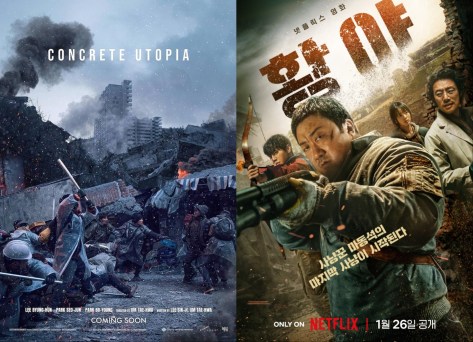
Directed by: Um Tae-hwa [1], Heo Myung-haeng [2] || Produced by: Byun Seung-min [1, 2]
Screenplay by: Um Tae-hwa, Lee Shin-ji [1], Kim Bo-tong, Kwak Jae-min [2] || Starring: Lee Byung-hun, Park Seo-joon, Park Bo-young [1], Ma Dong-seok, Lee Hee-joon, Lee Jun-young, Roh Jeong-eui [2]
Music by: Kim Hae-won [1], Kim Dong-wook [2] || Cinematography: Cho Hyoung-rae [1], Bong-sun Byun [2] || Edited by: Han Mee-yeon [1], Nam Na-young, Ha Mi-ra [2] || Country: South Korea || Language: Korean
Running Time: 130 minutes [1], 107 minutes [2] || 1 = Concrete Utopia, 2 = Badland Hunters
I’ve never decided whether major studio feature-film productions based on toy intellectual properties (e.g. Transformers [2007-2017], G. I. Joe [2009, 2013, 2021], Barbie [2023]) are sillier than corporate biopics about the creation of now everyday, ubiquitous products (e.g. Tetris, Flamin’ Hot, Blackberry, Air [all 2023]). On a metatextual level, one could argue they’re one and the same, as all the aforementioned are centered around corporate inventions we’ve taken for granted since their release regardless of whether we consider ourselves their target demographic. I’m also not commenting on the quality of any of those movies, either, as any idea, no matter how bizarre or esoteric, could make for an effective film if executed in the proper way.
In fact, sometimes the simple act of making a sequel, prequel, or spinoff of an established intellectual property can be just as strange, if not stranger, than making a toy, game, phone, or a fucking shoe the thematic centerpiece of your movie. Case in point is the vague yet very real diegetic connection between Um Tae-hwa’s dark, moody disaster film drama, Concrete Utopia (great title, by the way), and Heo Myung-haeng’s fun yet shlocky post-apocalyptic action movie, Badland Hunters ( …still a good title!). Um, the cowriter-director of the former, has previously directed two features you’ve never heard of while Hunters is the directorial debut of martial arts stunt coordinator Heo, and their apparent opposite approaches to the same cinematic sandbox — the same diegesis or fictional universe — make Utopia and Hunters‘ respective prequel and sequel status a true enigma.
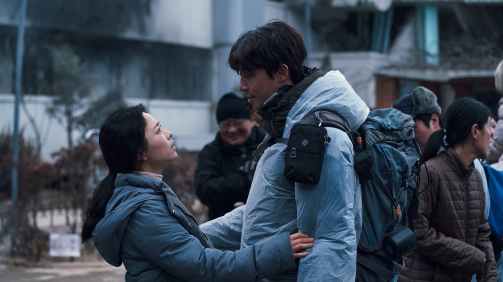
Park Bo-young bids a temporary farewell to her diegetic husband, Park Seo-joon, the latter of whom leaves on an expedition for supplies in Concrete Utopia.
To back up a bit, Utopia is an intelligent yet not revolutionary take on the disaster movie formula as well as a treatise on collective human nature in the vein of Lord of the Flies (1963, 1990), The Mist (2007), or even The Decline (2020). Its inciting incident is a massive, perhaps unparalleled earthquake that destroys an unspecified Korean city (Seoul, I assume?) save for a single apartment complex; thereafter, however, the film is about how its principal cast live together as residents of the lone surviving shelter in the area, including how to treat desperate survivors from outside their, well, “concrete utopia.”
Shot with a variety of subtle, diverse oners and smooth camera pans that illustrate to the audience well planned scene geography and memorable narrative clues integral to different character arcs, Utopia is a visual experience that shows its social commentary the way great genre films should rather than describing its would-be political messages through on-the-nose dialogue. Its editing is patient and versatile, switching from dramatic reveals where the film stretches diegetic time (e.g. female lead Park Bo-young investigating someone’s flat before she discovers a horrific crime scene) to almost documentarian aesthetics for sequences of quick action or chaotic movement (e.g. Lee Byung-hun scrambling to put out an apartment fire with a hose or shooting a mob of trespassers with a shotgun). The characterizations and overall narrative structure are unique in their own way, too, as the film separates Lee’s starring lead from Park Seo-joon’s relatable protagonist, the latter of whom is married to Park Bo-young, who serves as the screenplay’s moral center. Spreading audience sympathies across these three characters somehow doesn’t cloud the movie’s focus but instead adds different perspectives to the narratives and lends realism to each of their arcs. The only weaknesses to this movie I can think of, as a matter of fact, are the inconsistent composite background shots of urban rubble scattered throughout the movie, which often don’t look convincing.
Where Concrete Utopia is patient, thoughtful, and dramatic, Badland Hunters is fast-paced, direct, and action-packed, if more than a little sloppy at times. It begins with a brief prologue introducing Lee Hee-joon’s antagonist, a mad scientist whose true comic book ambitions aren’t revealed until the second act, before the aforementioned earthquake from Utopia jumps the story several years into the future. The rest of the movie feels more akin to a Korean Mad Max (1979, 1981, 1985, 2015) than the survival allegory of Um’s film, a typical pulpy Netflix Original Film built off the chemistry of starring castmembers Ma Don-seok, Lee Jun-young, and Roh Jeong-eui as well as some terrific action sequences.
Speaking of those well paced action scenes, they’re the main reason anyone would bother with this movie, which I enjoyed a fair amount, but most audiences beyond action fans might not. Hunters clocks in at a respectable 107 minutes (remember sub-two hour action movies?), doesn’t overload its supporting cast, has no irritating characters or stupid dialogue, and mixes and matches gunplay, vehicular mayhem, and hand-to-hand combat with pulpy abandon. So, what’s not to love? Aside from using the same general premise and many of the sets from Utopia, which most Netflix viewers won’t recognize, Hunters‘ main characters are forgettable in personality and their detachment from the ostensibly harsh, “brutal” wasteland around them, puzzling. The film’s post-apocalyptic backdrop almost feels unnecessary given how little it plays into the motivations of the main cast, begging the question as to why this movie couldn’t have been rewritten as a standalone film without any connections to Utopia at all.
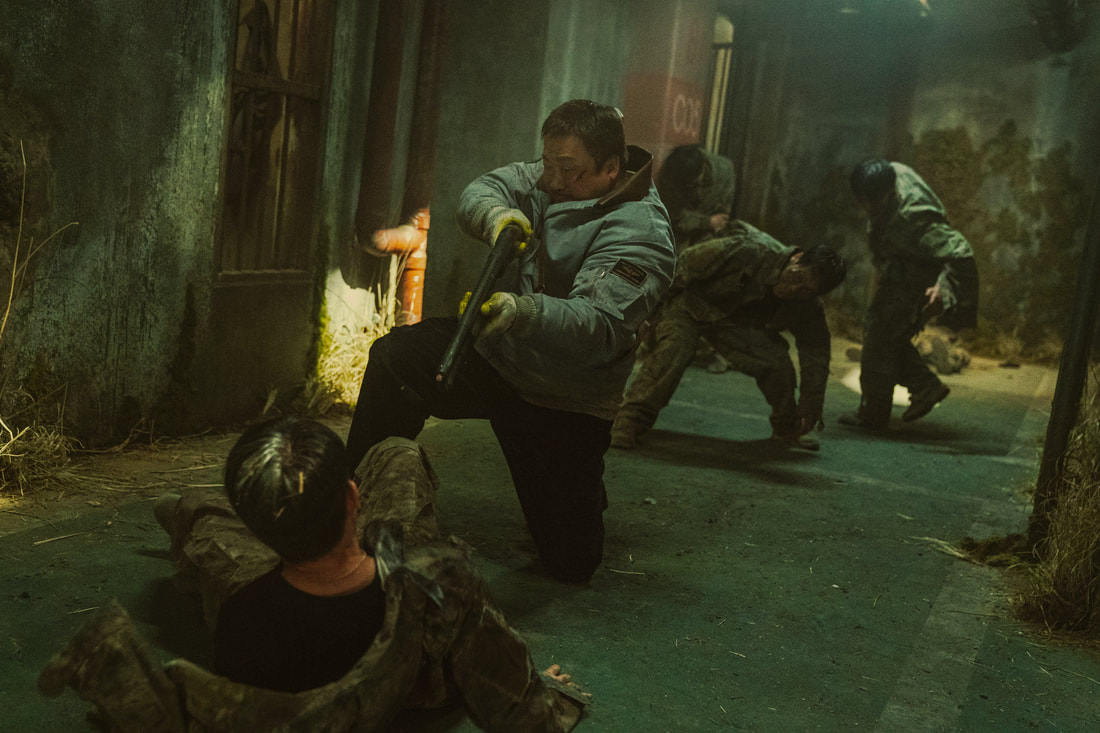
Dynamic handheld camerawork and mostly acceptable digital gore make for fun action set-pieces in Badland Hunters.
The development cycle of sequels and franchise expansions has grown into the lifeblood of Hollywood, so much so that notable film industries that don’t rely on them or develop them in alternative ways feel odd to me. In general, I prefer the inherent novelty of original intellectual properties for the same reasons major studio executives abhors their riskiness, but my God, the bizarre, almost contrived way Badland Hunters was spun off from Concrete Utopia within the Korean filmmaking system is so baffling to me. Whatever my thoughts on either of these movies, though, how filmmakers managed to connect them within the same diegetic universe is almost as goofy as, say, making a movie about a toy doll.
—————————————————————
SUMMARY & RECOMMENDATION: Morbid and emotional yet not without a sense of humor, Concrete Utopia represents another memorable B-movie concept executed in the now internationally famous Korean A-level execution. Badland Hunters, on the other hand, is the dictionary definition of a B-movie in both its bare-bones script as well as its fluid action camerawork. If only it had memorable characters in the slightest, the latter might be worthy of a general double-feature recommendation with Utopia.
—> Concrete Utopia, of course, comes RECOMMENDED, while I’m ON THE FENCE with respect to Badland Hunters.
? I want to know the behind-the-scenes story about how these films were greenlit in relation to one another.

 Express Elevator to Hell
Discussion
Trackbacks/Pingbacks
Pingback: ‘The Gangster, the Cop, the Devil’ (2019): Old Ingredients with Fresh Execution | Express Elevator to Hell - February 28, 2024