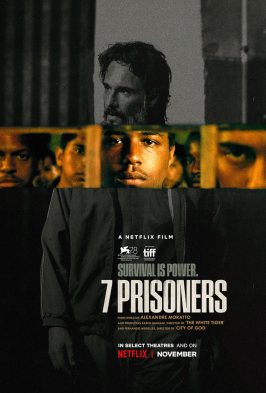
Directed by: Alexandre Moratto || Produced by: Ramin Bahrani, Fernando Meirelles
Screenplay by: Alexandre Moratto, Thayná Mantesso || Starring: Christian Malheiros, Rodrigo Santoro, Bruno Rocha, Vitor Julian, Lucas Oranmian, Cecilia Homem de Mello, Dirce Thomaz
Music by: Tiago Abrahão, Felipe Puperi, Rita Zart || Cinematography: Jão Gabriel de Queiroz || Edited by: Germano de Oliveira || Country: Brazil || Language: Portuguese
Running Time: 90 minutes
What little I’ve seen of Brazilian filmmaking has made me excited for gritty, cinéma vérité–style dramas — crime dramas in particular — that emphasize memorable social and ecological landscapes unique to the country (e.g. City of God [2002], Elite Squad [2007, 2010], Neighboring Sounds [2012]). My patience runs thin, however, when films use those socioecological backdrops for disorganized stories that don’t say anything (e.g. O Matador [2017]) or get too cute with their clunky, obvious message (e.g. Bacurau [2019]); but then again, those complaints apply to most types of cinema, not just those from the largest state in Latin America.
One of the most memorable, dare I say unsettling Brazilian dramas I’ve seen in recent years is the sophomore feature by Alexandre Moratto, a protege of the successful Iranian-American auteur, Ramin Bahrani. Bahrani, himself a connoisseur of sociopolitical dramas about the underprivileged forgotten segments of society (e.g. Man Push Cart [2005], Chop Shop [2007], Goodbye Solo [2008], 99 Homes [2015]) a la Sean Baker (e.g. Tangerine [2015], The Florida Project [2017], Red Rocket [2021]), serves as producer of this creepy, haunting meditation of modern slavery alongside City of God co-director Fernando Meirelles. All three filmmakers previously collaborated on Maratto’s feature debut of Sócrates (2018), where Moratto discovered the teenage star of both that film and 7 Prisoners, Christian Malheiros.
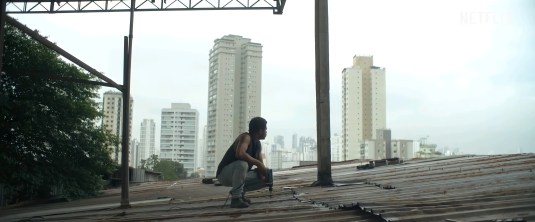
Christian Malheiros gazes at the São Paulo high rise apartments surrounding his veritable prison as he takes a break from his roofing tasks.
Like Bahrani’s most recent flick, The White Tiger (2021), 7 Prisoners is a Netflix Original Film, and both films represent their respective directors’ first foray into the world of streaming video on demand (SVOD). I mentioned in my review of El Conde (2023) — and will again in my future review of The Society of the Snow (2023) — how the era of free SVOD money for most every auteur who wants to pursue their expensive, self-indulgent passion-project (e.g. Bardo [2022], Killers of the Flower Moon [2023]) may be at an end with the apparent close of the “streaming wars” in the aftermath of the coronavirus pandemic; 7 Prisoners, however, appears to be one of the more worthwhile, if undermarketed streaming auteur ventures and, frankly, probably one of the more affordable ones.
Set first in the countryside and later in the eponymous capital city of the state of São Paulo, 7 Prisoners follows the story of Malheiros and three neighbors from their rural community who travel to the urban metropolis after they’re hired for manual labor in a junkyard by co-star Rodrigo Santoro. Malheiros and his supporting castmembers soon discover, however, that they’ve been ensnared in a nightmarish sort of indentured servitude analogous to modern slavery, where they’re locked inside their junkyard compound 24 hours a day, the local police coordinate their imprisonment with Santoro and threaten their families with violence if they don’t cooperate, and the surrounding urban communities are either oblivious to their plight or tacitly accept it.
7 Prisoners’ effective portrayal of these human rights abuses are a function of (1) its screenplay’s subtle expansion of the narrative scope of this corrupt system, whereby cowriter-director Moratto uses Malheiros as a near perfect fish-out-of-water protagonist for the audience to experience, comprehend, and eventually participate in the human trafficking system, and (2) its direction’s fluid exchange between static, almost emotionless visuals and the classical documentarian handheld camerawork that works so well in fast-paced Brazilian social dramas. The first act feels like a waking nightmare a la 12 Years a Slave (2013), where our main character is conned/abducted into a socially engineered trap, but the second act follows Santoro’s twisted “mentorship” of Malheiros as the former shows the latter how expansive and interconnected the Sao Paulo system of junkyard prisons, migrant sweatshops, forced prostitution rings, and illegal immigrant smuggling operations are. All the above are connected to legitimate sources of public and private sector power, which Moratto depicts through quiet yet creepy sequences of Malheiros mingling with ordinary, seemingly genuine civilians connected to his indentured, nonconsensual master. Even more powerful though, are Germano de Oliveira’s almost darkly comedic edits of city powerlines constructed with materials harvested by our entrapped main cast, then wide shots of the city streets lit by that same corrupt infrastructure, and then extreme wideshots of the greater nighttime cityscape powered by the fruits of forced labor.
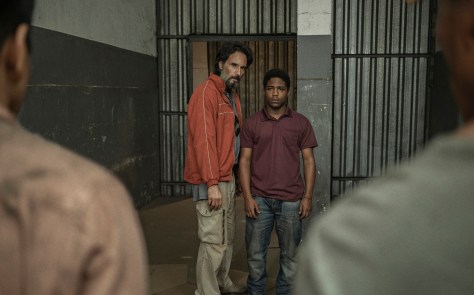
Choose three. Rodrigo Santoro (center left) forces Malheiros to choose additional forced labor for their junkyard in 7 Prisoners’ second act.
I won’t dissect the third act’s ironic twist save to note how unpredictable its conclusion is in an organic way. 7 Prisoners keeps you on your toes without compromising its original narrative tone, and gives Christian Malheiros’ protagonist a meaningful, memorable character arc that serves as better social commentary than any overwritten preachy monologue. Instead of telling its audience what to feel about its major plot-points, Alexandre Moratto and cowriter Thayná Mantesso show us the film’s message through succinct, impactful visuals aided by the relatable, multilayered lead performance of star Malheiros. 7 Prisoners, therefore, joins the ranks of earlier powerful Brazilian social dramas that utilize their native backdrop to explore sociopolitical dilemmas in cinematic ways their native filmmakers know best.
—————————————————————
SUMMARY & RECOMMENDATION: Cold in its portrayal of modern human slavery as it is calculating in the precision of its protagonist’s twisted “growth,” 7 Prisoners begins as one kind of movie and organically morphs into a different one by the end of its tight, engrossing 90-minute runtime without ever compromising its overarching themes. This is the inverse to many of those talky, self-serious, melodramatic Oscar–bait movies you see highlighted year in and year out every holiday season.
— However… the logistical credulity of law enforcement’s total complicity in the human trafficking depicted in 7 Prisoners is somewhat distracting.
—> RECOMMENDED for a feel-bad time.
? If you ever wondered what the actor behind King Xerxes I in 300 (2007, 2014) looks like sans makeup… that’s Rodrigo Santoro.

 Express Elevator to Hell
Discussion
Trackbacks/Pingbacks
Pingback: ‘Who Kills by Iron’ (2019): An Eye for an Eye | Express Elevator to Hell - February 7, 2024
Pingback: ‘Aniara’ (2018): Existentialism Goes Overboard | Express Elevator to Hell - August 8, 2024