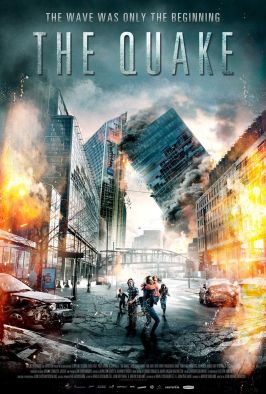
Directed by: John Andreas Andersen || Produced by: Are Heidenstorm
Screenplay by: John Kåre Raake, Harald Rosenløw-Eeg || Starring: Kristoffer Joner, Ane Dahl Torp, Jonas Hoff Oftebro, Edith Haagenrud-Sande, Kathrine Thorborg Johansen
Music by: Johannes Ringen, Johan Söderqvist || Cinematography: John Christian Rosenlund || Edited by: Christian Siebenherz || Country: Norway || Language: Norwegian
Running Time: 106 minutes
Roar Uthaug’s The Wave (2015) is one of the better disaster movies released in the past twenty years or so. It’s not the greatest piece of mainstream, FX-driven cinema since the turn of the millennium or even in the top twenty, but within the loud, bloated, incoherent, cliche-ridden subgenre of blockbusters built around natural disasters (e.g. Twister [1996]), worldwide alien invasions (e.g. Independence Day [1996]), incoming celestial bodies (e.g. Deep Impact, Armageddon [both 1998], Moonfall [2022]), or generalized planetary collapse (e.g. The Core [2003], 2012 [2009]), it doesn’t take much for a quality disaster film that acknowledges basic screenwriting tenets to stand apart. Armed with infrequent yet memorable special FX, great pacing, and realistic if simple (not simplistic!) characters, Uthaug’s Norwegian homage to late 1990s-early 2010s Hollywood disaster schlock earned its reputation across international cinephile communities and remains a cult favorite to this day.
The film earned enough box office success to warrant a sequel several years later, though without Uthaug at the helm: The Quake, an earthquake-centric feature with most of the original castmembers returning. While I was at first hesitant at the prospect of a sequel to The Wave with a different filmmaker, John Andreas Andersen in the director’s chair, the original film’s two screenwriters, John Kåre Raake and Harald Rosenløw-Eeg, and lone credited producer, Are Heidenstorm, return along with the main cast. This continuity of artistic vision, aside from Uthaug’s absence, likely explains the consistency of execution across both The Wave and The Quake. Though this sequel makes the wise decision to move locations from the rural coastal fjords of Geiranger to the urban metropolis of Oslo, most everything else in story concept, narrative pace, and action-packed set-pieces feel comparable between the two films without feeling like a retread.
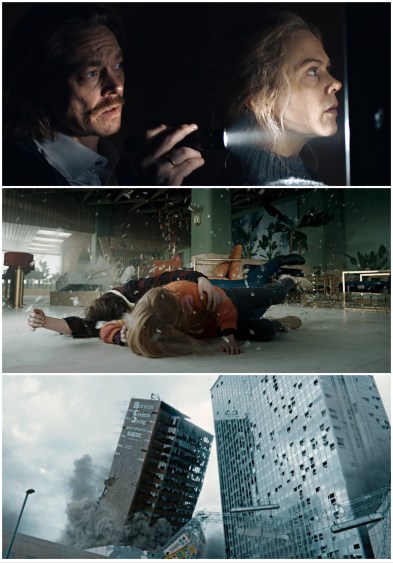
Top: Kristoffer Joner (left) and costar Ane Dahl Torp attempt to reconnect in Oslo during a blackout. Middle: Kathrine Thorborg shields Joner’s daughter, Edith Haagenrud-Sande, as the titular earthquake hits the capital city. Bottom: Some money shots from the third act…
A couple ballsy screenwriting decisions stand out in The Quake, such as killing off a major character in the final act without it feeling contrived, as well as focusing almost the entire third portion of the film on a single location with a single group of characters. To tackle the latter script choice first, it’s quite rare in Hollywood these days for tentpole blockbusters to not spread their storytelling point-of-views across bloated ensemble casts, specifically in their final mega, epic action centerpieces, which has the counterintuitive effect of diluting tension in those expensive set-pieces. Like the better Star Wars (1977, 1980, 2015, 2017) installments, The Quake builds to its computer generated imagery (CGI)-filled finale through its protagonist, Kristoffer Joner, almost exclusively and the movie’s overall pace, character development, and emotional payoff are better for it.
The aforementioned major character death also lends realism to the film’s titular seismological event; it feels neither cheap nor used for shock value, and I did not expect that emotional gutpunch in the moments leading up it. If sequels feel the need to kill off characters established in previous films, this is the way to do it, not cheaply dismiss them off screen (e.g. Alien 3 [1992]) or execute them in the opening scenes (e.g. Berandal [2014]). The character in question is meaningful to both the overall plot and Joner’s lead, and their mortality adds weight to the eponymous natural disaster through the epilogue.
The only complaints I think most viewers might have stem from one of the few lazy cliches the movie doesn’t handle well to start its story, as well as the general conservatism of its premise. With respect to minor complaint No. 1, The Quake opens with Joner somehow in the pits of depression over survivor’s guilt from the previous film, which views like a lame, artificial way to force our hero back to square one to allow room for his arc in the sequel. Minor complaint No. 2 isn’t a true weakness so much as it is a warning for those accustomed to Roland Emmerich’s disaster-porn filmography post-Independence Day. This Norwegian sequel, an homage like The Wave is in so many ways to the types of movies upon which Emmerich built his Hollywood career, works within its modest budget (less than $6 million) and builds to one, maybe one and a half set-pieces if we’re being generous.
When I first watched Roar Uthaug’s 2015 back-to-basics approach to the high-concept disaster film, I figured it was a one-and-done situation. I am more than pleased to report The Quake makes for an equally engaging continuation of The Wave despite changing directorial hands and not reinventing the traditional genre formula of its predecessor. Like The Wave, The Quake ain’t a perfect movie or much of an innovator, but it doesn’t have to be and provides the sort of straightforward, reliable FX-driven entertainment characteristic of Hollywood without skimping on meaningful characters to guide its audience through those FX.
———————————————————————————————————————————————————————————–
SUMMARY & RECOMMENDATION: Broken into its component parts, The Quake is nothing most audiences haven’t seen many times over, but relative to the bloated ensemble casts, cringeworthy comic relief characters, longwinded runtimes, and endless, repetitive CGI of Hollywood’s prolific disaster blockbusters from the 2000s in particular, this sequel is a breath of fresh air.
— However… screenwriters John Kåre Raake and Harald Rosenløw-Eeg don’t try too hard to justify why their protagonist isn’t heralded as a national hero riding high on life at the film’s start. You get 1-1.5 set-pieces, and no more.
—> RECOMMENDED as a nice two-parter with The Wave.
? When was the last time a massive earthquake hit Norway in real life?

 Express Elevator to Hell
Discussion
Trackbacks/Pingbacks
Pingback: ‘La Palma’ (2024): ‘The Wave’ (2015) & ‘The Quake’ (2018) on a Diet | Express Elevator to Hell - March 16, 2025