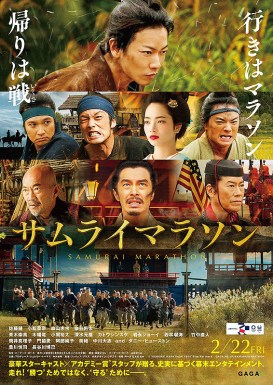
Directed by: Bernard Rose || Produced by: Jeremy Thomas, Toshiaki Nakazawa
Screenplay by: Bernard Rose, Hiroshi Saito, Kikumi Yamagishi || Starring: Takeru Satoh, Nana Komatsu, Mirai Moriyama, Shota Sometani, Munetaka Aoki, Naoto Takenaka, Danny Huston, Etsushi Toyokawa, Hiroki Hasegawa
Music by: Philip Glass || Cinematography: Takuro Ishizaka || Edited by: Mako Kamitsuna || Country: Japan, United Kingdom || Language: Japanese
Running Time: 104 minutes
One of the first live-action Japanese properties I watched in recent years was the multi-feature franchise adaptation of the Rurouni Kenshin (RK; 1994-1999) manga, cowritten and directed by Keishi Otomo. The final two installments, the confusingly subtitled RK: The Final and RK: The Beginning, were distributed online by Netflix as international exclusive titles and their catchy, colorful trailers caught my attention as an action fan in a flash. I soon binge-watched the entire four-part series and discovered that, while all but the last film (The Beginning) didn’t quite live up to the hype, I was impressed by the the films’ extensive swordplay and the classic stoic, if repetitive heroism of the series’ lead, Takeru Satoh.
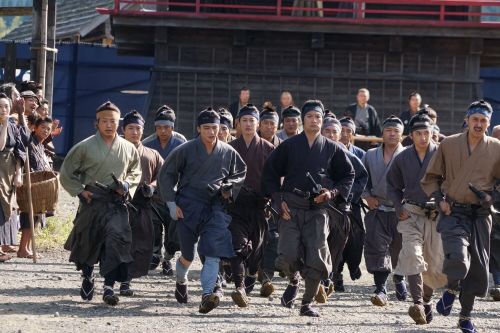
Annaka City samurai begin their marathon training session in response to encroaching socioeconomic threats from the outside world.
It took me some time before I stumbled upon marketing for another Satoh lead performance, this time on YouTube: Samurai Marathon by cowriter-director Bernard Rose. If the sound of a Westerner directing a film in East Asia sounds weird, that’s because it seems as rare to you as it does to this cinephile; recruiting foreigners to direct local crowdpleasers feels more the domain of Hollywood, or even mainland China with respect to Hong Kong filmmakers, but the seemingly isolated, protectionist society of the Land of the Rising Sun feels like, to me, one of the last cinematic cultures to feature guest directors from abroad.
The only other film of Englishman Rose with which I’m familiar is the 1992 urban legend horror film and pre-Jordan Peele social drama, Candyman, which is one of the more memorable horror films of a decade otherwise dismissed as the post-slasher era. Compared to that unique gruesome experience, Marathon can’t help but feel like a tame, predictable period-piece by comparison. When contrasted with your average 2010s-2020s era jidaigeki movie, the film comes across as unsure of what kind of story it wants to tell, let alone how to build memorable characterizations, the foundation of any story.
An almost incoherent dramatization of the first Ansei Toashi 30-km footrace that took place toward the tail end (~1850s) of the isolationist Edo Period, the film’s disorganized script paired with a forgettable lead performance by Satoh turn what might otherwise be tense, violent guerilla warfare into a poorly paced snoozefest. For one thing, almost every major plot development happens as the result of shortsighted misunderstandings or happenstance, including Satoh’s shogunate ninja spy mistaking the titular endurance test as a rebellion instead of the obvious training regime for local samurai that it is. What could’ve been a nice visual introspection of Japan’s conflicting reactions toward encroaching Western influence (the film is bookended by Danny Huston, a frequent collaborator of Rose’s, demonstrating US firearm technology to the bemused Tokugawa Shogun) peters into a weird, quiet period drama about Japanese village life; dramas require different strengths than your typical jidaigeki or chanbara film, of course, yet the cast’s broad collection of character archetypes (e.g. the rebellious nobleman’s daughter who refuses an arranged marriage [Nana Komatsu], an elderly hermit who mentors a fatherless child [Naoto Takenaka], the family man who contemplates bribes at the expense of his samurai honor [Shōta Sometani], etc.) feel out of place when the quaint, forgettable, talky sections of the first two acts transition to a haphazard action film in the last 35 minutes.
Direction-wise, the film looks nice thanks to its rugged, humid forest locations and handful of creative, bloody character beheadings via katana, but other than that, the set-pieces underwhelm both as fun, violent spectacle or as dramatic upticks in the film’s narrative pace. The film’s considerable production values no doubt make these sequences look more expensive than they are, but director of photography Takuro Ishizaka appears to focus his camera on the background foliage more than the human figures in front of them.
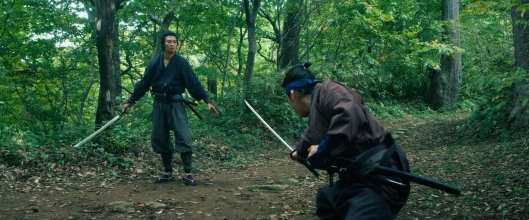
Lead Takeru Satoh (right) draws his sword for combat once the action sequences for Samurai Marathon kick in.
I was never too enamored with Takeru Satoh’s eponymous lead performance in the Rurouni Kenshin franchise, save for the effective prequel installment that was The Beginning. His understated, mopey personality operates best within a diverse ensemble filled with character actors that are, by in large, much louder than he was, so his role as protagonist here in Bernard Rose’s Samurai Marathon isn’t given much to work with in light of Marathon’s lackluster characters. Other than that, Rose doesn’t offer any unique outsider perspective on Japan’s iconic Edo Period, which makes me wonder what the point of this whole affair was.
—————————————————————————————————————————————————————————–
SUMMARY & RECOMMENDATION: Samurai Marathon is like a more reserved, realistic, and boring take on the same general themes and historical events referenced in Kenshin, with no discernible narrative structure to heighten tension or escalate emotional stakes throughout its limited set-pieces. Beyond reminding Japanese popular culture how the Ansei Toashi marathon came to be, this film doesn’t have much to show for all its gorgeous backdrops.
— However… Samurai Marathon remains a good-looking, scenic movie with some classical samurai decapitations to sate your bloodthirst and enough historical trivia to remind you that narrative cinema can be intellectual.
—> NOT RECOMMENDED
? Weren’t most ninja spies nonexistent or irrelevant in the Edo Period?

 Express Elevator to Hell
Discussion
Trackbacks/Pingbacks
Pingback: ‘Fable’ (2019, 2021): The Goofy, Lovable ‘John Wick’ | Express Elevator to Hell - October 3, 2024