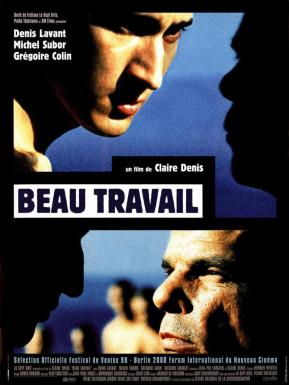
Directed by: Claire Denis || Produced by: Patrick Grandperret
Screenplay by: Claire Denis, Jean-Pol Fargeau || Starring: Denis Lavant, Michel Subor, Grégoire Collin, Richard Courcet, Nicolas Duvauchelle
Music by: Benjamin Britten, Charles Henri de Pierrefeu || Cinematography: Agnès Godard || Edited by: Nelly Quettier || Country: France || Language: French
Running Time: 90 minutes
Much like my slow, still ongoing progression through the American Film Institute’s 2007 100 Years… 100 Movies list, which I began only a couple years after that list released, my exploration of the 2012 and 2022 Sight and Sound Greatest Films of All Time by the British Film Institute (BFI) remains a patient, rewarding, if often confounding journey that leaves me with more artistic questions than answers. My cinephilia has expanded into different regional, cultural, and genre perspectives since the late 2000s when I graduated from high school and transitioned to college. To say I still do not relate to the vast majority of directorial styles, let alone diverse subject-matter (i.e. story content), presented in the latter BFI articles would be an understatement, but much of the point of artistic media appreciation is to learn about that which you are ignorant. I believe my decade-plus exploration of these critically respected rankings has achieved at least part of that goal.
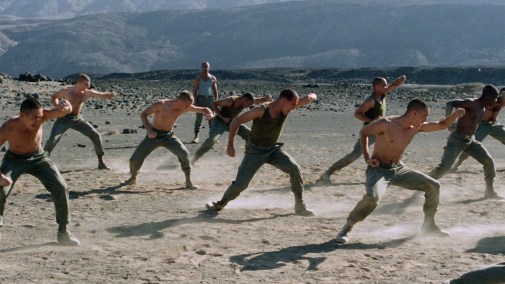
French Foreign Legionnaires perform martial arts forms in the arid deserts of the Horn of Africa.
One of the more recent feature-films that broke the BFI’s Top 10 in the organization’s most recent 2022 compilation was respected French filmmaker Claire Denis’ 1999 Beau Travail (English = “Good Job,” but I think the subtitles in my rented copy translated better to “Good Find” if I read the story correctly). While I’m not the biggest fan of slow, introspective dramas in general, I give those types of cinematic works a pass when French given how storied France’s national film culture is as well as how weird, in a good way, many of its trendier critical darlings tend to be (e.g. Raw [2016], Blue is the Warmest Color [2013], Cache [2005]). As much as a filmmaker like Julia Ducournau may beg to differ, French filmmaking boasts a distinct, identifiable flavor of auteur cinema that blends abrasive genre violence with otherwise conventional dramatic screenplays, a sardonic, almost nihilistic sense of humor, and the occasional satire of post-colonialism.
Beau Travail contains most of those notable attributes given its oddball portrait of an athletic, at times quite homoerotic section of the French Foreign Legion stationed in the east African nation of Djibouti. Sundrenched, choreographed to the rhythm of military training drills, and almost dialogue-free, Denis’ most famous movie feels like a colorized silent film captured with 1990s filming technology, driven by both the masculine comradery as well as the rivalry amongst the featured soldier characters. Its lead is an enigmatic, discontented Legionnaire officer (Denis Lavant) who inexplicably distrusts one of his section’s new recruits (Grégoire Colin; they’re the two dudes on the poster) on sight, and the former’s prejudiced relationship with the latter informs the development of the third act, into which the film packs most of its narrative. Travail’s first two acts revolve around the nonlinear portrayal of Lavant’s time in Djibouti, told through intermittent flash-forwards to his return to Paris where he awaits a court marshal for a predictable offense in the film’s aforementioned melodramatic finale.
When you’re not lulled to sleep — I don’t even mean that as a criticism so much as an observation of how relaxed the movie feels until its last half hour or so — by Travail’s hypnotic calisthenics against its high-key outdoor photography, you’ll draw parallels to both the earlier Full Metal Jacket (1987; at least its first half) and the later Moonlight (2016), films whose narrative structures are warped by atypical lighting schemes, memorable non-action, non-musical choreography (athletic blocking?), and softspoken yet palpable tension amongst the principal cast. Much of what makes this dynamic flow is the modest length of Travail (90 minutes; compare that to the 200-minute runtime of the top-ranked film of the 2022 Sight & Sound list, Jeanne Dielman [1975], by Chantal Akerman), which explores its main character without forgetting to humanize its supporting cast in a tight, efficient format.
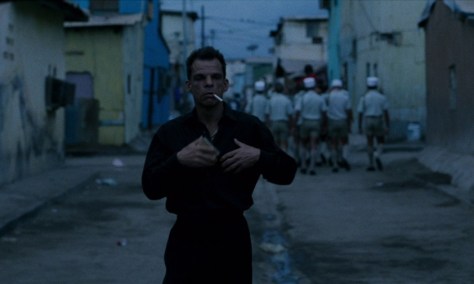
Lead Denis Lavant smokes during off-duty hours in a Djibouti village as new recruits pass him by.
To be sure, Beau Travail exemplifies the type of European, specifically French “art” film of which most general audiences will tire after the first 15-20 minutes, so keep in mind this patient drama isn’t meant for 1.5 hours’ of visceral genre entertainment even if you’re well accustomed to the “slow-burn” storytelling of, say, A24’s popular modern horror films. Claire Denis’ most well known feature is, on the other hand, not the sort of critical darling that bashes its thematic message over its audience’s heads, nor does it artificially balloon a 10-minute short film concept to feature-length. While relaxed in its narrative pace, Beau Travail doesn’t waste its viewers’ time and, in my assessment, earns its feature status with its impressive cinematography and general disdain for pointless dialogue. As much as I remain out of love with many of the films spotlighted in lists like the BFI’s Sight & Sound collection, gems like Beau Travail feel like notable rewards for adventuring outside my cinephile comfort zone.
——————————————————————————————————————————————————————————-
SUMMARY & RECOMMENDATION: Claire Denis paints a broad portrait of a specific aspect of French colonial decay that intersects with personal prejudice, complex physical movements, and a memorable, commanding East African landscape. If the “extreme” French horror films of the 2000s (e.g. High Tension [2003]) are too grisly for you and the older French New Wave dramas (e.g. Breathless [1960]) are just, well, too old-fashioned for you, I’d argue Beau Travail fits into a nice, artsy middle-ground.
— However… this ain’t the cinematic journey for those who prefer traditional, concrete story structure, charismatic, likable characters, or filmic themes spoonfed to them.
—> RECOMMENDED for those ready to slog their way through the less boring BFI recommendations…
? Should I assume Lavant committed suicide in the end? When did the movie stop thinking for me?

 Express Elevator to Hell
Discussion
Trackbacks/Pingbacks
Pingback: ‘Mayhem!’ (2023) & ‘Lost Bullet 3’ (2025): More French Ultraviolence | Express Elevator to Hell - March 21, 2026