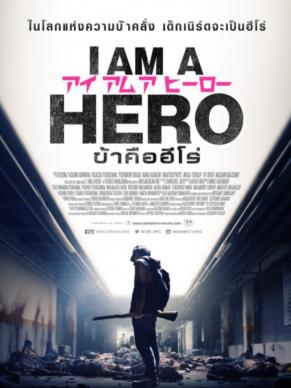
Directed by: Shinsuke Sato || Produced by: Akihiro Yamauchi
Screenplay by: Akiko Nogi || Starring: Yo Oizumi, Kasumi Arimura, Masami Nagasawa, Hisashi Yoshizawa, Yoshinori Okada
Music by: Nima Fakhara || Cinematography: Roger Campredon, Taro Kawazu || Edited by: Tsuyoshi Imai || Country: Japan || Language: Japanese
Running Time: 126 minutes
Revisiting Japanese cinema after years of ignoring it beyond Akira Kurosawa samurai flicks, Showa (1954-1975) to Heisei Era Godzilla (1984-1995) movies from my childhood, and the occasional sampling of famous anime classics has catalyzed my development as a cinephile. Most rewarding has been the occasional discovery of worthwhile Japanese filmmakers working outside of animation but “under the radar” relative to the far more popular, influential thrillers of the ongoing Korean New Wave. I’ve spoken before about my somewhat recent introduction to Takashi Miike, but the Japanese writer-director with whom I’ve become most enamored of late is Shinsuke Sato, a filmmaker most well known for his live-action adaptations of popular manga series like The Princess Blade (2001), Sand Chronicles (2008), Bleach (2018), and the Netflix Original Series, Alice in Borderland (2020, 2022).
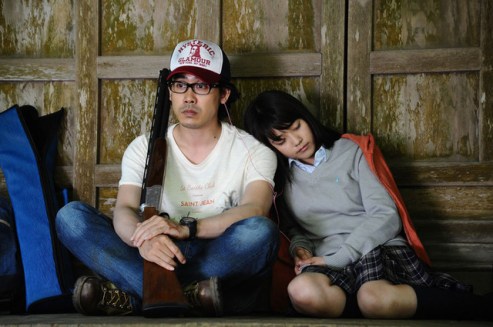
Yô Ôizumi (left) and Kasumi Arimura (right) bond during one of the few sequences where the latter isn’t mute. It’s a shame because what little chemistry they do have together is good.
Enter I Am a Hero, one of two cinematic translations of horror manga Sato directed but did not write from 2015-2016, the other being an installment in the Death Note (2006-2016) series, which Adam Wingard himself took an English-language stab at for Netflix in 2017. Hero is based on the zombie comic series of the same name (2009-2017) by Kengo Hanazawa, following the general outline of the primary graphic novel volumes about a struggling Tokyo manga artist (Yo Oizumi; write what you know, as they say… ) who attempts to survive the sudden outbreak of a disease that transforms people into rabid, flesh-eating maniacs. Armed with his personal sporting shotgun, Oizumi scrambles to escape the overwhelmed Tokyo metropolis while encountering strangers like underutilized female lead Kasumi Arimura along the way.
Perhaps the most immediately pleasing attributes of Hero on screen are (1) Sato’s smooth tracking camerawork whenever characters are running for their lives (Oizumi’s sprint away from his apartment throughout the Nerima ward streets alongside a Steadicam are a highlight) and (2) his use of the script’s visualization of the low self-confidence of its protagonist to convey sardonic, character-informing humor. With respect to the latter, the narrative segues from reality to plausible scenarios within Oizumi’s imagination at numerous points throughout the movie without telling the audience until after he triumphs or “dies”. Films that visualize a character’s inner thoughts aren’t that uncommon, to be fair (e.g. The Secret Life of Walter Mitty [2013]), nor is unreliable narration (e.g. Fight Club [1999]) rare, either, but the fluidity with which Hero transitions between objective and subjective storytelling is so smooth that the movie’s dark sense of humor lightens the narrative mood even at its darkest moments.
This organic comic relief dovetails with the primary arc of the main character. Softspoken, plain in appearance, mediocre in terms of career accomplishments, yet kindhearted underneath, Oizumi portrays the most relatable protagonist since Thomas Jane in The Mist (2007) and Kristen Connelly in The Cabin in the Woods (2012). His and the film’s secret weapon is his eclectic — for a Japanese citizen, anyway — side passion for skeet shooting; private firearm ownership is incredibly rare in Japan, so the narrative structures its protagonist to be subtly yet significantly better armed than his supporting cast (even when his weapon is confiscated by others, so few diegetic civilians are familiar with handling guns that they can’t take advantage of their stolen weaponry). The lone obstacle to his hidden “superpower,” as the first act makes clear, is his meek, deferential personality and low self-esteem.
Examining Hero beyond its reliable screenplay format and Sato’s well established action cinematography, problems crop up throughout its female characters like the aforementioned Arimura, as well as fellow costar Masami Nagasawa. Arimura’s unique reaction to the zombie virus feels like a giant missed opportunity, for one (either explore that detail from the comics, or don’t), while Nagasawa’s introduction halfway through the film doesn’t allow her character much room for growth… or to do much of anything, for that matter. Minor human villains (e.g. Hisashi Yoshizawa) also introduced in the second act, meanwhile, alternate between cartoony lines and somewhat contrived incompetence at handling even conventional melee weapons.
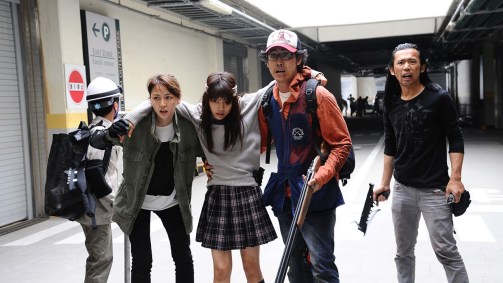
Ôizumi and the remaining survivors steel themselves for a fight to the death as zombies surround them on all sides.
With all that said, I Am a Hero is still one of the better zombie films released in the past decade, as well as one of the stronger live-action Japanese pictures I’ve seen since I got back into Japanese filmmaking. Contemporary cinema in the Land of the Rising Sun, as it has been for decades now, remains dominated by animation, but that doesn’t mean cinephiles should overlook its live-action side anymore than Western audiences should look down upon their native animated features. Its lackluster supporting cast aside, Shinsuke Sato’s 2015 horror-action hybrid boasts such a strong protagonist with such a satisfying arc that its over-the-top gore and surprisingly mature portrayal of civilian gun ownership almost feel like bloody cherries on top of its zombie apocalypse sundae.
—————————————————————————————————————————————————————————-
SUMMARY & RECOMMENDATION: The current environment of Japanese filmmaking can’t hold a candle to the likes of, say, modern Korean cinema in terms of either influence or consistency, yet I Am a Hero, alongside multiple other installments in the filmography of Shinsuke Sato, make a convincing argument for the potency of 2010s Japanese live-action film. With exciting set-pieces, natural humor, and a fluid visualization of characters’ internal monologues, I Am a Hero is the complete undead package.
— However… the film’s supporting cast are about as coherently written as the characters from Genome Hazard (2013); that is to say they are a wasted opportunity.
—> RECOMMENDED. While Hero isn’t the breath of fresh air that One Cut of the Dead (2017) is, its archetypal formula is as reliable as a 1998 Toyota Camry.
? Was that shotgun using buckshot or slugs? Maybe both?!

 Express Elevator to Hell
Discussion
Trackbacks/Pingbacks
Pingback: ‘Fable’ (2019, 2021): The Goofy, Lovable ‘John Wick’ | Express Elevator to Hell - October 3, 2024