Directed by: Gunasekhar [1], Trivikram Srinivas [2], Hari Shankar, Harish Narayan [3] || Produced by: M. S. Raju [1], B.V.S.N. Prasad [2], Sivalenka Krishna Prasad [3]
Screenplay by: Gunasekhar, Paruchuri Brothers [1], Trivikram Srinivas [2], Hari Shankar, Harish Narayan [3] || Starring: Mahesh Babu, Bhumika Chawla, Prakash Raj [1], Pawan Kalyan, Pranitha Subhash [2], Samantha Ruth Prabhu [2, 3], Unni Mukundan, Varalaxmi Sarathkumar, Murali Sharma, Rao Ramesh [3]
Music by: Mani Sharma [1, 3], Devi Sri Prasad [2] || Cinematography: Sekhar V. Joseph [1], Prasad Murella [2], M. Sukumar [3] || Edited by: A. Sreekar Prasad [1], Prawin Pudi [2], Marthand K. Venkatesh [3] || Country: India || Language: Telugu
Running Time: 171 minutes [1], 175 minutes [2], 132 minutes [3] || 1 = Okkadu, 2 = Attarintiki Daredi, 3 = Yashoda
Few things in filmmaking irritate me, as a viewer, more than a filmmaker who thinks their movie is way cooler than it actually is. Whether we’re talking about comedies whose stars claim they’re hilarious (e.g. every Happy Madison production ever), computer generated imagery-laden action blockbusters whose directors are convinced they’re badass (e.g. Michael Bay’s filmography from Armageddon [1998] to Transformers 5 [2017]), saccharine romantic melodramas whose writer-directors are under the delusion their stories’ forced, fake sentimentality is endearing (e.g. Karan Johar’s Kuch Kuch Hota Hai [1998], Rajkumar Hirani’s Munna Bhai, MBBS [2003]), or films that are way too in love with their heavy-handed social commentary (e.g. most any Koratala Siva picture), I have little patience for a film whose artistic design misses the mark so obviously. Sometimes that tone deafness only becomes obvious with hindsight once short-term box office success or critical hype (e.g. your typical Oscar-bait) fades into the background, but other times the artistic disconnect is clear right from the start.
Three films from the last couple decades of Telugu cinema that flirt with, if not outright embody this general air of presumptuousness are Gunasekar’s Okkadu (“The One & Only Person“), the venerable Trivikram Srinivas’ Attarintiki Daredi (“Which Path Leads to My Aunt’s House?”), and Hari Shankar and Harish Narayan’s Yashoda (no translation… that’s just the protagonist’s name!). To circumvent any premature anger at my blanket categorization of those films by their fans, please note I only hold one of this trio in low esteem, while I consider the remaining two, let us say, guilty pleasures. It is difficult to put oneself into the minds of the people making a given film, those behind the camera most of all, but I believe each of the aforementioned filmmakers don’t quite understand how well their films work — or don’t — in hindsight.

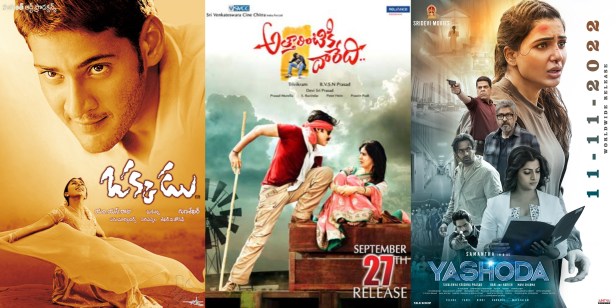
Top: Yashoda stars Samantha as the titular protagonist dealing with the nefarious machinations of an enigmatic surrogate maternity ward. Middle: Attarintiki Daredi features good songs, but great dance sequences? Not so much (this image brought to you by Isuzu!). Bottom: Lead Mahesh Babu celebrates his victory in a kabaddi championship in Okkadu.
First up is an early hit for one Mahesh Babu, my favorite South Indian star with limited facial expressions and questionable dance skills. Okkadu is a sort of romantic sports drama/action hybrid that combines mainstream Indian filmmaking tropes like colorful musical numbers (again, minus Babu’s stiff hips), a romance with a bubbly if sardonic female lead (Bhumika Chawla), and a goofy rivalry with an onery gangster (prolific character actor Prakash Raj) with competitive affections for said female lead, with notable twists like Babu’s ambitions as a semi-professional kabaddi player (Westerners, think Indian rugby), a surprisingly deep, multilayered paternal performance by Mukesh Rishi, as well as an outrageous, almost Edgar Wright-esque finale. To summarize, Okkadu works best when it channels its obvious West Side Story (1961) influences against its Telangana cultural backdrop (the photography of the Old City neighborhoods of Hyderabad looks gorgeous, and the on-set recreations of the Charminar monument are impressive), but wastes much of its charm on a predictable narrative, unambitious romance, and overindulgent runtime (a typical 2000s Indian film length of 171 minutes).
Somewhat more convoluted in execution, if that’s possible, but just as bloated in size is Attarintiki Daredi by Trivikram Srinivas. As a fan of Srinivas’ Athadu (2005) and Ala Vaikunthapurramuloo (2020), I was surprised at my mixed reactions to the 2013 film’s labyrinthine plot involving megalomaniacal business tycoons, ruthless Pinkerton-esque thugs, complicated corporate politics, and of course, a longwinded love triangle. The closest analogue to Daredi I can think of is Sooraj Barjatya’s Hum Aapke Hain Koun… ! (1994), which is considered a landmark of 1990s Hindi cinema that revitalized theatrical Bollywood filmmaking through its supposedly innovative cinematographic analyses of Northern Indian culture, but to an outsider like me, watches like an opaque, incoherent 200-minute soap opera. Daredi has more tension than that film because it’s about more than just a wedding ceremony, but at the end of the day, I can’t maintain interest in a film with pacing this inconsistent over 175 minutes. The fact that star and Telugu icon Pawan Kalyan is visibly 16-19 years older than female lead Samantha Ruth Prabhu further distracts from the film’s melodramatic style.
Enter Hari Shankar and Harish Narayan’s Yashoda, the latest vehicle for prolific Telugu-Tamil starlet Prabhu, who’s credited most often with her given name, Samantha. To my knowledge, Yashoda is her first lead role in an action film, though it might not seem like it at first, as well as its principal filmmakers’ Telugu debut after several independently produced Tamil genre films of similarly modest length. Like their earlier films, Yashoda is a sub-2.5 hour (132 minutes, to be exact) purebred genre experience (equal parts crime drama and action) whose story is easy to follow, but whose action set-pieces feel as stilted and unconvincing as those in Maria (2019), and whose limited special FX draw attention to the film’s cheap production values. The film might have been worth a watch, given its digestible size relative to the previous two films discussed here, had Yashoda not been so proud of its dual narrative twists, which one can see from a mile away, as well as its lead actress’ pale imitation of an Extraction (2020, 2023), The Night Comes for Us (2018), John Wick (2014–2023), Drug War (2012), or I Saw the Devil (2010) hero.
To reiterate, Yashoda is the only one of these movies I outright dislike, but even Okkadu and Attarintiki Daredi need serious editing to hone their unwieldy stories and accentuate their strengths (e.g. their likable main characters, memorable soundtracks, and quirky character relationships). I wouldn’t recommend any of these films to viewers outside South Asia, unfortunately, as their obvious weaknesses kneecap their cinematographic style in the vein of countless mainstream Hollywood and Bollywood films before them.
——————————————————————————————————————————————————————————
SUMMARY & RECOMMENDATION: Though Okkadu, Attarintiki Daredi, and Yashoda demonstrate the sheer diversity of South Indian filmmaking genres, storytelling tropes, and camerawork, they also exemplify how directorial style falls flat when not balanced by ruthless editing, plot-points that aren’t either telegraphed or indecipherable, and well executed set-pieces. Coolness on screen, like in any medium, must be earned.
—> I’m ON THE FENCE with regards to Okkadu and Attarintiki Daredi, while I DO NOT RECOMMEND Yashoda.
? Couldn’t that miracle cure have been produced with placentas, uterine fluid, and/or umbilical cords?

 Express Elevator to Hell
Discussion
Trackbacks/Pingbacks
Pingback: Telugu Reviews, Volume 11: 1: Nenokkadine (2014), Padi Padi Leche Manasu, & Mahanati (2018) | Express Elevator to Hell - August 22, 2024