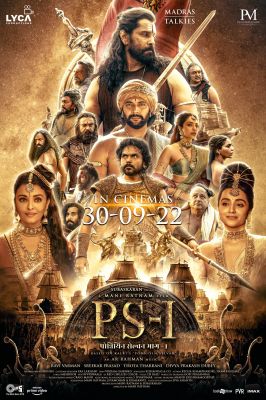
Directed by: Mani Ratnam || Produced by: Mani Ratnam, Subaskaran Allirajah
Screenplay by: Mani Ratnam, Elango Kumaravel, Bahuleyan Jeyamohan || Starring: Vikram, Aishwarya Rai Bachchan, Jayam Ravi, Karthi Sivakumar, Trisha Krishnan, Aishwarya Lekshmi, Sobhita Dhulipala
Music by: A. R. Rahman || Cinematography: Ravi Varman || Edited by: A. Sreekar Prasad || Country: India || Language: Tamil
Running Time: 332 minutes
In my review of Alejandro Iñárritu’s Bardo (2022), I noted the drawbacks of a filmmaker becoming too intimate with the subject of his movies. Upsides of auteur-driven cinema (i.e. filmmaking by directors or writer-directors with identifiable personal style and established skill) include the personal touches filmmakers lend to their projects even when their execution isn’t on-point, as well as the venerable experience that results from years if not decades of executing that personal style across a myriad of different projects. Cinephiles, film journalists, and academics often overlook, I feel, the downfalls of filmmaking becoming too controlled by a chief filmmaker whose tunnel vision and self-indulgence cloud their greater judgement, whose artistic ambition interferes with the overall artistic “point” of their film’s narrative. As interesting as parts of Bardo are, it is only one of the most recent features to exemplify the pitfalls (see also the Star Wars Prequels [1999, 2002, 2005], mid-career M. Night Shyamalan, Michael Bay’s Transformers [2007-2017], Heaven’s Gate [1980], etc.) of when directors’ lose their heads too far up their asses.
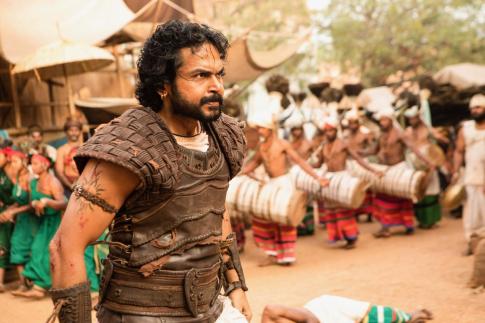
Maybe in an earlier draft of Ponniyin Selvan Karthi Sivakumar functioned better as the film’s protagonist, because his character drives the story more than most of the cast. At the same time, his arc in the theatrical release is limited and he disappears from the film for vast stretches of time.
The two-part film adaptation of Kalki Krishnamurthy‘s 2,210-page historical fiction novel, Ponniyin Selvan (“The Son of Ponni,” 1950-54), while not as over-the-top as some of the most notorious auteur projects to go off the rails, remains the latest big-budget South Indian blockbuster to lose sight of its cinematic strengths thanks to its director’s closeness to the source material. Selvan the novel is in many ways a sort of South Indian Lord of the Rings (LOTR; 1954-55), a type of loose yet popular cultural mythology about the real-life Tamil thalassocratic Chola Empire (~300s BCE-1279 CE) that feels both epic and timeless. Film adaptations have been considered ever since the novel’s publication, including from Ratnam as early as the late 1980s, but this first motion picture realization didn’t get off the ground until 2019, after which the film’s production dealt with multiple delays due to the COVID-19 pandemic. Ponniyin Selvan the movie (henceforth, PS) fulfilled its long awaited box office expectations and released to positive reviews from South Asian critics, but as a cultural outsider and quasi-skeptic of Ratnam’s filmography, I find myself puzzled by the final result.
From where I stand, PS suffers major problems from adapting a massive literary narrative that spans multiple decades and over a dozen principal characters. Previous adaptations of fantastical, sprawling epics like the aforementioned LOTR (2001-2003) and Dune (2021, 2023) have succeeded in translating their unwieldy source materials to screen even if they had to resort to splitting their projects across multiple theatrical installments; by contrast, PS fails to craft a coherent, engaging story thanks to its bloated length (over 5.5 hours) and lackluster pacing, not to mention its overall confused narrative focus.
For one thing, PS lacks a clear protagonist or audience surrogate to introduce viewers to the complicated geopolitics of its dramatized Chola Empire of the 10th century CE. Its star studded cast, from Tamil regulars like Vikram (Kennedy John Victor), Karthi Sivakumar, Trisha Krishnan, Telugu actress Sobhita Dhulipala, Malayalam actress Aishwarya Lekshmi, Kannada actor Prakash Raj, and the Tulu-Hindi queen herself, Aishwarya Rai Bachchan, offer a variety of character perspectives and extended dramatic monologues but little meaningful exposition or visual storytelling to explain what the hell is going on. So much scheming, backstabbing, and political maneuvering occurs that one loses track of numerous subplots before the halfway mark; the only things I could recall between theatrical installments is that Rai was the primary antagonist and Vikram was the Chola Empire’s heir apparent (i.e. crown prince).
To give credit where it is due, PS does not go overboard with its special FX nor any bloated set-pieces a la, say, S. S. Rajamouli’s Baahubali (2015, 2017) or Shankar Shanmugam’s 2.0 (2018). Obvious composite backgrounds are almost nonexistent and considerable effort appears to have been taken to capture as much of PS in real outdoor locations or within impressive constructed indoor sets as possible. PS also struggles to take advantage of these directorial strengths, however, as its mammoth runtime features so few notable action set-pieces, chase sequences, or dance numbers of any kind to modulate its narrative pace.
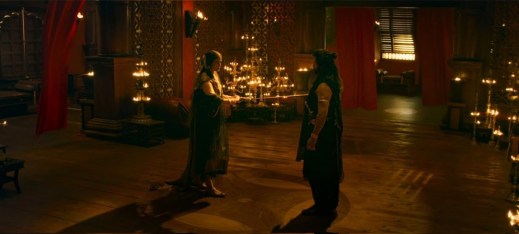
The closest thing to a heartbeat in PS is the contentious relationship between primary antagonist Aishwarya Rai and the film’s technical lead, Vikram.
In summary, Mani Ratnam’s long gestating passion-project to adapt the epic Kalki Krishnamurthy novel is nominally successful but functionally uncinematic. I don’t see what most audiences would get out of this piece beyond some nice South Indian nature footage unless they’re absolute diehard fans of the source material, and even then one has to sit through over five hours of endless, repetitive, dialogue-driven scenes that feel more like literary soap opera than cinema. Though Ponniyin Selvan the movie isn’t a filmmaker’s glorified soapbox like Bardo or overzealous with its computer generated imagery (CGI) like Baahubali, I found it borderline impossible to follow unlike the former and almost bereft of entertainment value as opposed to the latter. To me, Ponniyin Selvan is auteur self-indulgence run amok once again.
————————————————————————————————————————————————————————
SUMMARY & RECOMMENDATION: Perhaps Martin Scorsese’s Silence (2016) is the best comparison against which to judge Ponniyin Selvan, where a director’s personal obsession with a particular written work overwhelms their usual audiovisual style to the point where that filmmaker’s auteur stamp is nearly unrecognizable in their final adaptation of said work. Despite the lack of obvious CGI, shoehorned comic relief side-characters, stuntcasting, and other contrivances common to commercial filmmaking, Ponniyin Selvan is so bland that even its A. R. Rahman soundtrack is forgettable.
— However… the film looks nice, I guess? The outdoor principal photography and elaborate sets showcase good production values.
—> NOT RECOMMENDED. Critics assigning this movie positive reviews I feel are doing so out of respect for Ratnam’s influential career and his commitment to getting this near Sisyphean project off the ground, not because the project’s execution is noteworthy.
? I bet you couldn’t even tell that Rahman scored this film without looking it up, could you?

 Express Elevator to Hell
Discussion
No comments yet.