
Directed by: Werner Herzog || Produced by: Werner Herzog
Screenplay by: Werner Herzog || Starring: Klaus Kinski, Helena Rojo, Del Negro, Ruy Guerra, Peter Berling, Cecilia Rivera, Dany Ades, Armando Polanah
Music by: Popol Vuh || Cinematography: Thomas Mauch || Edited by: Beate Mainka-Jellinghaus || Country: West Germany, Mexico, Peru || Language: English, German
Running Time: 94 minutes
One of the most interesting periods of modern human history to me is the Spanish and Portuguese conquest of the Americas. My fascination with these events dovetails with their cultural and temporal overlap with the French and English invasion of the northern regions of the same continents, which of course inform the sociopolitical history of my Midwestern United States origins. Beyond the social studies implications of the New World’s discovery by various European empires, the incredible biodiversity and still, to this day, untapped wilderness of the Amazonia region further enhance the mythological aura of 15-16th century Spanish expeditions throughout tropical South America.
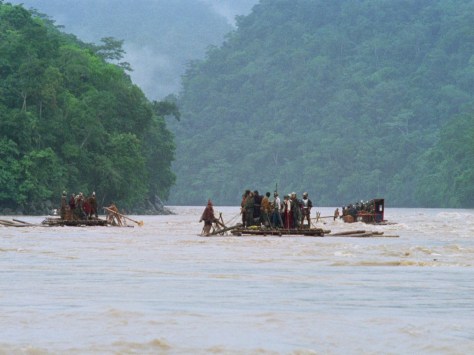
Much of Aguirre takes place on floating rafts such as these, which were built by local Peruvian crewmembers.
One of the more notable cinematic dramatizations of this period during the Western counterculture era is Werner Herzog’s Aguirre, the Wrath of God, shot on location in the Peruvian Amazon, including the mountainous regions near the Incan city of Machu Pichu. Only the now prolific German filmmaker’s third narrative feature and his first of five collaborations with the notorious, emotionally unstable Polish-German actor — and now alleged sexual predator — Klaus Kinski, Aguirre became a foundational project for its then burgeoning auteur and influenced most every Odyssey (~8th century B. C.)-like film set in a forest, tropical or otherwise, that came after it (e.g. Apocalypse Now [1979], The New World [2005], Predator [1987], The Blair Witch Project [1999], etc.). The film possesses an epic, almost fantasy tone to its characters’ journey through uncharted land, but also wraps its simple story without much propulsive narrative momentum in a modest 94 minutes. In some ways, its hazy, fever dream tone channels surrealism to the script’s advantage (e.g. Annihilation [2018]), but other times just feels an excuse to develop a predictable story with generally unlikable characters toward an unsatisfying conclusion (e.g. La Cienega [2001]).
What no one in their right mind can fault Aguirre for is Herzog’s visual direction. His command of director of photography Thomas Mauch’s cinematography is without a doubt the film’s greatest strength when combined with the immaculate, unforgettable filming locations. From the misty foothills of the Andes to the lush, claustrophobic banks of the Amazon’s tributaries, the film’s natural backdrops enhance the story’s tension and help the viewer empathize with the main cast’s dire situation the further they float down the river system. Aguirre’s documentarian aesthetic sells its story’s realism thanks to its immersive locations and plentiful handheld camerawork. When the character’s aren’t talking, the movie hasn’t aged a day.
That story changes when the characters open their mouths or when one considers the story as a whole. Aguirre is a fictionalized account of the final expedition of the eponymous Basque Spanish soldier, Lope de Aguirre (Kinski), who in real life mutinied against his superior conquistador officers to lead a rogue mission throughout the Orinoco River basin. His ultimate goal was to find the mythic city of El Dorado, a sort of New World “Holy Grail” metaphor that combined the conquistadors’ collective obsession with mining indigenous riches with vague mentions from — or perhaps misinterpretations of — various native tribal religions in what is now Colombia and Venezuela. Here in Herzog’s film, the action centers in western Peru but maintains the Spanish explorers’ obsession with conquering rumored Amerindian empires deep within the South American continent.
My problems with The Wrath of God’s story as portrayed are (1) how obvious the story’s ending is from the outset (we know our primary cast are doomed the moment Kinski’s quasi-lead mutinies), and (2) how relentlessly slow the movie’s pace is throughout the second and third acts. There’s little to no forward story progression after the halfway mark but instead a series of repetitive monologues describing the main characters’ impending demise. One by one, each castmember drowns, falls ill, or dies by native spear and arrow, and there’s never any escalation of narrative stakes, no story twists, nor any unexpected character development. The journey ends pretty much how any reasonable person would expect it to, which is in an incoherent haze of misery wrapped in sweaty malaise.
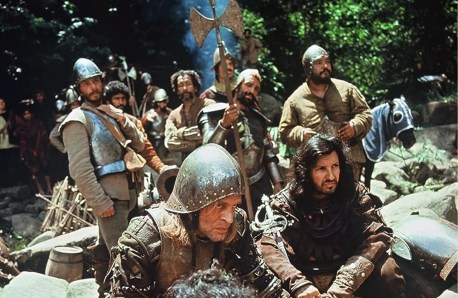
Lead actor Kinski (foreground left) doesn’t dominate the film’s screentime as implied by the film’s poster until the second and third acts.
All the aforementioned might be tolerable if the film sounded as good as it looks, but its sound-design is ass. Both the dialogue looping and the quality of the sound mixing date Aguirre as much as any Spaghetti-western, which is an ongoing source of unintentional comedy throughout the viewing experience.
I looked forward to Aguirre, the Wrath of God in light of my positive experience with Werner Herzog’s Nosferatu (1979) and my general fascination with the European Age of Exploration, but all in all, I consider the film a letdown. Its production ambition, from filming on location in the Andes to the Amazon, as well as its memorable documentarian style, are admirable given the technology of the 1970s, but to be frank I consider the film’s influence to have long since been superseded by the likes of Francis Ford Coppola, John McTiernan, et al. If the film sounded much better or scripted a less conventional story, I might be on board with this Amazonian river raft, but as it is, I remain on the fence.
———————————————————————————————————————————————————————————–
SUMMARY & RECOMMENDATION: Easy on the eyes but rough on the ears, Werner Herzog’s Aguirre, the Wrath of God feels akin to many older, classic James Bond (1962-1989) films that are now better remembered for nostalgia and their impact on later, more effective likeminded films whose modern technology and hindsight executed greater stories. I would be more partial to Aguirre and its lackluster audio component if its story built to a tangible goal a la Apocalypse Now (e.g. Martin Sheen’s mission to execute Marlon Brando) or Predator (e.g. Arnold Schwarzenegger’s team attempting to escape and/or eliminate their extraterrestrial stalker).
— However… Herzog’s commitment to on-location photography, documentary realism, and a powerful setting are unforgettable. The concise runtime is also appreciated.
—> ON THE FENCE
? What was the point of Kinski’s character’s obsession with incest at the end?

 Express Elevator to Hell
Discussion
No comments yet.