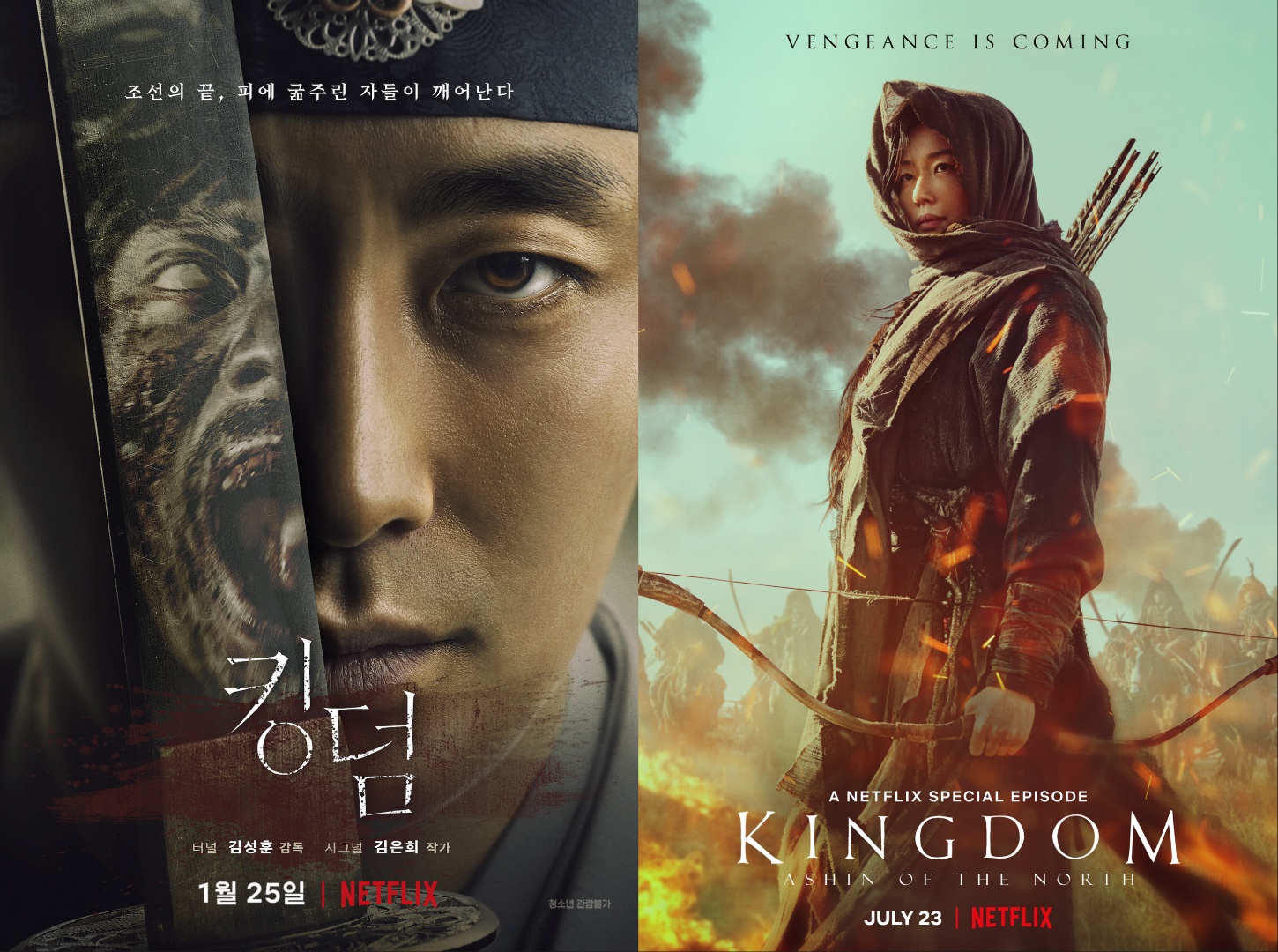
Created by: Kim Eun-hee || Written by: Kim Eun-hee
Directed by: Kim Seong-hun, Park In-je || Starring: Ju Ji-hoon, Bae Doona, Ryu Seung-ryong, Kim Sung-kyu, Jeon Seok-ho, Kim Hye-jun, Kim Sang-ho, Huh Joon-ho, Jun Ji-hyun, Kim Si-a, Park Byung-eun, Koo Kyo-hwan, Kim Roi-ha
No. of Seasons: 2 || No. of Episodes: 12 + 1 Special
For such a bland, generic one-word title, the Netflix Kingdom series from South Korean studios AStory and Studio Dragon has left one of the biggest impacts on me of any project on the streaming platform. It was one of the first titles I watched, series or feature-film, Korean or otherwise, not long after I first subscribed to Netflix in the last few months of 2018. Although the creators behind Kingdom quietly “canceled” the project due to a falling out over the streaming giant’s distribution terms, this two-season epic plus feature-length sidequel, Ashin of the North, tell a complete story that stands apart from the plethora of Joseon period dramas endemic to South Korea’s contemporary filmmaking culture. The first Korean Netflix Original released on the streaming network, in fact, distinguishes itself through incredible cinematography, unparalleled action sequences, and an unforgettable blend of seemingly disparate genres.
When I first completed the series by the early, ominous months of the COVID-19 pandemic, that last attribute and the series’ oddball premise most stuck out to me: Just a few years after the Imjin War, a politically fragile Joseon faces both a war of succession and a coincidental plague that transforms its victims into ravenous ghouls. That’s right, folks, we have a throwback period drama with zombies!
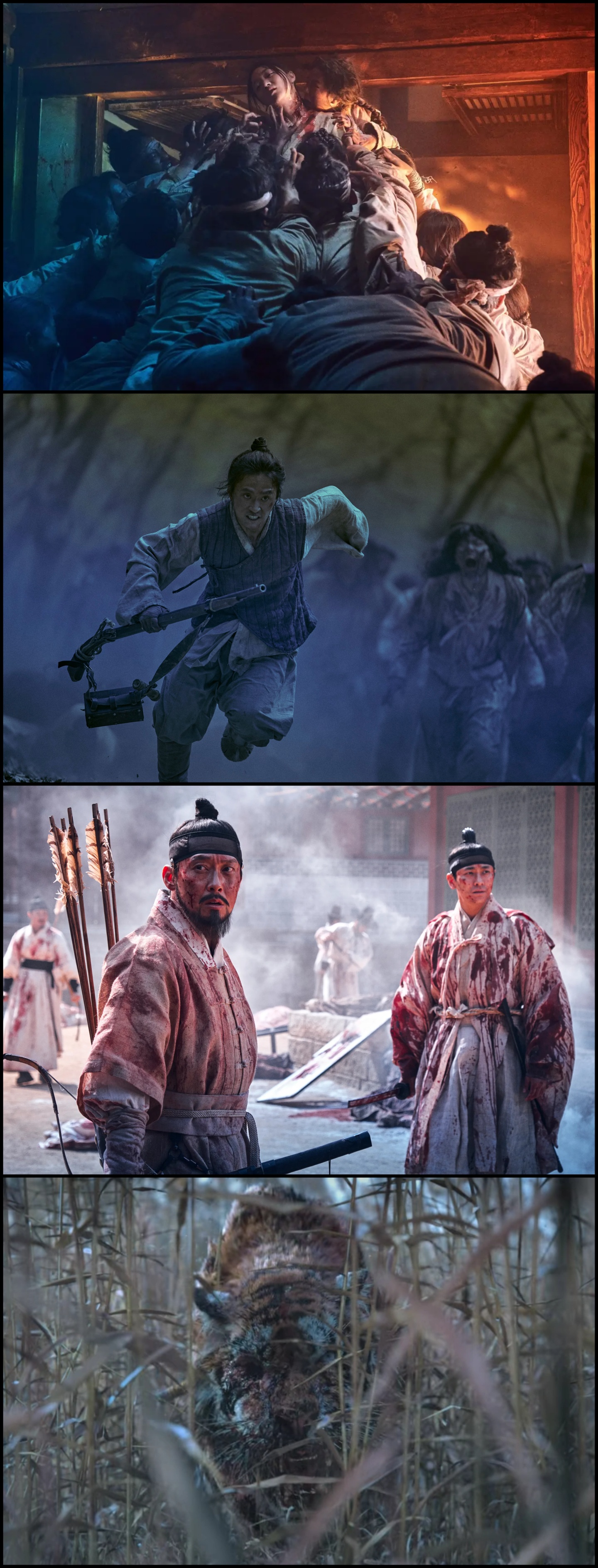
From top to bottom: (1) Ravenous undead feast on civilians in perhaps Kingdom’s most iconic shot; (2) Kim Sung-kyu sprints in front of a horde of zombies with a 17th century matchlock rifle; (3) lead Ju Ji-hoon (right) portrays the Joseon crown prince, who allies with nobleman and memorable costar Huh Joon-ho (left); (4) in Ashin of the North, a CGI tiger stalks multiple supporting castmembers.
The narrative power of this show stems from (1) its strong telewriting and (2) the aforementioned strong direction, some of the best I’ve seen in any Korean production before or since. The teleplays convey memorable characters brought to life by a strong cast, figures whose development feel realistic, well paced, and earned across memorable conflicts. All of those aspects, however, are not unique to Kingdom and are, in fact, prevalent across both Korean feature-filmmaking and serial television, including many Joseon historical melodramas shot on the same or similar studio sets. The audiovisual style of Kingdom, however, contrasts with most popular Joseon serial dramas given its dour horror tone, high production values in its large-scale action sequences, and overall stylish lighting schemes. Put another way, Kingdom looks and feels like a medieval Korean version of Lord of the Rings (2001-2003) or, perhaps more accurately, Game of Thrones (2011-2019). Given how the show’s devious political subplots, which include everything from royal court backstabbing to coup d’états, coalesce with the show’s overarching undead threat, Kingdom’s structural similarities to HBO’s premiere fantasy epic are uncanny.
The show’s two main seasons work as a cohesive 12-episode arc. About nine hours’ worth of runtime (~45 minutes per episode) allow for a sizeable but not excessive cast to intermingle with storytelling detail impossible even for a 3-hour feature. While Season One ends on one of the best television cliffhangers of the streaming era, Season Two closes most of its major plot threads in a concise, satisfactory manner.
The few exceptions to the above are several minor subplots the writers did not have to leave open, but may have done so expecting another season. Interesting yet ultimately superfluous narrative details related to the origin of Kingdom’s zombie plague are explored in the series’ standalone feature-length special episode, Ashin of the North, however. Ashin is one of the better unnecessary franchise expansions in the Netflix Originals catalog, further contextualizing the main series’ fictional premise while featuring the same gorgeous outdoor cinematography, natural lighting, and stylized indoor camerawork. The episode is more or less a quality Netflix Original Film comparable to the production values of my oft recommended Calibre (2018), Triple Frontier (2019), Lost Bullet (2020, 2022, 2025), Black Crab (2022), Ballerina (2023), et al. As a matter of fact, my only significant complaint about the entire Kingdom intellectual property is the so-so computer generated imagery (CGI) of a big cat in the standalone special (the animal plays a crucial part in the story), which is just decent by Korean standards.
Other than that, though, Kingdom remains one of my favorite properties exclusive to Netflix, a situation that feels somewhat ironic given how I have not reviewed the series till now and its creators’ contentious relationship with the company. Those in the mood for a Game of Thrones-style medieval political thriller will not be disappointed, while the story’s genre-hybridization makes Kingdom one of the most unique shows of the 2020s thus far. I have little else to say about Kingdom other than I regret not writing about it in the years since I first watched it. On the other hand, the good news for many of you is that you can still enjoy it for the first time!
————————————————————————————–
SUMMARY & RECOMMENDATION: In some ways, writing about a show or movie you love is more straightforward but also less interesting than projects over which you are undecided or that you dislike. Kingdom is just a quality show plus a memorable feature-length special, through and through. With quality telewriting, great directorial style, and a high-concept premise to die for, you cannot go wrong with this stuff.
— However… one of my few long-running complaints with Korean filmmaking, my recurring pick for the best film culture on the planet, is the industry’s shaky CGI.
—> Kingdom comes HIGHLY RECOMMENDED, of course.
? How many times did Japan invade the Korean peninsula beside the Imjin War? That and the early 20th century?

 Express Elevator to Hell
Discussion
No comments yet.