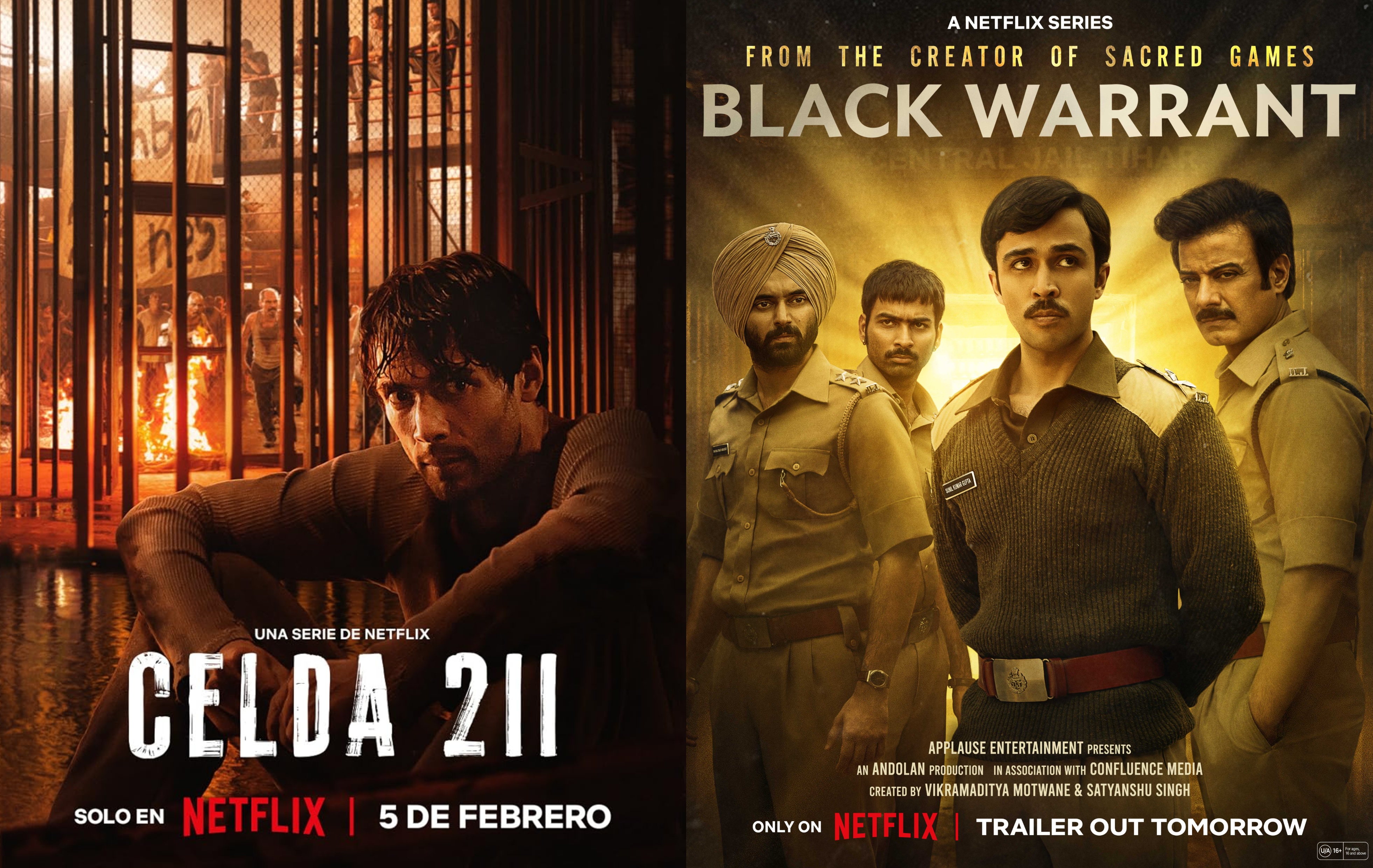
Created by: Gerardo Naranjo, Jaime Reynoso [1], Vikramaditya Motwane, Satyanshu Singh [2] || Written by: Benjamín Figueroa García, César Gándara, Javier Peñalosa[1], Arkesh Ajay, Satyanshu Singh [2]
Directed by: Gerardo Naranjo, Jaime Reynoso [1], Vikramaditya Motwane, Satyanshu Singh, Arkesh Ajay, Rohin Raveendran Nair, Ambiecka Pandit [2] || Starring: Diego Calva, Noé Hernández, Gerardo Taracena, Alejandro Puente, Ana Sofía Gatica, Úrsula Pruneda [1], Zahan Kapoor, Rahul Bhat, Paramvir Singh Cheema, Anurag Thakur [2]
No. of Episodes: 6 (~220 minutes total) [1], 7 (~290 minutes total) [2] || 1 = Cell 211, 2 = Black Warrant
Although I have long enjoyed the Hollywood prison drama classics of The Shawshank Redemption (1994) and The Green Mile (1999) by writer-director Frank Darabont, I never considered myself a connoisseur of the subgenre like I am of science-fiction monster movies (e.g. Godzilla Minus One [2023], Skull Island [2017]), brawler action films (e.g. The Shadow Strays [2024], Kill [2023]), or combinations of the two (e.g. Blade II [2002]). I did not realize I was as familiar with the subgenre as I actually was until I perused my blog catalog in preparation for this review, having seen and formally reviewed The Platform (2019), Brawl in Cell Block 99 (2017), Cell 211, A Prophet (both 2009), Cube (1997), and of course Alien 3 (1992). Part of this underappreciated familiarity with the prison drama no doubt stems from my affection for thrillers restricted to a single location, particularly those where characters must escape some sort of nightmarish, mazelike trap (e.g. the aforementioned Cube; see also In the Tall Grass [2019], 10 Cloverfield Lane [2016], Panic Room [2002], etc.).
Two recent Netflix series, one limited and one potentially long-form, offer additional stories defined by their correctional facility setting. The first is Cell 211, a Mexican thriller miniature series remake of the Spanish feature-film of the same name mentioned above, itself an adaptation of the eponymous novel by Francisco Pérez Gandul. The second is Black Warrant, the latest dramatic project from established Hindi filmmaker Vikramaditya Motwane, based on the first-hand accounts of Tihar Prison guard Sunil Gupta and journalist Satyanshu Singh from their nonfiction read, Black Warrant: Confessions of a Tihar Jailer (2019).
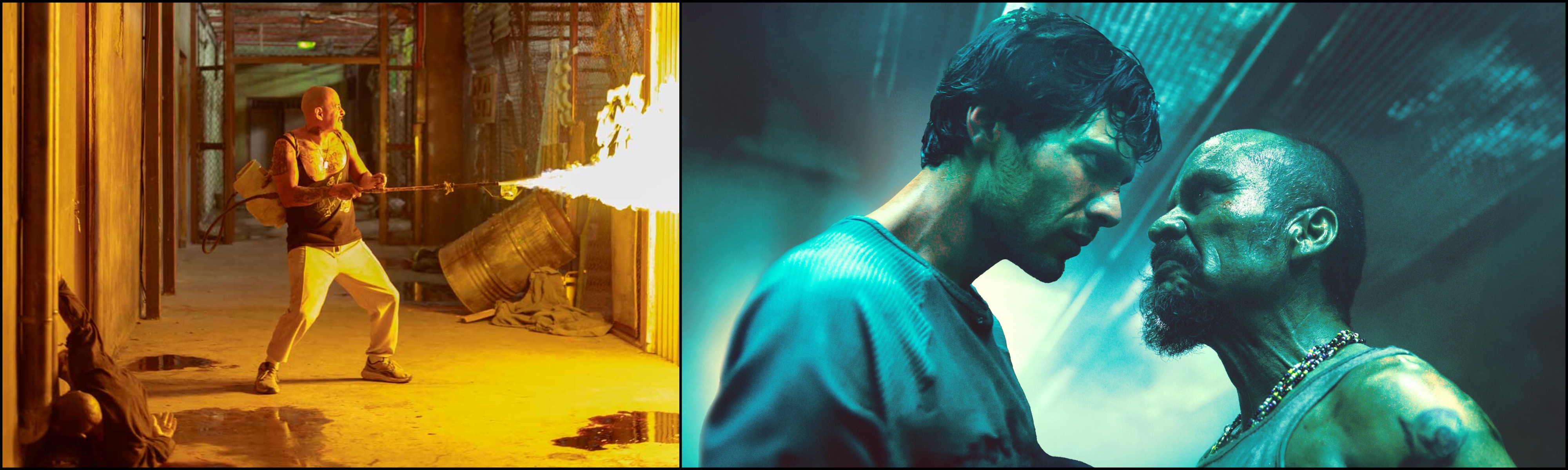
Left: Much of the visceral impact of Cell 211’s prison riots are muted thanks to obvious digital FX that look even worse in motion. Right: The heart of this prison drama is supposed to be the contentious relationship between lead Diego Calva (left) and costar Noé Hernández (right), yet it is crowded by too many extraneous subplots.
The 2009 Spanish feature of Cell 211 remains one of my favorite thrillers from that country and stars one of the better performances from versatile Spanish actor Luis Tosar. The enticing central premise revolves around a civilian protagonist — a rookie prison guard (Alberto Ammann) in the 2009 movie and a criminal defense attorney (Diego Calva) in the 2025 Mexican show — caught in a sudden prison riot where said protagonist must pose as an inmate to survive. As such, I had relatively high interest in the expanded scope of the Mexican limited series given both (a) the increased runtime and (b) the novel geopolitical backdrop in Chihuahua near the US-Mexican border. Both potential strengths for this miniseries end up wasted opportunities, however, as the haphazard narrative and bloated pacing slow the plot’s progression to a crawl after the second episode (there are six in total). The initially tense, foreboding crime drama related to the story’s drug cartel figures leads the main cast in circles to pad out the series’ length, while later episodes segue into hamfisted, on-the-nose diatribes by minor characters about international narcotics policy. Adding insult to injury is the series’ distracting computer generated imagery for digital flames, blood squibs, explosions, and firearm muzzle flashes, the cheap plugin FX of which clash with the project’s otherwise grounded, gritty tone.
Compared to Cell 211, Black Warrant fares much better thanks to the creative leadership of Montwane and writers Arkesh Ajay and Satyanshu Singh. Like Nikhil Nagesh Bhat, Montwane, for the most part, specializes in genre projects with runtimes shorter than your typical mainstream Indian melodrama (2.5-3 hours!). He has also produced and/or directed several limited and long-form television series for streaming platforms prior to Black Warrant, most notably Sacred Games (2018-2019), which I maintain is the best Indian Netflix Original project, film or show, to date.
Given that artistic experience, Black Warrant works as a slow-burn, standalone 7-episode storyline a la the first season of Delhi Crime (2019), yet also leaves enough plot threads unresolved for a potential sequel season. Most apparent at first glance is the show’s overall look, its effective usage of muted colors and somber camerawork to emphasize social dread throughout its principal setting. That setting is the 1980s Tihar Prison system of New Delhi, a complex that feels as lived-in as the fictional New England Shawshank State Prison; its narrative scope is never overextended like Cell 211, however, thanks to rigorous editing and a modest cast.
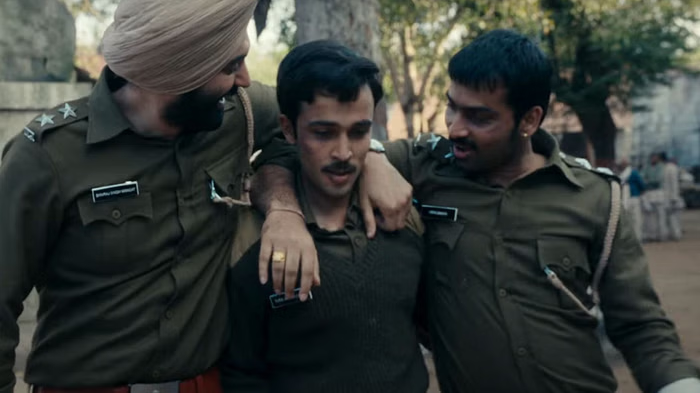
A major component of Black Warrant is the budding friendship between main castmembers Paramvir Cheema (left), Zahan Kapoor (center), and Anurag Thakur (right).
I cannot recall how many movies and television shows, Indian productions in particular, that bloat their supporting casts to accommodate everything from unnecessary comic relief to stunt castmembers to throwaway love-interests. By contrast, telewriters Ajay and Singh orchestrate their entire cinematic exploration of north Indian prison life through the perspective of Zahan Kapoor’s relatable, nuanced protagonist. The considerable yet realistic arc of Kapoor’s fish-out-of-water main character (a rookie prison guard a la the 2009 Cell 211) might be my favorite aspect of the series, in fact. Montane and company’s storytelling discipline, therefore, is a welcome change relative to both mainstream Indian filmmaking and your rarer, deliberately paced social drama with an ambitious narrative scope (e.g. The Wire [2002-2008]).
I do not wish this review to come across as a love letter to Black Warrant or an unapologetic sneer toward Cell 211, but rather a comparison between effective and ineffective television series formatted around the prison drama. The latter pails in comparison to its far more memorable, efficient feature-length source material starring Luis Tosar, while the former presents yet further evidence of Indian Netflix Original filmmaking prowess. Examining these projects side by side, however, demonstrates how much diversity in audiovisual and screenwriting style exist within the prison drama in the streaming era.
—————————————————————————————————————————————————————————–
SUMMARY & RECOMMENDATION: Undercut by a lackluster narrative pace, inconsistent focus, odd dialogue, and unacceptable digital FX, Cell 211 the Mexican limited series fails to offer much creativity relative to its 2009 Spanish counterpart. Black Warrant, on the other hand, is another television showcase for Indian auteur Vikramaditya Motwane, whose dedication to multilayered characterizations and an identifiable cinematographic style tells a universally relatable story.
— However… Cell 211 has considerable tension across its first two episodes, whereas Black Warrant’s slow pace will not convert those who expect gang violence every other plot-point.
—> Cell 211 is NOT RECOMMENDED given its inconsistent focus and surprising cheapness, yet Black Warrant comes RECOMMENDED for its subtlety and patient storytelling.
? Is the Cell 211 prison supposed to be what El Salvador’s Centro de Confinamiento del Terrorismo (CECOT) is like?

 Express Elevator to Hell
Discussion
Trackbacks/Pingbacks
Pingback: ‘Khakee: The Bihar & Bengal Chapters’ (2022, 2023) & ‘The Family Man’ (2019, 2021): The Expansion of Hindi Streaming Television | Express Elevator to Hell - March 21, 2026