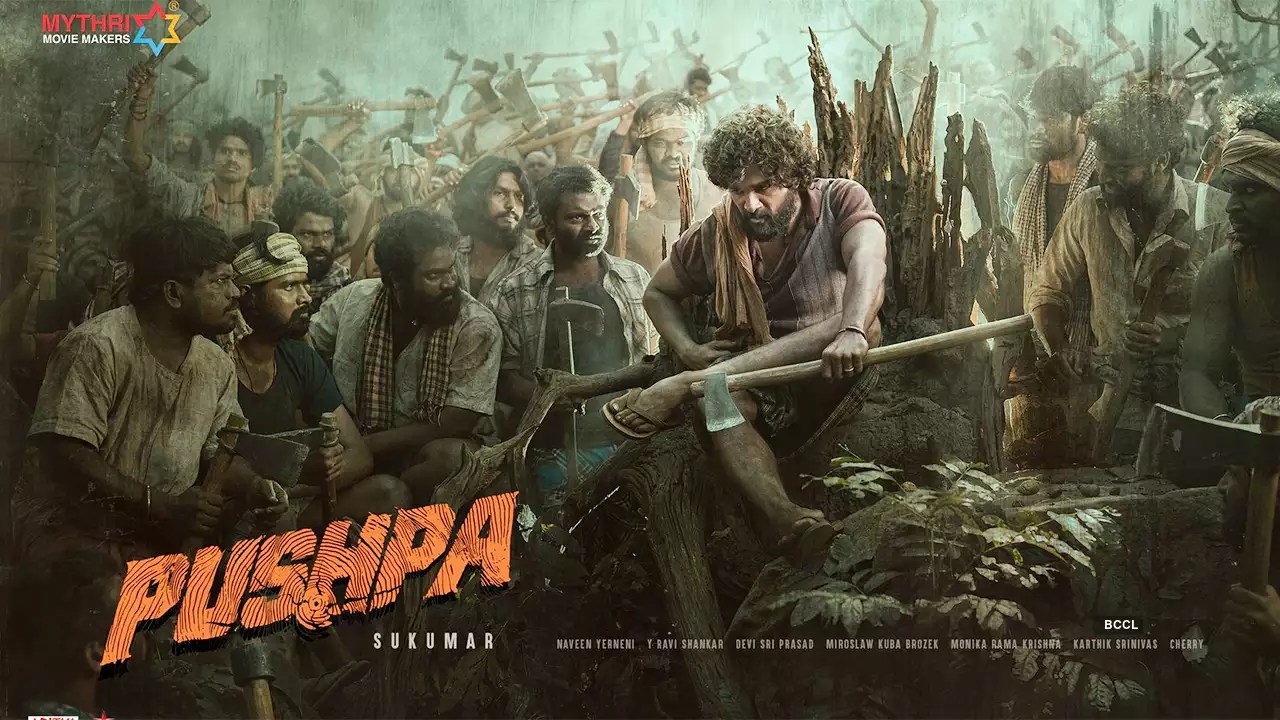
Directed by: Bandreddi Sukumar || Produced by: Naveen Yerneni, Yalamanchili Ravi Shankar
Screenplay by: Bandreddi Sukumar, Srikanth Vissa || Starring: Allu Arjun, Rashmika Mandanna, Fahadh Faasil, Jagadeesh Prathap Bandari, Indukuri Sunil Varma, Kalenahalli Adaviswamy Dhananjaya, Ajay Ghosh, Rao Ramesh, Jagapathi Babu
Music by: Devi Sri Prasad || Cinematography: Miroslaw Kuba Brozek || Edited by: Karthika Srinivas Ruben, Naveen Noolil || Country: India || Language: Telugu
Running Time: 403 minutes
I have spoken at length on this blog about the cultural growth and increasing box office power of Telugu cinema throughout the international film industry in general and the Indian film ecosystem in particular. In terms of popular cultural relevancy in South Asia, most cinephile commentators would argue the movies of the Telugu nation (re: the Indian states of Telangana and Andhra Pradesh) nowadays rival if not surpass the Hindi-language blockbusters of Mumbai, also known as Bollywood. Whether this contemporary artistic output from the Dravidian ethnolinguistic region of the Indian subcontinent (i.e. South India) is a function of significant infrastructural development over the last few decades is answerable to sociologists more studied than I, but there is no question in my mind that Telugu filmmaking and its regional cousins (i.e. Tamil, Kannada, Malayalam-language film) is “hot” right now.
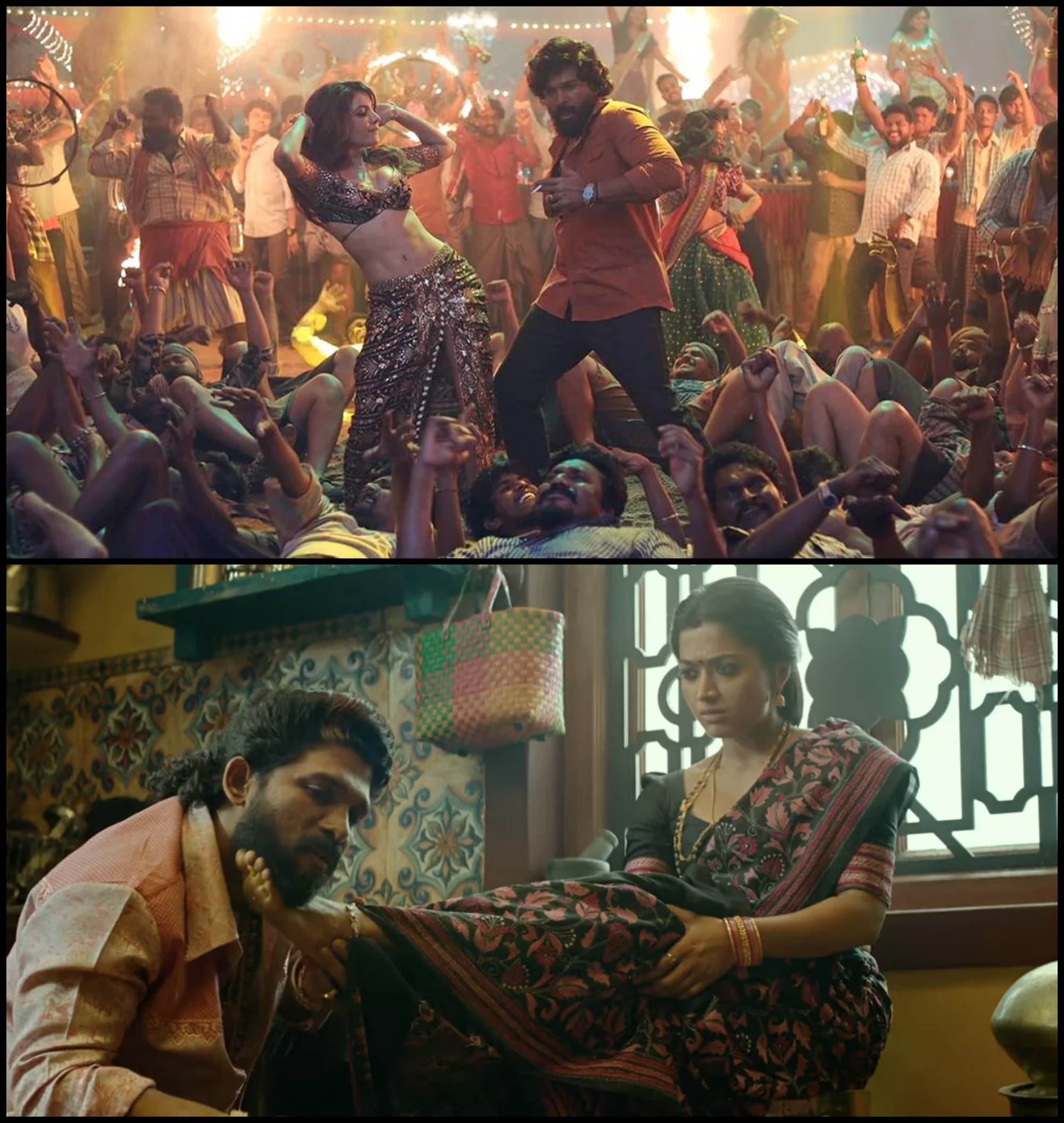
Though Pushpa (Allu Arjun) spends time with girls like Samantha Prabhu in passable item songs (“Oo Antava Oo Oo Antava“, top) across both movies, he occasionally acts in filler sequences with ostensible female lead Rashmika Mandanna (bottom).
I would put most of the immediate responsibility for that critical and commercial success on the recent works of S. S. Rajamouli, the Telugu auteur and “pan-Indian” blockbuster extraordinaire whose last two films — Baahubali (2015, 2017) and RRR (2022) — have crossed South Asian and even Western cultural lines. In addition to the directorial success of Rajamouli, fellow South Indian properties like Nag Ashwin’s science-fiction epic Kalki 2898 AD (2024) and Bandreddi Sukumar’s Pushpa have further contributed to this modern surge of interest in South Indian and especially Telugu blockbusters.
In contrast with Rajamouli’s last several films, however, the actual storytelling quality of the aforementioned are much less impressive than their box office receipts. The marketing hype behind movies like Pushpa, for example, has translated into genuine cultural momentum for their original intellectual properties (IPs), but I argue their directorial execution are more or less the same as mediocre Indian blockbusters from decades past, just with less emphasis on romance a la 1990s Bollywood and greater focus on action sequences.
The cinematographic and stylistic monotony of the latter are a major reason why I remain unimpressed with the storytelling of Pushpa and most of its contemporaries. While most of Sukumar’s action scenes sort of advance the plot, they (1) last way longer than their choreography or emotional momentum warrant, (2) utilize the same laughable Matrix (1999)-esque fight choreography that countless other Indian blockbusters have since the turn of the millennium, and (3) lack any tension whatsoever thanks to their invulnerable superhuman protagonist (Allu Arjun’s lead). I have never understood the appeal of nonstop speed-ramping in the action scenes of movies like Pushpa, where real-world physics vanish into thin air; off-screen wind machines pummel dust, debris, and clothing across the frame; and supposedly real-world characters like street thugs, office workers, attorneys, beat cops, or college professors flaunt the strength and agility of Superman. For my part, these fight sequences boast all the technical wizardry of 300 (2007) but none of that film’s sense of style.
Other reasons why I cannot relate to the cultural hype of Pushpa have to do with my general impatience with the narrative pacing, editing, and overall structure typical of mainstream Indian filmmaking, big-budget tentpole movies in particular. The 2021 debut film, The Rise, clocks in at just under three hours (179 minutes), while the 2024 follow-up, The Rule, ranges from 200-224 minutes depending on the cut available. Neither part has a traditional three-act structure, introducing, developing, and disposing multiple villains (e.g. M. Ramakrishna “Shatru,” Fahadh Faasil, Tarak Ponnappa), none of whom pose even a vague threat to Arjun, with zero narrative escalation. The only interesting attributes of Arjun’s protagonist, an up-and-coming smuggler of red sandalwood, are his chemistry with love-interest Rashmika Mandanna, which doesn’t go anywhere after Part 1, and his insecurity over his illegitimate background, the latter of which is overwhelmed by the aforementioned forgettable slow-motion fight scenes, numerous passable musical numbers, and endless dialogue.
Did I, in fact, like anything about Pushpa? To be honest, the biggest compliments I can pay to these first two installments (a third, subtitled The Rampage, is in development) are in regards to irritating features common to many tentpole movies that are not present in Pushpa 1 and 2. No major characters at any point lecture the supporting cast (re: the audience) about progressive social policy or conservative Hindustani customs, thankfully; and no irritating, cringeworthy comic relief characters interrupt the story with tonally out-of-place jokes.
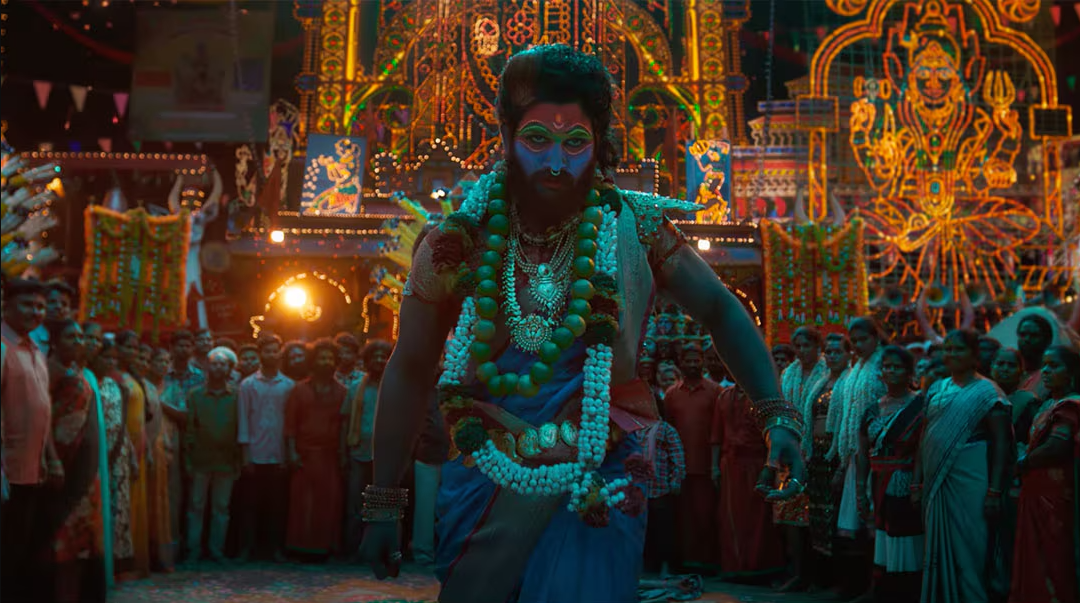
While Pushpa’s makeup, costumes, and set-design are impressive like most big-budgeted Indian crowd-pleasers, they’re little more than superfluous eye candy give the movie’s mediocre characters and mundane story.
As trendy as the Pushpa IP has become, I cannot buy into the hype of Bandreddi Sukumar’s franchise or other Indian blockbusters like it, Bollywood or South Indian, regardless of how charismatic stars like Allu Arjun may be. Their elongated, occasionally superfluous action sequences must be controlled by more interesting choreography, more vulnerable heroes, and relatable narrative stakes, while their obnoxious screenplay length and pacing must be streamlined so they feel more like feature-films than overstuffed music video medleys or poorly edited television miniseries. As of this writing, S. S. Rajamouli is the only high-profile South Indian filmmaker who appears capable of the aforementioned necessities with any sort of consistency. Too many bland, monotonous action sequences, colorful yet superfluous song-and-dance numbers, and overall way too much damned filler bloat Pushpa: The Rise and The Rule past the point of breaking. In other words, contemporary Telugu cinema may have matured in budget and production values relative to decades’ past, but if films like Pushpa remain the industry’s bread and butter, they will grow as stale as the longwinded Bollywood romances of 1990s.
————————————————————————————————————————————————————————-
SUMMARY & RECOMMENDATION: If you’re a diehard follower of South Indian superstars or the 2010s-2020s pan-Indian blockbuster movement in general, my naysayer commentary won’t convert you. If you’re reading movie blog reviews like this, though, chances are you might’ve grown tired of empty 3-hour+ extravaganzas like Pushpa. Movies like these exist more to sell disconnected item songs than creative narratives, and their idea of “action filmmaking” is riffing the style of the Wachowskis and Zack Snyder to the point of delirium rather than building visceral tension in a novel Indian context (e.g. Kaithi [2019]; Kill [2023]).
— However… Allu Arjun’s title character has kernels of personality that could resonate if given enough screentime to breathe; and the film never preaches morality lessons to its audience, thank God.
—> Despite fleeting moments of entertainment in this ~400-minute Telugu masala marathon, Pushpa’s repetitive cliches are NOT RECOMMENDED.
? None of those alleged yakuza characters looked very… you know, Japanese to me; and lo and behold, the main yakuza boss is Vithaya Pansringarm from Only God Forgives (2013)!

 Express Elevator to Hell
Discussion
Trackbacks/Pingbacks
Pingback: ‘Kill’ (2023): The Best Indian Action Film… Ever? | Express Elevator to Hell - April 25, 2025
Pingback: ‘Pichaikkaran’ (2016, 2023): From Creativity to Vanity | Express Elevator to Hell - May 2, 2025
Pingback: ‘Black Storm’ & ‘Blade of Fury’ (2024): Qin Pengfei’s Modernized Kung Fu Cinema | Express Elevator to Hell - March 21, 2026