
Directed by: Coralie Fargeat || Produced by: Coralie Fargeat, Tim Bevan, Eric Fellner
Screenplay by: Coralie Fargeat || Starring: Demi Moore, Margaret Qualley, Dennis Quaid
Music by: Raffertie || Cinematography: Benjamin Kračun || Edited by: Coralie Fargeat, Jérôme Eltabet, Valentin Feron || Country: France, United Kingdom, United States || Language: English
Running Time: 141 minutes
I had never heard of Coralie Fargeat, a young, up-and-coming French filmmaker who was apparently a candidate to direct the Marvel Cinematic Universe’s Black Widow (2021) several years ago, until the release of her sophomore feature this past year, The Substance. According to cinephiles and film journalists, we’re all lucky she passed on that empty yet sizeable paycheck from a major Hollywood studio (another small-time dramatic auteur, Cate Shortland, directed Widow instead) given the reception to her second movie. The Substance may be the most notable body horror film since the 1970s-1990s glory days of David Cronenberg (the recent Crimes of the Future [2022] doesn’t count), as it combines visceral desecration of the human body with extensive thematic deconstruction of character development and social commentary. Unlike the works of Cronenberg, though, The Substance is sundrenched, dominated by high-key lighting, and comedic in tone, however black its sense of humor may be. Its characters, themes, and overall stylistic execution are so consistent that I did not mind its extended 141-minute running time, which is a rare reaction from yours truly.
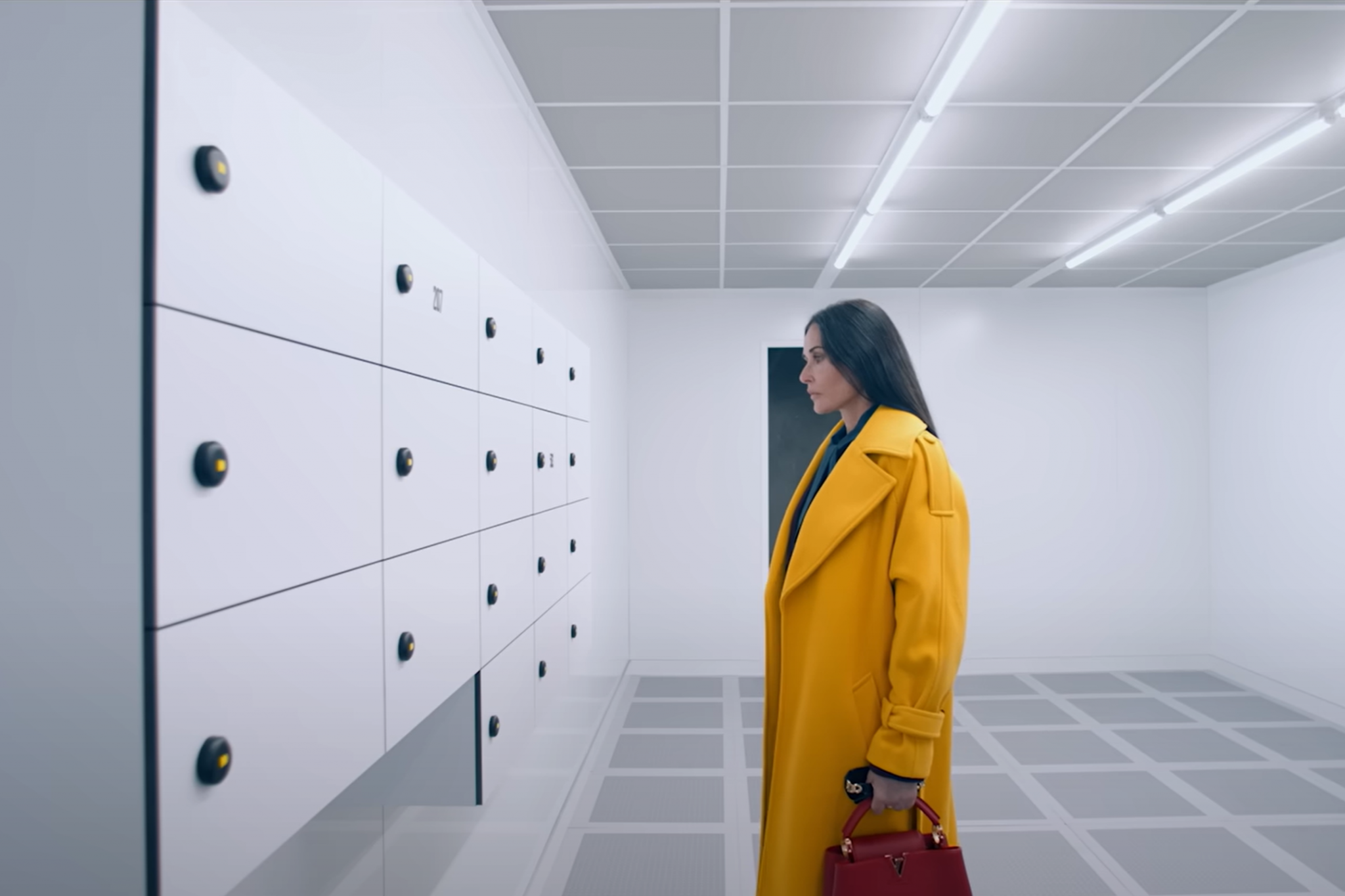
You’ll find no elaborate science-fiction laboratories in The Substance, the only insight into the eponymous black market cocktail being a sterile, Stanley Kubrick-esque drop-box site behind a grungy, nondescript alley
In fact, the only problems that most viewers may have with Fargeat’s follow-up to her directorial debut, the quasi-feminist “rape-revenge” film creatively titled… Revenge (2017), is its sheer lack of subtlety. The Substance’s thematic obviousness is comparable to the obnoxious comic relief characters of a Michael Bay blockbuster (e.g. the Transformers franchise [2007-2017]), the overindulgent cinematography of most of Alejandro Gonzalez Iñárritu’s movies (e.g. Biutiful [2010], Birdman [2014], The Revenant [2015]), or the dump truck of heavy-handed dialogue in most Brazilian social treatises (e.g. City of God [2002], Elite Squad [2007, 2010], Bacurau [2019]).
While the breadth of the movie’s social commentary impresses — one could compare The Substance’s eponymous drug to not only feminine beauty standards but also drug addiction, partying, the general shortsightedness of youth, old age bitterness, etc. — its depth is fittingly skin-deep. Its entertainment value is a function of (*takes breath*) writer-coproducer-coeditor-director Fargeat’s aforementioned execution of her dedicated, hyper-stylized vision, including and especially its rigorous sound-editing, emphasis of visual cues over dialogue, and clear escalation of narrative stakes from act to act.
To be clear, the less you know about The Substance prior to viewing, the more entertaining the experience will probably be for you. The broad strokes of its premise concern an aging 50-something Hollywood star (Demi Moore) who, when dismissed from her long-running aerobics television show by her mercurial studio executive boss (Dennis Quaid), seeks out a black market drug that transfers her consciousness to a younger, healthier version of herself (Margaret Qualley). The well defined rules of the titular serum are not only intriguing and easy to follow, but set the tone and central conflict of the entire screenplay. Qualley and Moore are two sides of the same character but have distinguishable enough personalities to keep the story’s pace snappy despite the length of the script.
Much like The Big Lebowski (1998) could be interpreted as a sunsoaked comedy version of classic Hollywood noir, The Substance is the brightly lit, feminine, darkly funny, and energetic opposite of Cronenberg’s infamous body horror classics. The colorful indoor sets and wide-angle lenses recall many of Terry Gilliam’s wackier movies (e.g. Brazil [1985], 12 Monkeys [1995]) as well as Alfred Hitchcock’s technicolor thrillers (e.g. Vertigo [1958]), with exaggerated, almost cartoony mise-en-scène (e.g. elaborate artificial sets, terrific body prosthetics, etc.) substituting for extraneous dialogue, voiceovers, or showy camera movements. Most of the film’s physical energy stems from its over-the-top sound-editing and upbeat soundtrack, the latter courtesy of composer Raffertie, which combine to give the film a music video aesthetic for vast stretches of its runtime.
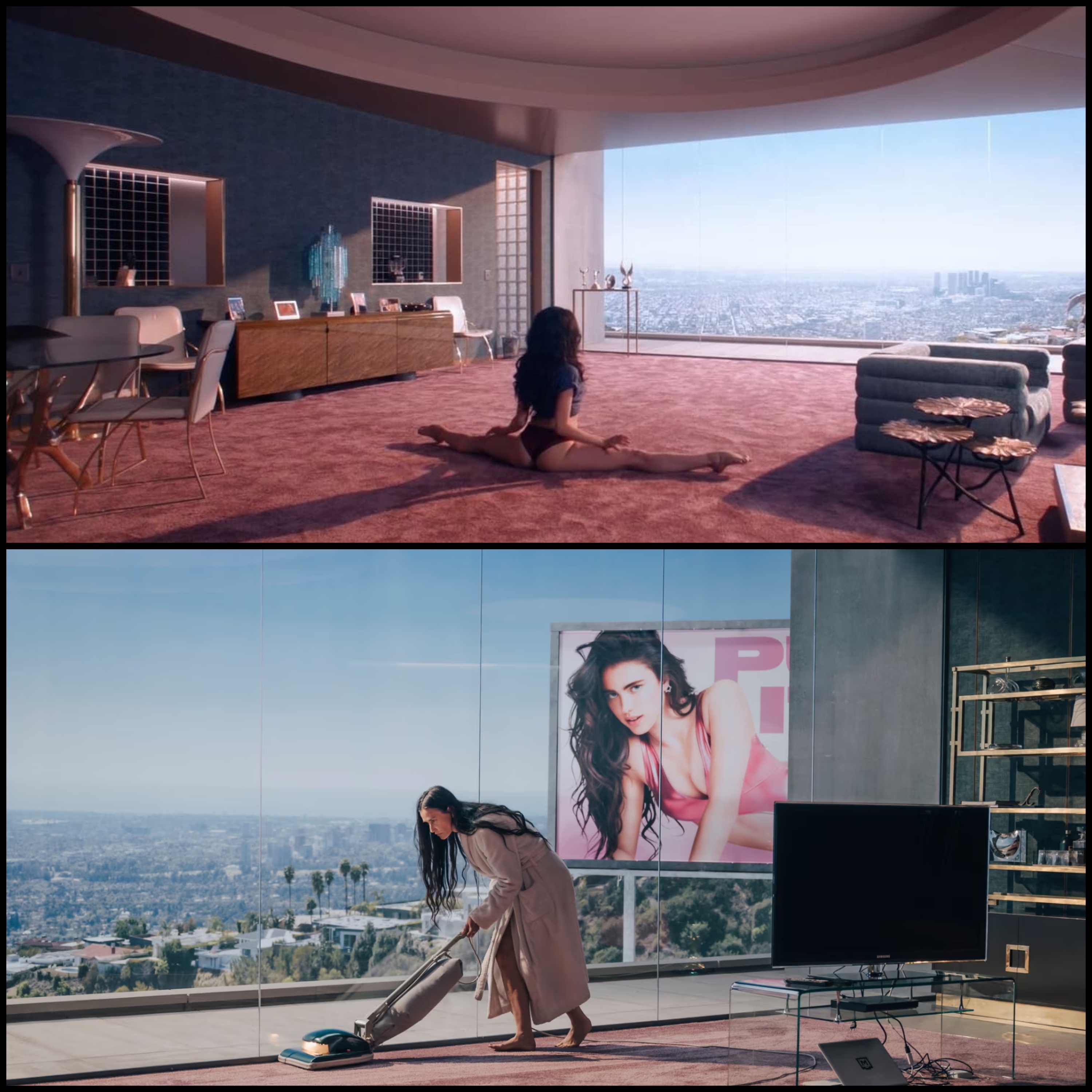
After injecting the titular drug into her system, our protagonist splits her time between the youthful, hedonistic lifestyle embodied by Margaret Qualley (top) and the increasingly reclusive, bitter persona of her original body as portrayed by Demi Moore (bottom). In the latter scenario, Qualley’s success (note the billboard) becomes a source of resentment rather than pride for Moore.
All things considered, I am happy to report that Coralie Fargeat’s The Substance is another awards-friendly feature that happens to be cinematic entertainment first and polemic device for film journalists second. Plenty of divisive social themes exist within The Substance for those who seek them, but the cinematographic, set-design, editing, and musical elements of Fargeat’s vision take centerstage so that said themes may speak, rather than the other way around.
———————————————————————-
SUMMARY & RECOMMENDATION: Good-looking faces by Demi Moore, Margaret Qualley, and Dennis Quaid are more side helpings than main course in The Substance, yet their unglamorous commitment to the greater story by Coralie Fargeat help give the film its vibrant personality and disgusting sense of humor. The movie’s identifiable mise-en-scène, soundtrack, and efficient camerawork execute an admirable body horror picture that is far away from David Cronenberg.
— However… if you prefer narrative subtlety in filmmaking, The Substance may jar you too much over nearly two and a half hours of desecration of the human body. I have seen Netflix Original action movies with more thematic finesse.
—> RECOMMENDED
? I had no idea this movie was filmed entirely in France because the cinematography conveys that Los Angeles hard sunshine so well.

 Express Elevator to Hell
Discussion
Trackbacks/Pingbacks
Pingback: ‘Mayhem!’ (2023) & ‘Lost Bullet 3’ (2025): More French Ultraviolence | Express Elevator to Hell - March 21, 2026