
Directed by: Kiran Rao [1], Yashowardhan Mishra [2], Pulkit [3] || Produced by: Aamir Khan, Kiran Rao, Jyoti Deshpande [1], Shobha Kapoor, Ekta Kapoor, Guneet Monga, Achin Jain [2], Gauri Khan, Gaurav Verma [3]
Screenplay by: Biplab Goswami, Sneha Desai, Divyanidhi Sharma [1], Ashok Mishra, Yashowardhan Mishra [2], Jyotsana Nath, Pulkit [3]|| Starring: Nitanshi Goel, Sparsh Shrivastava, Pratibha Ranta, Abhay Dubey, Chhaya Kadam, Ravi Kishan [1], Sanya Malhotra, Anant V. Joshi, Vijay Raaz, Rajpal Yadav, Brijendra Kala, Neha Saraf [2], Bhumi Pednekar, Sanjay Mishra, Aditya Srivastava, Sai Tamhankar [3]
Music by: Ram Sampath [1, 2], Anurag Saikia, Anuj Garg, Clinton Cerejo, Bianca Gomes [3]|| Cinematography: Vikash Nowlakha [1], Harshvir Oberai [2], Kumar Sourabh [3] || Edited by: Jabeen Merchant [1], Prerna Saigal [2], Zubin Sheikh [3] || Country: India || Language: Hindi
Running Time: 124 minutes [1], 115 minutes [2], 135 minutes [3] || 1 = Laapataa Ladies, 2 = Kathal, 3 = Bhakshak
Welcome to the first installment in what I hope is a long-running (see also my Telugu Review volumes… ) series of review essays on multiple smaller-budgeted, lower-profile Hindi-language features. These film productions might be interpreted — more or less subjectively, I guess — in a U.S. context as “independent” films or films produced mostly, if not entirely outside the control of major studios. As I mentioned in my early blog essay on American independent cinema, definitions of both studio size and independent filmmaking status are fluid, murky, and change from decade to decade depending on the financial success of different production houses. All three of today’s films, despite their grounded subject-matter, were made with the involvement of large, successful Bollywood (re: Hindi-language filmmaking based in Mumbai) studios — Yash Raj Films, Balaji Motion Pictures, and Red Chillies Entertainment distributed, coproduced, and solely produced Laapataa Ladies, Kathal, and Bhakshak, respectively — to a certain degree. And yet, all three are quite different in tone and execution than the vast majority of mammoth-budged, longwinded (i.e. 2.5-3 hour+) Hindi blockbusters for which northern Indian filmmaking is best known.
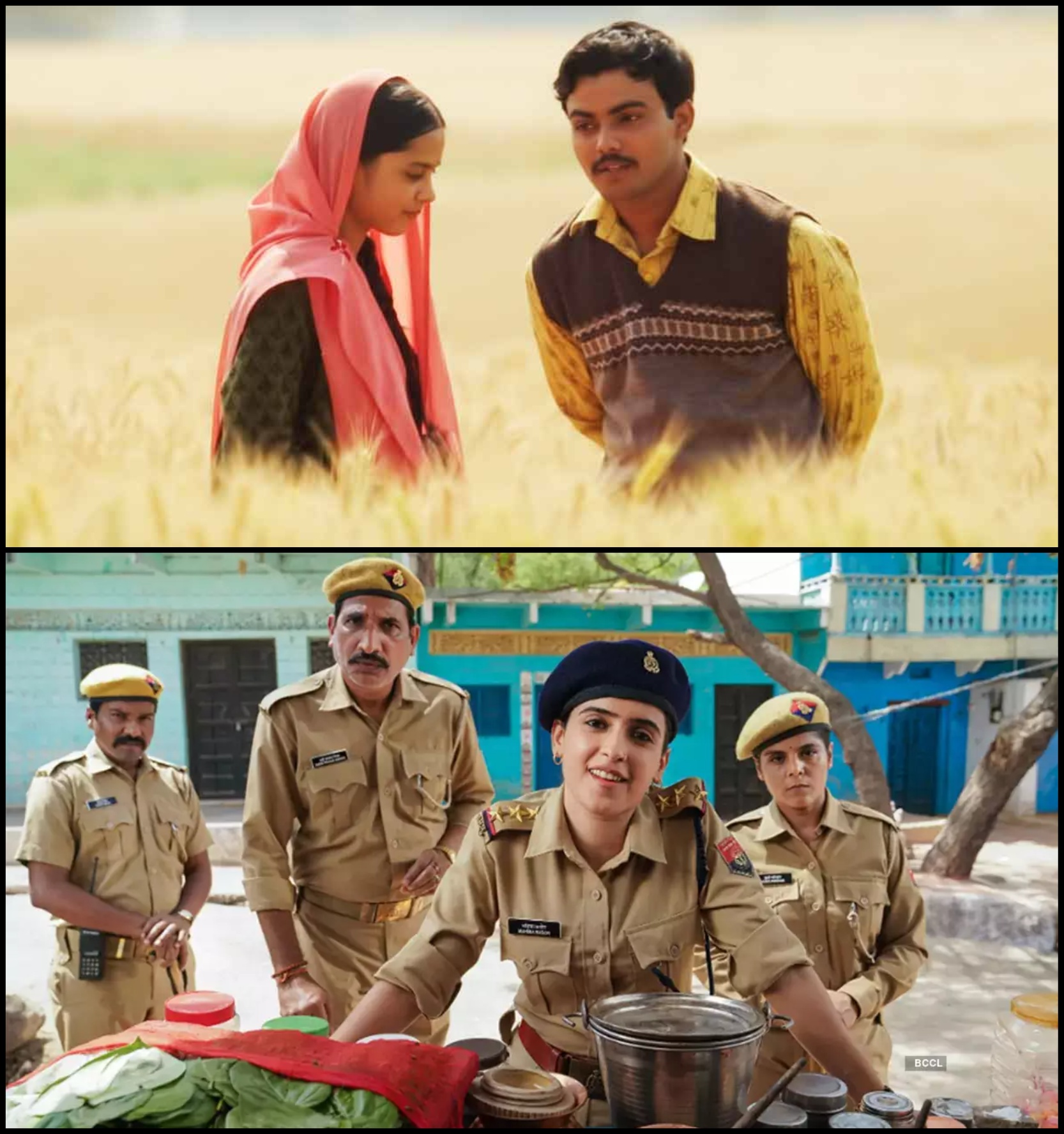
Top: Nitanshi Goel (left) and Sparsh Shrivastava (right) bond in perhaps the ideal arranged marriage where no one is forced into matrimony against their will in Laapataa Ladies. Bottom: Comedic flat angles abound in Kathal, where lead Sanya Malhotra (center right) interrogates village locals about various missing persons.
First in the lineup is Laapataa Ladies (English = “Lost Ladies”), whose screenwriters Biplab Goswami, Sneha Desai, and Divyanidhi Sharma write as both a celebration and deconstruction of the stereotypical arranged marriage-melodramas that were all the rage in 1990s-2000s Bollywood (e.g. Hum Aapke Hain Koun [1994], Dilwale Dulhania Le Jayenge [1995], Kal Ho Naa Ho [2003]). Director Kiran Rao builds her movie around the funny premise where two newly wed couples move to their respective groom’s family villages only to “mix up” the brides thanks to travel exhaustion and those North Indian bridal veils; the plot thickens over Acts Two and Three, but overall this rather modest story arc breathes well thanks to consistent, realistic performances, solid pacing, and great location-photography.
Those positive attributes are present to varying degrees in all three of these spotlighted films, as a matter of fact. Their only true drawbacks involve a somewhat though not offensively long runtime in Bhakshak (see below), as well as occasional on-the-nose preachy dialogue that feels out of place in these movies’ otherwise realistic settings. For example, one of the two principal “lost brides” in Ladies, Pratibha Ranta, has a character and portrayal that feels more akin to an educated, wealthy non-resident Indian studying abroad as opposed to a girl born and raised in the conservative rural countryside.
Next up is Kathal (English = “Jackfruit”), a sort of comedy-police procedural that blends multiple genres with relative ease, something that cannot always be said of the numerous masala films that attempt that difficult balancing act every year. Lead writer Ashok Mishra and cowriter-director Yashowardhan Mishra treat serious subjects (e.g. local political corruption, apathetic law enforcement, sex trafficking, casteism, etc.) with narrative gravity rather than drowning in morbid edginess (e.g. Rang de Basanti [2006]) or writing them as part of live-action cartoons (e.g. Simmba [2018], Etharkkum Thunindhavan [2022]); instead, they introduce their audience to these topics organically through relatable yet flawed characters (e.g. Sanya Malhotra, Anant V. Joshi) with dark senses of humor. On-location photography throughout rural and urban Madhya Pradesh helps sell both the dramady setting as well as the complicated detective work that drives the narrative; this is in part thanks to the memorable yet not bloated supporting cast, which focuses audience attention on a handful of well developed characters with distinct personalities and allows the script to better explore the story’s diegetic background.
Last and sort of least is Bhakshak (English = “Devourer”), which tackles similar topics as the previous two films (e.g. sexual abuse of female minors in orphanages) with less panache thanks to an overlong runtime (135 minutes) and too many on-the-nose dialogue exchanges. Lead Bhumi Pednekar plays a relatable freelance journalist who investigates obvious signs of systemic misconduct in an underprivileged segment of society, on the other hand, and I appreciate how cowriter-director Pulkit (Is that a first name or last name?) incorporates her character’s family drama into the story without distracting from the main storyline. Other strengths include memorable outdoor cinematography that appears to utilize natural light in most scenes, as well as striking indoor sets that utilize a variety of creative blocking arrangements. Even the movie’s primary villain, orphanage headmaster Aditya Srivastava, is a memorable and realistic presence who smirks at our heroine even through Bhakshak’s conclusion. If only the screenwriters had written a better ending monologue for Pednekark, I might place this movie closer to our previous two films…
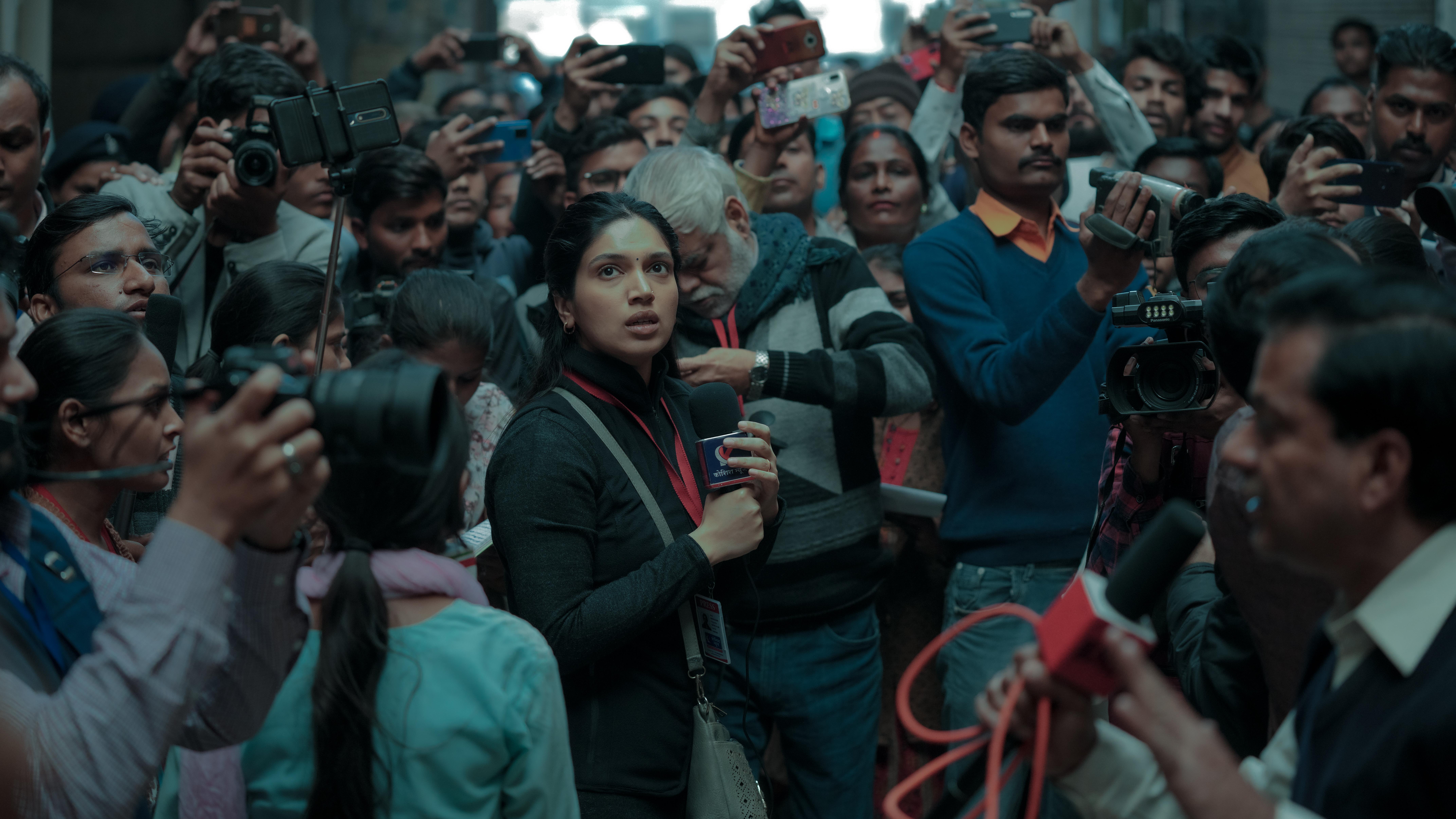
Bhumi Pednekar (center midground) is one of the bright spots of the interesting but often heavy-handed Bhakshak, which is based on a real-life sexual abuse scandal in Bihar but was filmed in Lucknow.
On the whole, though, this trio of somewhat independent, smaller budgeted, and mercifully shorter-than-average Hindi features exemplify the broad range of northern Indian filmmaking when compared to the popularity of mainstream Bollywood blockbusters. Stylistic contrasts between the two groups could not be more different, I argue, and while the latter grab most of the domestic South Asian limelight, I have found more consistent quality in the former a la the A24, Neon, and Lionsgate productions of the United States. While I cannot stand self-important awards-bait regardless of cultural origin (see my favorite perennial punching bag, The Lunchbox [2013]), these sorts of less pretentious yet creative “indie genre” projects tend to stand the test of time.
——————————————————–
SUMMARY & RECOMMENDATION: For those tired of longwinded musical melodramas not directed by Sanjay Bhansali or gonzo masala action movies when not made by S. S. Rajamouli, I recommend — for the most part — these quieter but stronger dramadies despite their weaknesses. Laapataa Ladies examines the contemporary nature of arranged marriages in rural India with (mostly) strong characters and a creative premise; Kathal mixes crime drama, comedy, and a broad ensemble cast for a fun whodunit mystery; and Bhakshak uses solid visual direction to lend cinematographic depth to a grounded sociopolitical crusade. Ladies and Kathal in particular feature memorable location-photography in Madhya Pradesh that accentuates their stories’ tone.
— However… both Ladies and Bhakshak feature their share of unnecessary, groan-inducing dialogue, and the latter lasts 15-20 minutes too long. Pratibha Ranta’s performance feels out of place in the former and comes across as a writer/director-surrogate rather than an actual character.
—> Laapataa Ladies and Kathal come RECOMMENDED, while I am ON THE FENCE with respect to Bhakshak.
? You do know that agricultural pesticides are designed to protect farmers’ target crops, right?

 Express Elevator to Hell
Discussion
Trackbacks/Pingbacks
Pingback: Hindi Indies, Volume 2: ‘Haseen Dillruba’ (2021, 2024) & ‘Dhoom Dhaam’ (2025) | Express Elevator to Hell - May 25, 2025