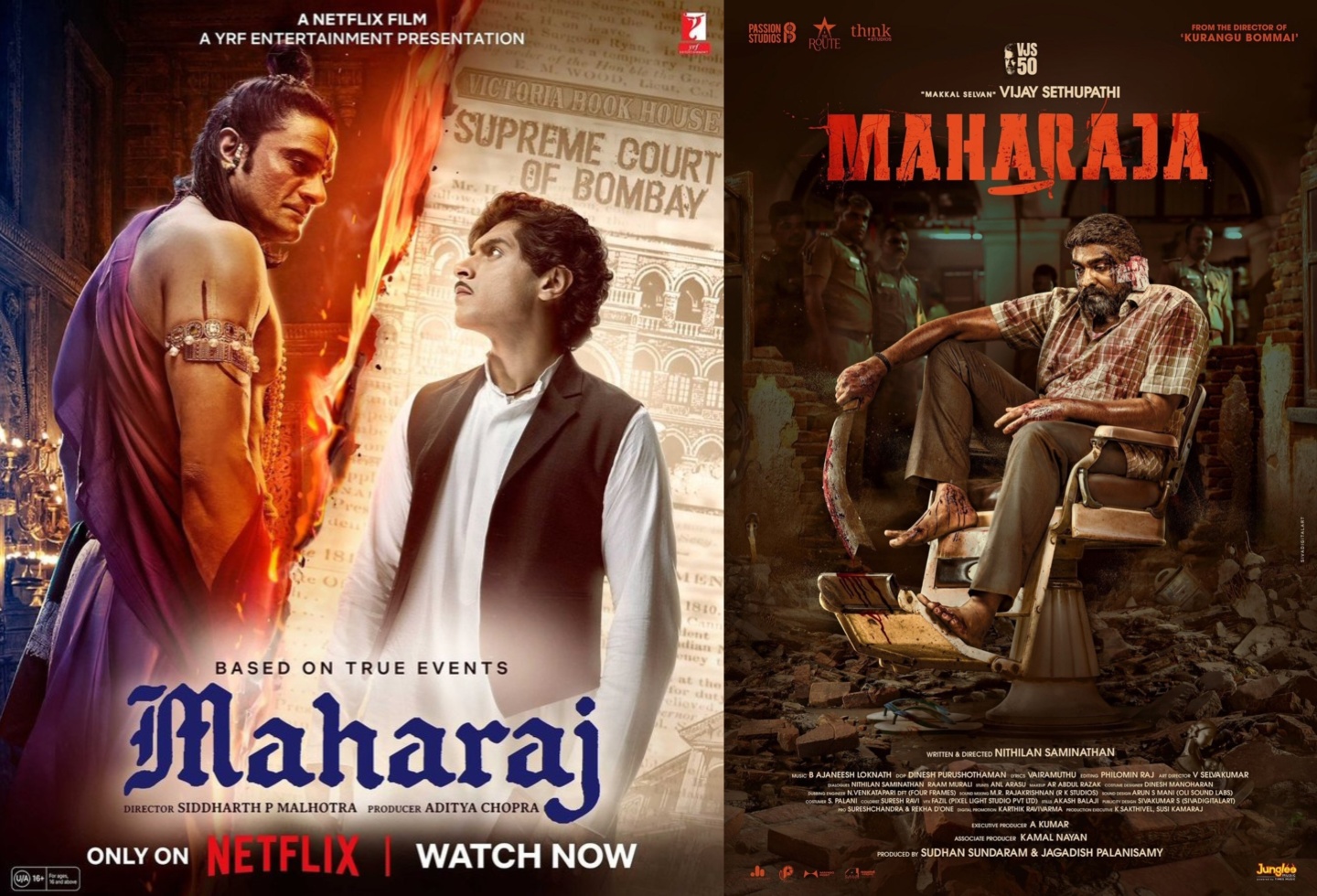
Directed by: Siddharth P. Malhotra [1], Nithilan Swaminathan [2] || Produced by: Aditya Chopra [1], Sudhan Sundaram, Jagadish Palanisamy [2]
Screenplay by: Vipul Mehta, Sneha Desai [1], Nithilan Swaminathan, Raam Murali [2] || Starring: Junaid Khan, Jaideep Ahlawat, Shalini Pandey, Sharvari Wagh [1], Vijay Sethupathi, Anurag Kashyap, Mamta Mohandas [2]
Music by: Sohail Sen, Sanchit Balhara, Ankit Balhara [1], B. Ajaneesh Loknath [2] || Cinematography: Rajeev Ravi [1], Dinesh Purushothaman [2] || Edited by: Shweta Venkat Matthew [1], Philomin Raj [2] || Country: India || Language: Hindi [1], Tamil [2]
Running Time: 131 minutes [1], 141 minutes || 1 = Maharaj, 2 = Maharaja
A frequent criticism I’ve made against many films with social justice themes is how preachy they feel; how much on-the-nose dialogue, simplistic characters, or general talkiness negatively affects a movie’s pacing, mise-en-scène, and overall cinematic language strongly predicts the long-term influence of various high-profile Hollywood blockbusters (e.g. Titanic [1997], Avatar [2009]), numerous awards-bait (e.g. Dallas Buyer’s Club, The Lunchbox [both 2013], Spotlight [2015]), wannabe edgy genre films and melodramas (e.g. Speak No Evil [2022], Mrs. Chatterjee vs. Norway [2023]), and the occasional dumb Indian action film (e.g. Etharkkum Thunindhavan [2022], Jawan [2023]), among other types of films. Although being forthright with your movie’s central message may help it reach a broader audience and give starring actors their much desired Oscar-performance reels, that philosophy often cuts against the central mantra of filmmaking, “show, don’t tell,” while also encouraging clunky exposition.
Two recent, similarly titled Indian films, one a Netflix pickup from the Hindi-language Bollywood industry (Maharaj) and one a theatrical Tamil-language picture (Maharaja) from South India, provide good examples of cinematic storylines that incorporate social justice messages organically into their screenplays. One is a more effective, better paced film than the other, but both bat well above the average of socially conscious cinema. Maharaj is the silver screen debut of Junaid Khan, son of the famous Aamir Khan, and details the historical true story of the 1862 Maharaj Libel Case in colonial British India, whereby a local religious leader (Jadunathjee “JJ” Brajratanjee Maharaj, played in the film by a memorable Jaideep Ahlawat) was accused of sexual misconduct. Khan portrays the real-life Gujarati progressive journalist and social reformer, Karsandas Mulji, an almost Spielbergian everyman who boasts relatable character flaws and admirable motivation to tackle corruption in his local community. The character whose fate incites most of the plot is quasi-female lead Shalini Pandey, Khan’s betrothed and devout follower of Ahlawat’s JJ, and is introduced in Maharaj’s lone song-number that recalls the flowery choreography of Sanjay Bhansali’s musicals.
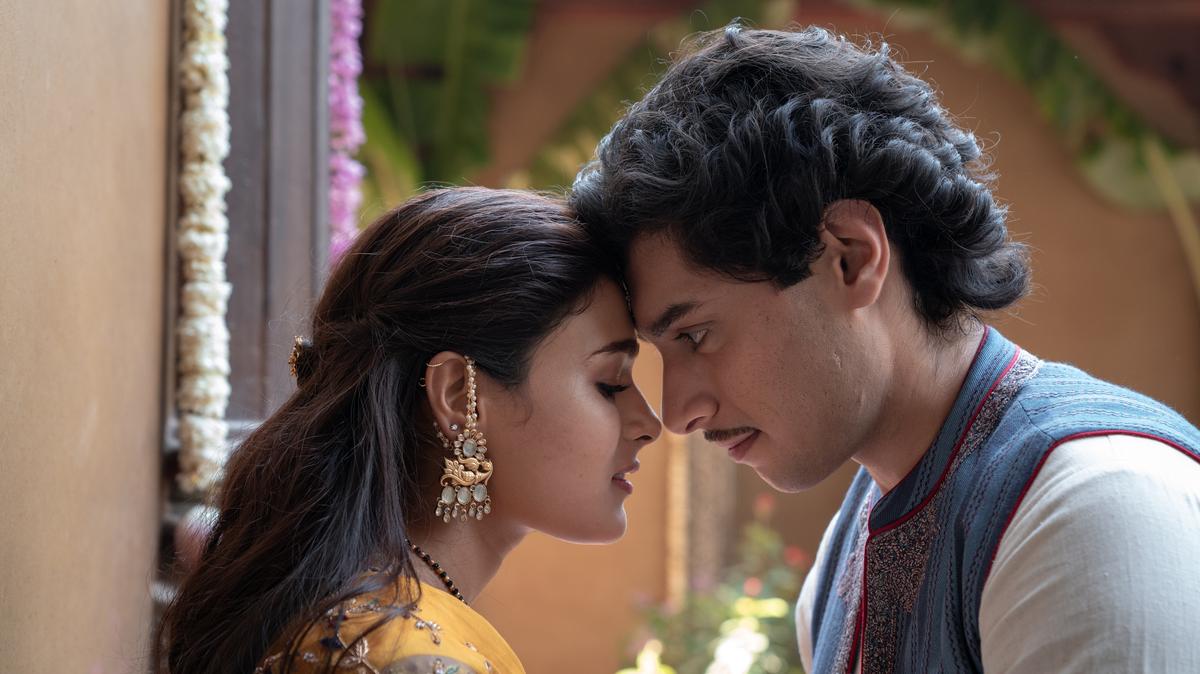
Although her screentime is limited compared to lead Junaid Khan (right), supporting actress Shalini Pandey (left) leaves an impact thanks to a sympathetic, multilayered performance in a complex role that shapes the entirety of Maharaj’s story.
Though I wish director Siddharth P. Malhotra had incorporated more diegetic musical elements into the film given how effective Pandey’s introduction is, he establishes all central characters in short order along with the sociopolitical dynamics of his 19th century backdrop. It is hard to understate how effective the diegetic details of Maharaj are, from the wonderful indoor and outdoor sets to the impressive costumes to the minor British imperial lawyer roles played by American and British actors fluent in Hindi. Aside from a couple weird expository lines that seem directed to Indian viewers, overall, Maharaj avoids pandering to specific audiences to score religious or nationalist points, thus avoiding the preachy overtones of heavier-handed movies that cover similar subject-matter.
A more conventional but still conscientious Indian movie concerned with articulating right from wrong is the Tamil feature Maharaja. Vijay Sethupathi stars as the title character, a working-class barber and family man who suffers a terrible tragedy in the opening act that dovetails with the fate of antagonist Anurag Kashyap (yeah, the auteur filmmaker behind Gangs of Wasseypur [2012]). Throughout its first half, Maharaja transitions from this dark opening to a sort of goofball mystery drama wherein Sethupathi searches for a beloved family heirloom, a trashcan that via happenstance saved his daughter (Sachana Namidass) in the aforementioned freak incident. The end of the second act reverts the story back to the seedier, unsettling tone of the film’s opening, however, and thereafter the movie becomes dependent on revelations established earlier, unbeknownst to the viewer, through nonlinear narrative structuring.
While writer-director Nithilan Swaminathan isn’t as clever as he thinks he is with his nonlinear screenplay, the ultimate conclusion of Maharaja is satisfying and develops the characters of Sethupathi and Kashyap a great deal. Moreover, the physical comedy and grim violence of numerous key sequences are well executed and feel earned, neither undercutting the serious tone of dramatic moments with juvenile humor nor wallowing in characters’ misery for the sake of edginess. Even the fistfights are entertaining and well choreographed thanks to their near complete absence of the obnoxious slow-motion common to many South Indian blockbusters, though I’d argue the fights still last too long.
My significant complaints with Maharaja have to do with, unfortunately, weaknesses as common to mainstream Indian movies as slow-motion action cinematography. The film’s overindulgent runtime (141 minutes) could’ve resolved in under two hours, while the bloated supporting cast (e.g. the majority of the police officer characters, Mamta Mohandas’ throwaway starring role, et al.) wastes much of that runtime on dialogue, plot-points, and character beats that don’t go anywhere.
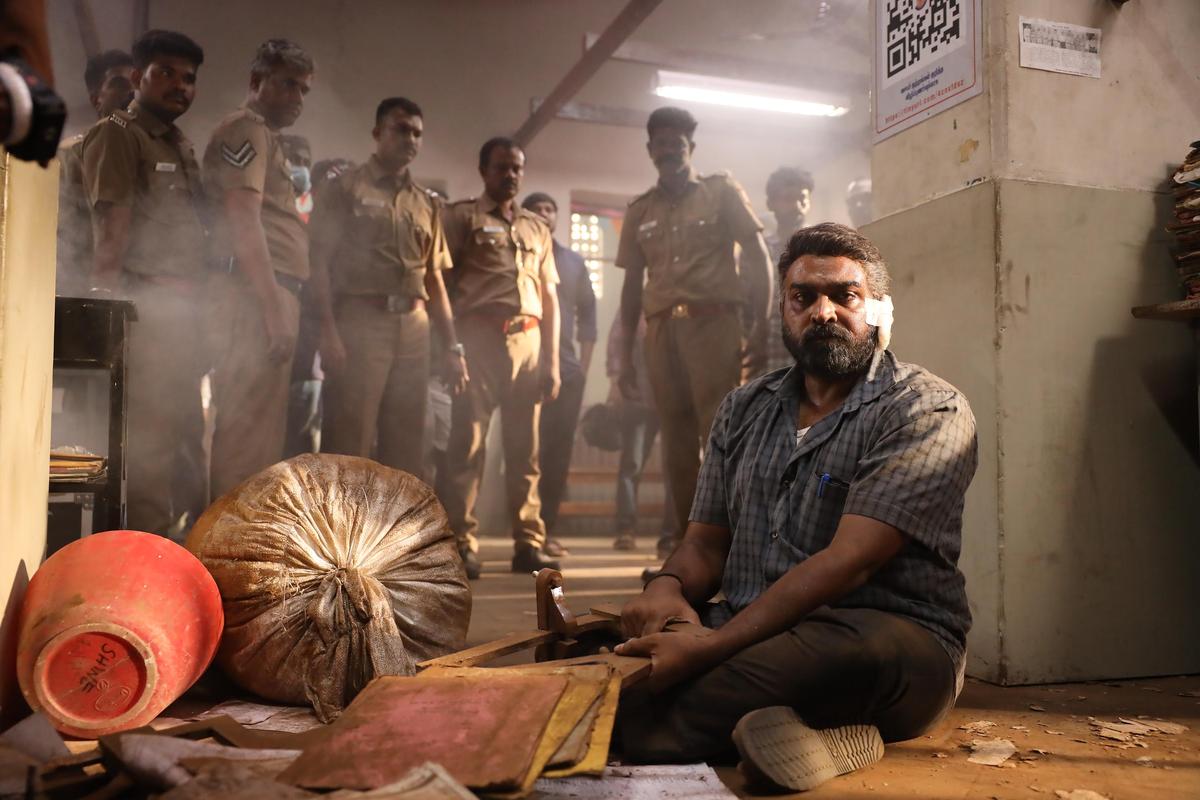
Vijay Sethupathi is something of an enigma in Maharaja until the third act when his character motivations are revealed. Even then, however, his character refuses to lecture the audience and lets his actions speak louder.
As inconsistent as Nithilan Swaminathan’s Maharaja is and as uninventive as Siddharth P. Malhotra’s Maharaj feels, both punch well above their weight given the many screenplay and cinematographic pitfalls they could’ve suffered. Numerous higher-profile Indian crowdpleasers built atop far more expensive budgets, some of which I have reviewed on this site, have kneecapped their stories through obnoxious, self-indulgent special FX and/or finger-wagging their narrative’s central themes at their audience. Both movies analyzed here showcase admirable reserve in their audiovisual direction and self-awareness with respect to their social messages, and if nothing else, deserve respect for not talking down to their audiences.
—————————————————————–
SUMMARY & RECOMMENDATION: Relatively well paced and guided by relatable characters, the Hindi-language Maharaj is yet another memorable Netflix Original Film and a fine introductory vehicle for Junaid Khan. Maharaja is less consistent and longer-winded, but mines enough drama from its nonlinear storytelling and nontraditional heroic and villainous roles.
—> Maharaj comes RECOMMENDED, while I remain ON THE FENCE with regard to Maharaja.
? For the record, I’m told that both “Maharaj” and “Maharaja” mean “the great king” or something to that effect.

 Express Elevator to Hell
Discussion
No comments yet.