
Directed by: Prasanth Varma [1], Karthik Gattamneni [2], Vi Anand [3] || Produced by: K. Niranjan Reddy [1], T. G. Vishwa Prasad, Vivek Kuchibhotla [2], Razesh Danda [3]
Screenplay by: Scriptsville, Prasanth Varma [1], Karthik Gattamneni, Manibabu Karanam [2], Vi Anand [3] || Starring: Teja Sajja, Amritha Aiyer [1], Vinay Rai [1, 2], Ravi Teja, Navdeep Pallapolu, Anupama Parameswaran [2], Kavya Thapar [2, 3], Sundeep Kishan, Varsha Bollamma, Brahmaji, Vennela Kishore, Harsha Chemudu [3]
Music by: Gowra Hari, Anudeep Dev [1], Davzand [2], Shekar Chandra [3] || Cinematography: Dasaradhi Sivendra [1], Karthik Gattamneni, Kamil Plocki, Karm Chawla [2], Raj Thota [3] || Edited by: Sai Babu Talari [1], Karthik Gattamneni, Uthura [2], Chota K. Prasad [3] || Country: India || Language: Telugu
Running Time: 156-158 minutes [1, 2], 136 minutes [3] || 1 = Hanu-Man, 2 = Eagle, 3 = Ooru Peru Bhairavakona
Though this may be a function of my personal, biased exploration of Indian cinema, I feel that the more recent Indian filmmaking I explore, the less dominated by film musicals and the more generic their industry feels. None of the Telugu-language features of today’s review rival the massive successes of Shah Rukh Khan’s trio of comeback films (e.g. Pathaan, Jawan, Dunki [all 2023]) or Sandeep Reddy Vanga’s overindulgent vanity project, Animal (2023), from last year — all films with minimal musical flourishes, particularly with respect to popular Indian cinema, historically — but their generic style bode well for the financial profits of South India‘s 2024 box office. Two of these, Eagle and Hanu-Man, are stereotypical high-concept Telugu action ventures in the vein of your average preachy Indian morality play (see also: Simmba [2018], Etharkkum Thunindhavan [2022]) or Hollywood superhero copycat (e.g. Krrish 3 [2013]), respectively. The third, Ooru Peru Bhairavakona (“The Village Name is Bhairavakona”), is almost the mid-budgeted genre inverse of those bigger, over-the-top crowdpleasers that focuses more on characterizations than FX-driven spectacle, though not always to the greatest results.
Eagle is the sophomore directorial feature of longtime Telugu cinematographer Karthik Gattamneni. Released almost a decade after his debut of Surya vs. Surya (2015), Eagle blends the sort of clumsy social commentary featuring bland, airbrushed main characters with loud, generic action set-pieces that I find comical. The movie details the life of a former contract killer (lead Ravi Teja) turned heroic vigilante with a heart of gold via a longwinded, inefficient Rashomon (1950)-narrative structure that grows repetitive instead of suspenseful given the screenplay’s predictable plot beats, Gattamneni’s boring, slow motion-heavy action (the movie’s photography is credited to Gattamneni and two collaborators), and Teja’s ineffective chemistry with sympathetic antagonist Vinay Rai. Worst of all may be Teja’s forced romance with his much younger female costar, Kavya Thapar, whose distracting 28-year age difference borders on creepy depending on the scene. The complete failure of all the aforementioned elements leads me to believe that Gattamneni overstretched his duties as both director, co-cinematographer, cowriter, and coeditor.
Inconsistent in execution but far more effective at connecting with general audiences is the highest grossing Indian film of 2024 thus far, Hanu-Man, by Prasanth Varma. A play on the name of the Hindu deity Hanuman, Hanu-Man represents the most obvious, boldfaced attempt by an Indian film studio to replicate Hollywood superhero blockbusters and “shared cinematic universes” since Rakesh Roshan’s Krrish 3, though thankfully with much less obvious CGI and a more grounded story.
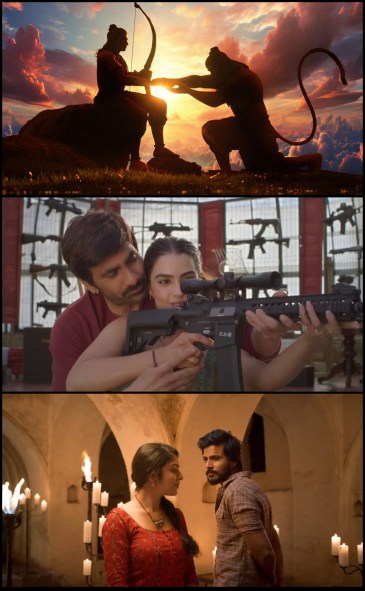
Top: Some tasteful (re: backlit) CGI from Hanu-Man shows the titular monkey god (right) kneeling before Rama (left). Middle: 56-year old Ravi Teja with heavy hair dye romances a 28-year old Kavya Thapar in Eagle, a movie about — I shit you not — the dangers of gun violence. Bottom: Sundeep Kishan courts love interest Varsha Bollamma in Ooru Peru Bhairavakona’s semi-unpredictable romantic subplot.
Hanu-Man begins as an almost archetypal small-town coming-of-age tale with protagonist Teja Sajja, a small-time petty thief, struggling to make ends meet and “get the girl (female lead Amritha Aiyer),” but transforms into an epic, almost miniature version of Baahuabli (2015, 2017) by its end. Vinay Rai’s forgettable antagonist aside (does that guy play anything besides lame villains?), Hanu-Man’s combination of modern comic book aesthetics with classical Hindu imagery and South Asian cultural backdrops (e.g., the muggy lowlands of Andhra Pradesh, colorful musical numbers and costumes of rural villages, etc.) works. Sajja’s considerable arc leads into halfway decent sequel bait, he isn’t portrayed as an unstoppable badass but rather a relatable underdog whose limitations amplify narrative tension, and the fantastical MacGuffin that endows him with his titular Hanuman-superpowers is governed by simple, straightforward rules. What’s not to like — other than the 2.5+ hour runtime?
Different in tone, style, and scale from both Eagle and Hanu-Man is Ooru Peru Bhairavakona (henceforth, OPB), a more modestly paced (~136-minute) supernatural adventure about another smalltime Indian village crook (Sundeep Kushan; why do so many mainstream Indian movies have thieves or low-level gangsters as their protagonists?) who finds himself in alternative paranormal dimensions in an attempt to right past career wrongs. OPB’s hackneyed flashback structure and convoluted narrative are its greatest sins, as I struggled to follow the primary storyline or understand the main characters’ motivations for most of the first two acts.
Making matters worse are the lackluster visual FX, including the obvious CGI that distract from the haunting, eerie ambience for which writer-director Vi Anand is clearly aiming. At times, the only factors that kept me invested in OPB’s story — a story that ends in a halfway decent, semi-unpredictable conclusion, by the way — were Kushan’s relatable lead performance along with the memorable location-photography that sold the tone of OPB’s supernatural antagonists better than any of the cheap digital FX.
You may have noticed I hardly mentioned these three movies’ musical elements (Eagle’s are generic and superfluous to the main plot; Hanu-Man’s are pretty good but also add little to its overarching storyline; Ooru Peru Bhairavakona doesn’t have any notable song-and-dance routines at all), which may indicate the increasing decline of the cinematic musical in popular Indian cinema. To me, that’s a shame given how South Asia’s history of cinematic song-and-dance are what most differentiate it from fellow blockbuster industrial cinema from mainland China and Hollywood. Indian filmmaking, northern Hindi cinema (Bollywood) to Dravidian-language South Indian Cinema, seems inclined to move further away from the musical pedigree that has long defined it, a trend that started in the 2010s at the latest.
—————————————————————————————————————————————————————————–
SUMMARY & RECOMMENDATION: While Hollywood appears willing to think smaller for the first time in at least 15 years, India’s latest blockbusters may be most memorable for their dismissal of their parent industries‘ rich musical heritage. Eagle, for example, uses every heavy-handed, preachy cliche in the South Asian crowdpleaser handbook to mix tone-deaf social commentary with excessive, tiresome slow-motion action sequences to the benefit of neither. Hanu-Man fares much better from both a characterization and set-piece standpoint, using its likable main character to generate tension through his wits and limitations rather than unlimited strength. Somewhere in between those two is Ooru Peru Bhairavakona, a rare supernatural thriller within the Indian filmmaking ecosystem that still feels the need to shoehorn in various industry tropes (e.g. slow-motion hand-to-hand combat, bad CGI, out of place, dialogue-driven comic relief, etc.) except for the ones I like (i.e. musical numbers that drive the plot forward).
—> Eagle, Hanu-Man, and Ooru Peru Bhairavakona are NOT RECOMMENDED, RECOMMENDED, and leave me ON THE FENCE, respectively.
? What the hell was that CGI dragon monster at the end of Hanu-Man?

 Express Elevator to Hell
Discussion
Trackbacks/Pingbacks
Pingback: ‘Born to Fly’ (2023) & ‘Fighter’ (2024): ‘Top Gun’ Copycats | Express Elevator to Hell - May 7, 2024
Pingback: ‘Shaitaan’ (2024): The Enigma That Is Indian Horror | Express Elevator to Hell - May 29, 2024