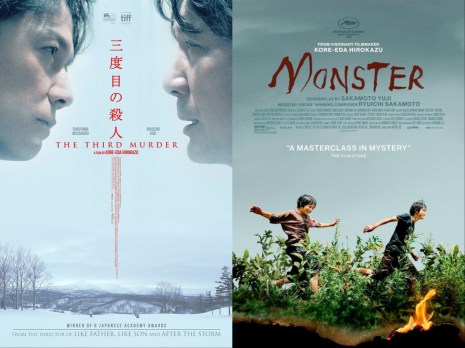
Directed by: Hirokazu Kore-eda || Produced by: Matsuzaki Kaoru [1], Hijiri Taguchi [1, 2], Megumi Banse, Minami Ichikawa, Taichi Itô, Ryo Ota, Kiyoshi Taguchi, Hajime Ushioda, Kenji Yamada, Tasumi Yoda [2]
Screenplay by: Hirokazu Kore-eda [1], Yuji Sakamoto [2] || Starring: Masaharu Fukuyama, Suzu Hirose, Shinnosuke Mitsushima, Mikako Ichikawa, Izumi Matsuoka, Yuki Saito, Kōtarō Yoshida, Isao Hashizume, Kōji Yakusho [1], Sakura Andō, Eita Nagayama, Sōya Kurokawa, Hinata Hiiragi, Yūko Tanaka [2]
Music by: Ludovico Einaudi [1], Ryuichi Sakamoto [2] || Cinematography: Mikiya Takimoto [1], Ryûto Kondô [2] || Edited by: Hirokazu Kore-eda || Country: Japan || Language: Japanese
Running Time: 124-125 minutes || 1 = The Third Murder, 2 = Monster
For a variety of subjective to objective reasons, one of the more memorable East Asian pictures I watched over the past couple years was Hirokazu Kore-eda’s Like Father, Like Son (LFLS; 2013). The single greatest explanation for my personal connection to that film was my then newfound fatherhood (my daughter was around four months old at the time) given LFLS’s narrative about two families whose respective 6-year old sons were switched at birth. With regards to the execution of that narrative, however, the detached, unobtrusive yet emotional camerawork and physical environment, the latter of which included everything from playgrounds to shopping malls to intimate bedrooms, informed the conflicted main characters better than any melodramatic, longwinded sobbing monologues could.
Some time passed before I had the opportunity to appreciate additional Kore-eda pictures from his enticing filmography, most of which consist of would-be tearjerker material captured in the same mature, introspective audiovisual style that helped LFLS stick in my memory beyond its circumstantial reflections of my burgeoning parenthood. One of these, The Third Murder, is a relative outlier in Kore-eda’s body of work given its legal drama backdrop and central focus on a violent crime, recalling the sensibilities of a modern Korean murder-mystery at times. The other film, Monster, is his most recent family/community treatise that sidesteps easy character archetypes and cliched plot-devices for creative, nuanced storytelling to humanize an ensemble cast.
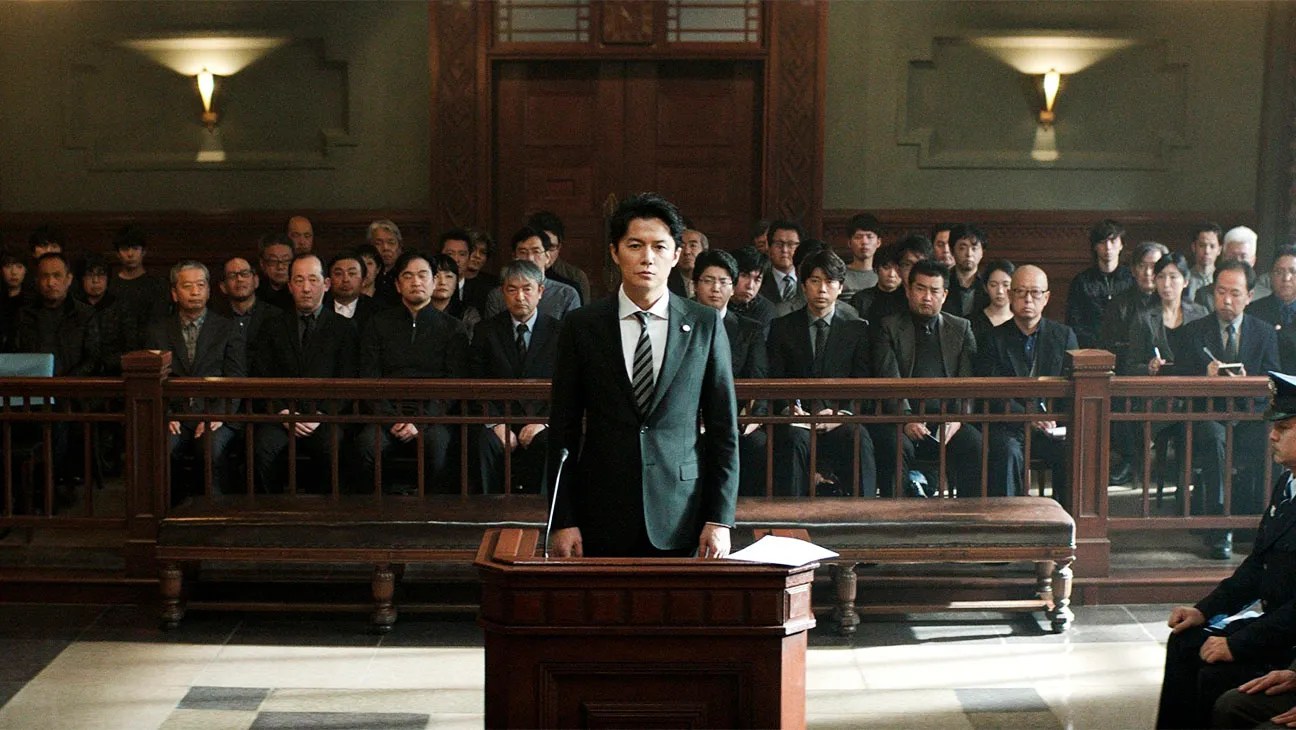
Lead Masaharu Fukuyama addresses a courtroom in the third act of The Third Murder.
The Third Murder (TTM) concerns a suspect (Koji Yakusho) accused of robbing and murdering his former employer and who previously served time for the same crime several decades earlier. Criminal defense attorney Masaharu Fukuyama is recruited by a colleague to at first assist and then later lead the former’s defense counsel. Obfuscating both the criminal investigation as well as Fukuyama’s legal strategy are Yakusho’s repeated, inexplicable changes to his side of the story; after initially admitting to the crime and a straightforward retelling of events leading up to said crime, Yakusho alters his account as new evidence comes to life and soon prompts Fukuyama to investigate the matter on his own. In other words, TTM is Kore-eda’s dissection of Japanese legal proceedings via a character who seeks the truth rather than strict adherence to legal minutia.
The repetitive nature of the story is a feature rather than a bug of the screenplay, but just as interesting as the narrative’s social commentary is Kore-eda’s visual direction. Less reserved, more stylish, and more noticeable than his work on LFLS, cinematographer Mikiya Takimoto interweaves striking camera movements with stark, placid static shots and portrays hypothetical flashbacks (e.g., characters like Fukuyama imagining events described by potentially unreliable narrators like Yakusho) in brief yet memorable slow-motion against distinctive soft-lighting.
By contrast, Monster is more comparable to LFLS both in terms of content, its focus on familial and communal relationships, as well as in visual style. Kore-eda’s first project in his native Japan since Shoplifters (2018; the follow-up to TTM; he directed the French-English language film The Truth and the South Korean Broker, the latter starring Song Kang-ho, in 2019 and 2022, respectively) and his first film based on another writer’s script since his directorial debut (Maborosi [1995]), Monster is another Cannes Film Festival darling (see the awards for LFLS and Broker) that returned Kore-eda to his Japanese family drama roots.
In terms of camerawork, Monster is less self-reflexive than TTM yet still more active than LFLS’ borderline documentarian aesthetic. What’s most interesting about Monster, though, is not its cinematographic muscle so much as its inventive, efficient screenplay structure. Instead of a traditional linear plot or a Rashomon (1950)-style collage of subjective storylines from unreliable narrators, Monster instead objectively portrays the personal and professional lives of multiple ensemble cast members — a single mother (Sakura Ando) disturbed by recent changes in behavior by her fifth grade child (Soya Kurokawa), a school teacher (Eita Nagayama) accused of inappropriate conduct towards said fifth grader whose professional life unravels, and the understated relationship between said fifth grader and another classmate (Hinata Hiiragi). This distinctive multi-protagonist three-act structure is easy to follow and feels organic in hindsight, yet its shifting perspectives treat every character’s point-of-view with equal weight and build on the collective character development of the entire cast.
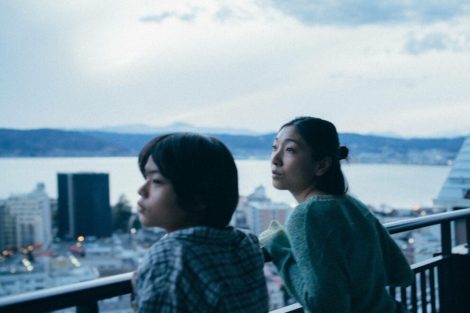
Sakura Andō bonds with her son, Sōya Kurokawa, as the latter exhibits sudden alarming behavior in Monster.
Stumbling upon the filmography of Hirokazu Kore-eda is one of my happier cinephile accidents of the past several years, as my predisposition toward genre movies (i.e. action, science-fiction, horror, etc.) and impatience with most awards-bait have soured my adult views of quieter dramatic cinema. From what I can tell, this pair of Kore-eda films provide a good summary of the auteur’s cinematographic and storytelling range, undercutting the boredom most general audiences expect from artsier dramas. The relatability of his characters may explain the appeal of his directorial style compared to so many Oscar favorites, film festival awardees, and wannabe arthouse movies that center upon weird, amoral, unlikable, neurotic dorks (e.g. In Bruges [2008], Amour [2012], Joker [2019]).
————————————————————
SUMMARY & RECOMMENDATION: The Third Murder and Monster are further evidence that, with Hirokazu Kore-eda’s directorial style, less cinematographic flash is more. The subtlest changes in camera movement, lightning, and framerate illustrate character development and help conjure some of the more understated, realistic screen performances of the past couple decades. The Third Murder is a memorable thinking man’s legal drama with no clear heroes, villains, or guilty verdicts, while Monster is a backdoor coming-of-age drama that sidesteps the heavy-handed preaching of many lesser social dramas.
— However… as good as these films are, Hirokazu Kore-eda’s style remains quiet and patient to fault, where “exciting” is not an adjective even his biggest fans would use to describe his auteur style.
—> Both films come RECOMMENDED.
? For my part, I’m on the team that says both kids lived at the end of Monster.

 Express Elevator to Hell
Discussion
No comments yet.