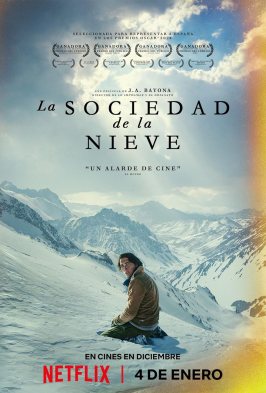
Directed by: J. A. Bayona || Produced by: Belén Atienza, Sandra Hermida, J. A. Bayona
Screenplay by: J. A. Bayona, Bernat Vilaplana, Jaime Marques, Nicolás Casariego || Starring: Enzo Vogrincic, Matías Recalt, Agustín Pardella, Felipe González Otaño, Luciano Chatton, Valentino Alonso, Francisco Romero, Agustín Berruti, Andy Pruss, Simón Hempe, Juan Caruso, Esteban Bigliardi, Rocco Posca, Esteban Kukuriczka, Rafael Federman, Manuela Olivera, Agustín Della Corte, Tomas Wolf
Music by: Michael Giacchino || Cinematography by: Pedro Luque || Edited by: Jaume Martí, Andrés Gil || Country: Spain, United States || Language: Spanish
Running Time: 144 minutes
One of the most underappreciated filmmakers working today is Juan Antonio García Bayona, credited in most of his professional works as J. A. Bayona. Across just five films over 16 years, the Spanish director has demonstrated considerable stylistic range with melancholic Gothic supernatural horror (The Orphanage [2007]), dark fantasy (A Monster Calls [2016]), special FX-driven Hollywood blockbusters (Fallen Kingdom [2018]; say what you will about the bizarre script, but it’s the best directed Jurassic Park/World film since the 1993 original), and survival thrillers set against unforgettable natural disasters (The Impossible [2012] and Society of the Snow). That latter category has culminated in Bayona’s subscription video on demand (SVOD) debut in Society of the Snow (Spanish = La sociedad de la nieve), which debuted as a Netflix Original Film near the end of 2023 and represents the latest auteur project to be distributed primarily by an SVOD service. It is also perhaps Bayona’s strongest directorial effort yet, as well as his debut lead screenwriting credit on any feature.
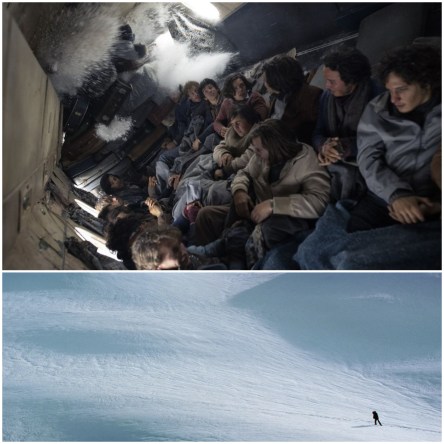
Top: The remaining survivors huddle inside the wreckage of their aircraft at night before a massive winter avalanche breaches their shelter. Bottom: One survivor heads back to their crash site after an infected wound slows their expedition to find help in the spring thaw.
Based on the 1972 Uruguayan Air Force Flight 571 crash in the Argentine Andes near the Chilean border, the nonfiction book of the same name by Pablo Vierci in particular, Snow details the arduous, cruel, nightmarish survival ordeal of 45 passengers and crew after their forced landing. Bayona and cowriters Bernat Vilaplana, Jaime Marques, and Nicolás Casariego allot just enough prologue screentime to preview their large main cast’s backgrounds before embarking on their doomed flight, the crash of which is captured via one of the grislier, more precise, better edited montages I’ve seen in a while. The sound-design of the fall is impeccable, too, along with the sharp, quick flashes of dummy limbs crumpling on impact.
After the blunt, brutal horror of the plane crash set-piece, the bulk of the narrative concerns endless, harrowing sequences of human suffering in high altitude cold that assault the viewer somehow without feeling gratuitous or exploitative. The combinations of on-location photography in mountainous regions of Spain, Uruguay, and the actual crash site in Argentina with on-set virtual production backgrounds and fuselage replicas in studio are seamless, another example of the film’s great editing as well as impressive lighting techniques. Despite how much of the movie is high-key lit, its tone feels so oppressive due to the cyclical nature of our characters’ suffering whenever temperatures plummet at night and the rhythmic, habitual pace at which individual castmembers succumb to the elements or discover frozen bodies from the earlier crash.
What gives heart to the aforementioned on-screen pain, what prevents the narrative from devolving into a tortuous endurance test are the memorable, relatable performances from the main cast, though their similar dress, hair, and makeup may prevent most viewers from distinguishing individuals from one another. Thanks to the story’s real-life inspirations, a lack of melodramatic backstabbing, emotional betrayal, or convoluted schemes on the part of the survivors give this Netflix Original Film a genuine overtone that’s almost documentarian in style. Characters often bicker over the best plans of action in a given moment, but the film depicts no one as a formulaic archetype (e.g. the straight man, the comic relief, the bully, the sniveling coward, etc.), let alone a stereotype. This paired with the aforementioned uniform dress code and equally disheveled appearance of the ensemble cast, again, makes differentiating between most of them difficult and encourages the viewer to empathize with the group rather than with specific characters.
This rare combination of effective editing, realistic performances, and an incredible true-to-life inciting incident produces one of the few 2-hour, 20-minute-plus adventures (the film clocks in at 144 minutes) I believe earns its extended runtime. From Hindi action–musicals to Hollywood superhero blockbuster extravaganzas to overindulgent biopics of all nationalities, popular feature-length movies overstaying their welcome have been a consistent irritant throughout my cinephile media consumption since the early 2010s; Snow isn’t the best paced movie in recent years (for comparison, see John Wick 4 [2023], No Time to Die [2021], Infinity War [2018], etc.), but it is a smooth ride despite its one-note color palette, indistinguishable character personalities, and tonal intensity.
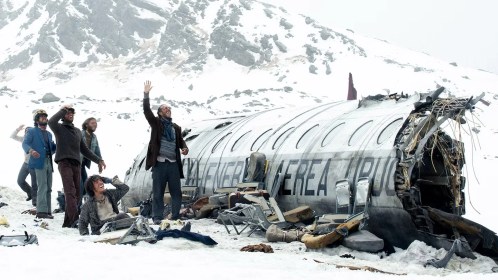
Sixteen — yes, 16 — are all that survive 72 days in the Andean Mountains.
J. A. Bayona has outdone himself with his latest project and SVOD debut, in other words. I enjoyed his earlier works of The Orphanage and A Monster Calls, and appreciate his great direction of Fallen Kingdom to this day despite the latter’s nonsensical script, but Society of the Snow trumps them all. Bayona’s command of true life source material appears so strong that I’m now curious to see the one other film of his thus far I haven’t yet seen, The Impossible, another disaster thriller about the 2004 Indian Ocean tsunami. Regardless of the strength of that film, however, Snow remains one of the better auteur projects financed by any major SVOD platform in recent years, so as Netflix scales back the annual quantity of their Original Films, I hope they keep Bayona, like David Fincher, on their shortlist.
—————————————————————————————————————————————————————————-
SUMMARY & RECOMMENDATION: Well paced, edited, and with an unforgettable source material around which to build its cinematic thrill ride, Society of the Snow may be the best non-English language Netflix Original Film since All Quiet on the Western Front. The chilling portrayal of the Andean climate is matched only by the diversity of camerawork J. A. Bayona and cinematographer Pedro Luque execute with documentarian efficiency, all without resorting to distracting handheld cinéma vérité techniques.
— However… as good as the ensemble cast’s performances are, only the most eagle-eyed viewer will pick apart most characters until the third act given their near identical dress, hair, makeup, and personalities.
—> Society of the Snow comes HIGHLY RECOMMENDED.
? Correct me if I’m wrong, but aren’t bearded dragons (genus Pogona) native to Australia, not South America?

 Express Elevator to Hell
Discussion
Trackbacks/Pingbacks
Pingback: ‘The Killer’ (2023): Everyone’s Got a Plan Until… | Express Elevator to Hell - March 10, 2024
Pingback: ‘Paradise’ (2023): Age Isn’t Just a Number | Express Elevator to Hell - November 10, 2024